Sales intelligence tools for logistics: how to choose

Sales intelligence tools give a sales team data about which companies to contact, who to contact there and why now. For a freight forwarder or carrier, the useful version answers one more question that general B2B databases can’t: who ships what, on which lane, and what changed recently. Pick a tool on that trade-lane data first, then on contacts and timing signals.
The old routine still runs in plenty of logistics sales teams. A rep gets a spreadsheet of “importers”, calls the switchboard, reaches the wrong person, sends a generic email and repeats it all afternoon. By Friday there’s activity everywhere and very little pipeline. Shippers don’t move freight to you because you called first. They move it because you understood their lane, reached the person who routes it and offered something that fits.
Why cold lists fail in logistics sales
The bad version of freight prospecting goes wrong in four ways:
- Wrong company. The account doesn’t move the modes, origins or volumes your team handles well.
- Wrong person. The rep finds the CEO when the decision sits with logistics, import operations, procurement or supply chain.
- Wrong moment. The email lands after a routing decision or contract is already locked.
- Wrong message. “End-to-end logistics solutions” instead of a concrete lane, product or service problem the shipper already has.
A smaller list with real lane relevance beats a large list built from industry filters. Sales intelligence is how you build that smaller list.
What is sales intelligence?
Sales intelligence is the data a sales team uses to find, prioritise and approach accounts: company facts, contacts, buying signals and history, pulled together so a rep can decide who to call and what to say. IBM describes it as the collection and analysis of data to improve sales. The category started as contact databases and now also covers intent data, conversation recording and engagement tools.
Logistics sales intelligence is sales intelligence built on freight data: which companies import or export what, on which lane, how often and with which partners abroad, what changed recently, and who at each company handles the freight.
For a logistics seller that addition matters most. Firmographics tell you a company is a “consumer goods importer”. They don’t tell you it buys machinery from China by sea every month, or that it started a new origin this quarter. In freight, that operating context is the part that turns a name into a reason to reach out.
Types of sales intelligence tools
Most buyer guides sort the market into five groups. A freight team needs a sixth, and it matters more than the other five.
| Type | What it gives you | Use in freight sales |
|---|---|---|
| Contact and company data | Emails, phone numbers, job titles, company size and industry | Useful for reaching people, weak for choosing shippers |
| Intent data | Accounts researching a topic online | A timing hint at best. Web research shows interest in a topic, not which lane a shipper moves |
| Conversation intelligence | Call recording, transcripts, coaching | Helps reps improve calls they already have, finds no new accounts |
| Sales engagement | Email sequences, call tasks, tracking | Runs outreach, doesn’t tell you who deserves it |
| ABM and predictive scoring | Ranked account lists for marketing and sales | Only as good as the data underneath, which is rarely shipment data |
| Trade and shipment data | Who imports or exports what, on which lane, how often, with which partners | The core layer: it shows shippers in motion on lanes you serve |
A general platform with a “transportation” industry filter doesn’t become freight intelligence. It still can’t tell you who ships on your lane. If you want the longer list of data sources, see our guide to supply chain databases.
Logistics sales intelligence: signals that matter
A reason to reach out is a change on a shipper’s freight. These are the signals worth acting on, roughly in order of usefulness:
- New on a lane. The company started importing from an origin, or exporting to a destination, that it didn’t use before.
- Volume growth. More shipments or containers on a lane than a year ago, so the current setup may be stretched.
- New buyers or suppliers. A new partner abroad often means new routings and a new conversation about who handles them.
- Change of forwarder or carrier. Only where the records name them: US records name the carrier, and so do ocean records in Chile, Peru, Ecuador and Colombian imports. Indian records don’t. A switch means the account is open to moving.
- Mode or port changes. A shift from air to ocean, or to a different port, can be a cost or capacity problem you can solve.
- Company events. Hiring for logistics roles, a new warehouse or new markets. Useful, but weaker than shipment signals on their own.
Web-based intent signals sit below these. A shipper reading about tariffs tells you little. A shipper that added three new suppliers in Vietnam tells you a lot.
Worked example: China to India
A lot of freight prospecting starts and ends with US import records. That works for a US forwarder handling imports from Asia and leaves out most of the world’s trade lanes. China is a good test. On the records Coreties holds, the US is only the fifth-largest destination for Chinese exporters.
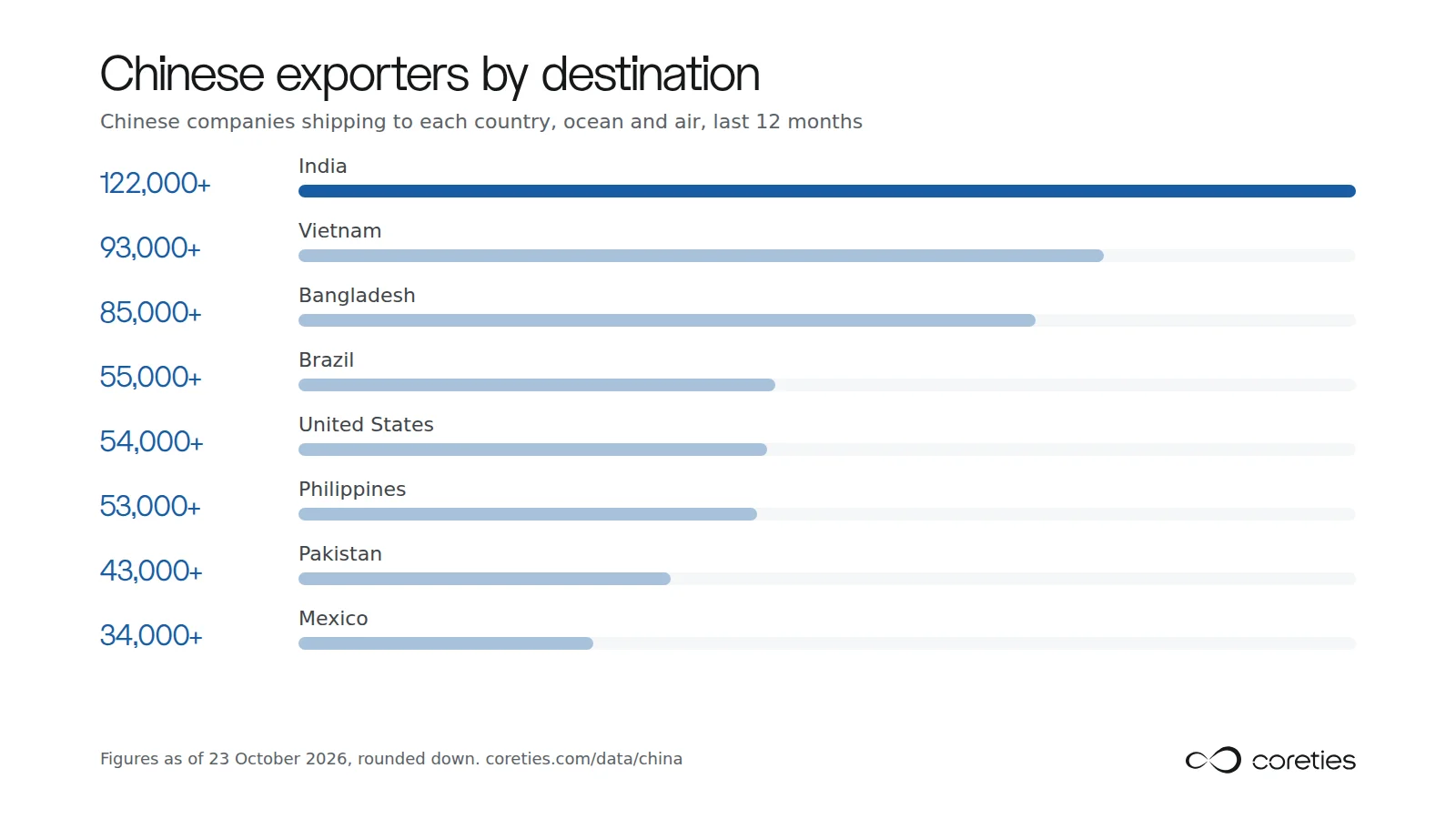
Take an Indian forwarder with an agent in Shanghai, or a Chinese forwarder with an office in Mumbai, that wants more import business on the China to India lane. The figures from our China and India pages:
- 122,000+ Chinese exporters shipped to India in the last 12 months, ocean or air.
- 82,000+ Indian companies imported between March 2025 and February 2026, and 53,000+ of them bought from China.
- The biggest cargo groups among Chinese exporters overall are yarn and textiles (82,000+) and machinery (78,000+).
No team can call 53,000 importers. The work is in the narrowing. Filter Indian importers buying machinery from China by sea. Customs records classify goods by Harmonized System code, so you filter on what the shipments declared (HS chapter 84 covers machinery and mechanical appliances), not on a guess from a company description. Keep the ones that are new on the lane this year or growing. Drop the accounts that ship too rarely to matter. That leaves a list a rep can work in a month, and each account comes with its own reason to reach out: a new Chinese supplier, more shipments than last year, a first order in a new product group. A contact database with an “India, manufacturing” filter can’t produce that list, because it has no idea who imports from China.
How to evaluate sales intelligence tools for logistics
Every tool looks good in a demo. Judge it on the problem your team already has, and score each area red, amber or green:
- Lane coverage. Which reporting countries, which directions (imports, exports or both), ocean and air. Check your own top three lanes, not the vendor’s favourite.
- Freshness. How old the newest month is for each country. Some countries publish within weeks, others months later.
- Change signals. Can it show who is new on a lane, who grew and who changed partners, or only static totals?
- Contacts at shippers. Does it find the logistics, import or supply chain person, with an email that has been checked as deliverable rather than guessed from a pattern?
- Explainable ranking. Can a rep see why an account is on the list? A score with no reason behind it gets ignored.
- CRM and integrations. Accounts and contacts should land in your CRM with the lane attached, without manual clean-up.
- Outreach workflow. Can a rep go from account to approved draft without exporting spreadsheets between three tools?
- Total cost. Ask how usage is counted (seats, exports, contacts revealed) and what a normal month for your team would use.
- Adoption. Will reps still open it after the first month?
Questions to ask in the demo
Don’t accept a generic walkthrough. Bring a lane you sell and make the vendor work on it live.
| Ask this | What it tells you |
|---|---|
| Show me the importers on [origin] to [destination] by sea, last 12 months | Whether the tool knows lanes or only industries |
| Which of them are new on this lane this year? | Whether it tracks change or only totals |
| What is the newest month for this country? | How stale the list is before you start |
| Who handles freight at this account, and how was the email checked? | Contact depth below the C-suite and bounce risk |
| Why is this account ranked above that one? | Whether reps will trust the ranking |
| Show me a lane outside US imports | Whether coverage extends beyond the one dataset everyone has |
If a vendor can’t run a real freight workflow in the demo, your reps will have to build it themselves. That usually means slow adoption. For side-by-side comparisons, see how Coreties compares with other trade data tools and our guide to lead generation software for freight forwarders.
Where Coreties fits
Coreties is built for freight forwarders and carriers selling to shippers. It finds the importers and exporters on a lane from customs declarations and bills of lading, and shows what changed: who is new on the lane, who is growing and who has new buyers or suppliers. Supply Chain Analysis gives a rep sourced reasons to reach out to a specific account. Contact discovery finds a named person with a deliverable email, never a guessed one. Outreach drafts wait for the rep’s approval and send from the rep’s own mailbox. See how it works or browse trade data by country.
Use cases and how to measure ROI
Teams lose the value of a good tool in the first month, usually because the rollout is vague. Start with one of these three use cases:
- A lane pilot. Give one trade lane to two or three reps and compare the conversations against the old process.
- A territory pilot. Field reps pick accounts for a trip from the tool before they book meetings.
- A contact pilot. Take 50 named accounts and see how many reach the person who routes the freight.
Measure business movement, not activity. Count qualified accounts created, days from first touch to first real meeting, reply rate on lane-specific messages and opportunities that enter the CRM with a named lane and a freight problem attached. Emails sent is not a result.
Sales intelligence FAQ
What are sales intelligence tools?
Software that gives sales teams data on which accounts to target, who to contact and when: company and contact data, buying signals and account history. For logistics, the most useful ones add trade data showing who ships on which lane.
What is logistics sales intelligence?
Sales intelligence built on freight data: importers and exporters by lane, their volumes, partners and recent changes, plus the people who handle logistics at those companies. It lets forwarders and carriers pick shippers by what they move, not by industry.
How is sales intelligence different from a CRM?
A CRM records the accounts and conversations you already have. Sales intelligence finds new accounts and adds outside data to the ones you have. Most teams use both, with the intelligence tool feeding the CRM.
Is intent data useful for freight forwarders?
As a secondary timing hint. Web research shows interest in a topic, not which lane a shipper moves or when its freight changed. Shipment changes on a lane (new origins, growth, new suppliers) are a record of what actually changed.
Do I need data beyond US imports?
If you sell lanes that don’t touch the US, yes. On China alone, India, Vietnam, Bangladesh and Brazil each have more Chinese exporters shipping to them than the US does on our records.
How do I measure ROI from a sales intelligence tool?
Compare a pilot group against your old process on qualified accounts, time to first meeting, reply rate and opportunities with a named lane. Set the baseline before the pilot starts.
Related reading: how to find decision makers, sales in logistics and how to find shippers.
Want to see the shippers on your lanes and what changed on them? Get a free market study or book a demo.