How to Land Winsome Trading Woodinville as a Client
If all you know about Winsome Trading Woodinville is the address, the phone number, and that they sell furniture, what exactly are you going to say that earns a meeting? That's where most logistics prospecting breaks down. Reps collect directory data, paste it into a sequence, and send a generic note about rates, service, or […]

If all you know about Winsome Trading Woodinville is the address, the phone number, and that they sell furniture, what exactly are you going to say that earns a meeting?
That's where most logistics prospecting breaks down. Reps collect directory data, paste it into a sequence, and send a generic note about rates, service, or capacity. The target sees it for what it is. Another message from someone who knows the company name but not the supply chain.
Winsome Trading is a better account than that kind of outreach deserves. The company was established in 1977 and has maintained continuous operations for over 35 years according to its Better Business Bureau profile for Winsome Trading Inc.. That kind of operating history matters to a freight seller. You're not looking at a casual reseller with a thin footprint. You're looking at a long-standing furniture manufacturer with enough staying power to justify careful account work.
Going Beyond Basic Data on Winsome Trading
Most reps start with map listings and stop there. That's the mistake.
For Winsome Trading Woodinville, the primary qualifying question isn't where the office is. It's this: what are their actual shipment patterns, lanes, and frequencies? Public listings don't answer that. In fact, MapQuest's listing context explicitly reflects the gap around Winsome Trading's primary import/export lanes and monthly shipment frequencies.
That gap is where good prospecting starts. A map entry tells you who exists. It doesn't tell you who's buying capacity, who's dealing with customs friction, who may be consolidating inbound freight, or who's running a warehouse operation that creates follow-on domestic moves.
Why generic outreach fails here
A furniture shipper usually has moving parts that don't show up in a business directory:
- Inbound complexity: raw materials, components, or finished goods may move on different lanes with different urgency.
- Handling sensitivity: wood, glass, iron, and finished surfaces don't move like palletized commodity freight.
- Multi-leg coordination: import, deconsolidation, warehousing, and final distribution often sit with different vendors.
If your email says only “we handle ocean and air freight,” you've told them nothing useful.
Practical rule: Don't prospect the company record. Prospect the operating model behind the company record.
That means building an account view before writing a single subject line. Start with corporate age, product categories, facility hints, and location footprint. Then use that profile to form a lane hypothesis you can test.
A lot of reps skip that because it feels slower. It isn't. Blind outreach creates more wasted activity than research ever will. If you need a clean framework for that research stack, this guide on sales intelligence tools for prospecting workflows is a useful reference point.
The account lens that changes the conversation
For Winsome Trading Woodinville, the shift is simple:
| Weak approach | Better approach |
|---|---|
| “Furniture company in Washington” | “Established manufacturer with likely recurring inbound and outbound freight needs” |
| “Need a contact” | “Need lane evidence, shipment signals, and the right owner” |
| “Send capabilities deck” | “Lead with a specific logistics observation” |
That's the difference between being ignored and sounding relevant.
Profiling the Shipper What Matters for Logistics
A shipper becomes interesting when the physical footprint starts telling you how freight probably moves.
Winsome Trading Inc. operates a consolidated 200,000-square-foot facility in Woodinville, Washington that unifies its USA office, assembly operation, and distribution warehouse, according to its LinkedIn company profile. For a logistics seller, that single fact is more useful than ten generic company descriptions.
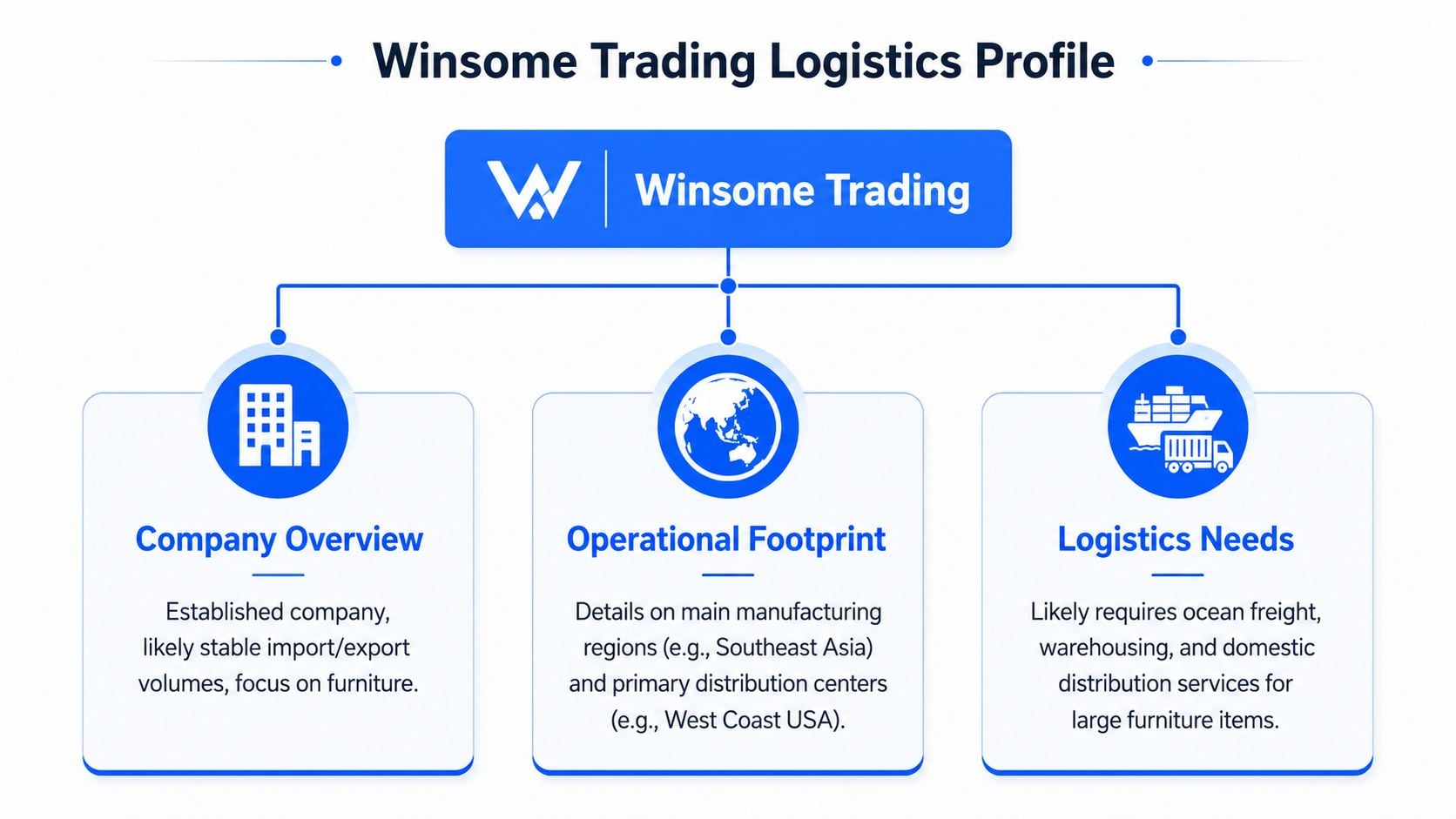
What a consolidated facility usually signals
When office, assembly, and distribution sit together, a few practical implications follow:
- Inbound scheduling matters more. Delays don't just affect receiving. They can disrupt assembly timing and outbound fulfillment.
- Warehouse flow matters. If one site is handling multiple functions, congestion at receiving docks can spill into order release.
- A forwarder can sell coordination, not just transport. The pitch becomes smoother handoffs, cleaner visibility, and fewer surprises across modes.
That changes how you qualify the account. You're not asking only whether they import or export. You're asking whether their operation benefits from tighter alignment between customs, drayage, warehousing support, and domestic distribution.
Product mix tells you where service risk lives
The company's Better Business Bureau profile describes a product range that includes accent tables, bed trays, TV tables, occasion tables, stools, and shelving, with materials including wood, wrought iron, aluminum, steel, marble, and glass. That mix creates real trade-offs.
Wood and finished furniture surfaces raise packaging and damage-prevention questions. Glass adds breakage exposure. Metal and stone components can change weight distribution, container loading plans, and final-mile handling. A rep who understands that won't lead with “best rates.” They'll ask better questions.
If the shipment can be damaged by poor loading, poor packaging advice is a sales problem, not just an operations problem.
How to rank this account internally
New reps often treat every manufacturer the same. Don't. Build a short qualification view around operational fit. If you want a simple framework for building a lead scoring model, adapt it to logistics-specific variables like facility type, product fragility, cross-border indicators, and likely modal mix.
A practical scorecard for Winsome Trading Woodinville would weigh:
Facility structure
Consolidated operations often create coordination pain points worth solving.Product handling demands
Mixed materials usually increase the value of specialized execution.Operational maturity
Long-standing manufacturers tend to have established processes, which means you need a sharper entry angle.
For reps learning account breakdowns, I like comparing one target against another known manufacturer profile to sharpen pattern recognition. This review of Marathon Sales Inc and account qualification signals is useful for that exercise.
Uncovering Potential Trade Lanes and Shipment Patterns
The useful question isn't “Does Winsome ship?” It's “What route logic would make sense for this shipper, and how do we verify it fast?”
Winsome Trading Inc. generates annual revenue of approximately $39,033,867 and maintains a secondary location at 8116 Alexander Rd, Delta, BC, Canada, according to its Manta company profile. The number matters because it suggests a meaningful operating scale. The Delta location matters because it gives you a real cross-border clue.
Start with hypotheses, not assumptions
You don't need to invent facts to form a prospecting plan. You need disciplined hypotheses.
For Winsome Trading Woodinville, I'd test these possibilities first:
Cross-border movement between Washington and British Columbia
The Delta facility creates a plausible lane for inventory balancing, supplier coordination, or distribution support.West Coast port dependency
A Woodinville furniture operation with mixed-material products may rely on Pacific Northwest import flows, even if the exact port mix still needs verification.Container-level handling complexity
Furniture and pantryware often create cube, stacking, and breakage considerations that influence carrier and warehouse choices.
None of those statements claims a shipment history. They tell you where to look first.
What to pull from customs and commercial signals
In this critical phase, new reps either become dangerous in a good way or stay stuck in list-building mode. You want records and signals that answer a narrow set of questions:
| Signal to verify | Why it matters |
|---|---|
| Port of entry patterns | Tells you which gateway problems are worth discussing |
| Carrier names | Helps frame switch-risk and incumbent strength |
| Commodity descriptions | Reveals whether the lane fit matches your service strengths |
| Consignee and shipper naming variants | Prevents missing records due to entity mismatch |
| Recurring origin locations | Turns a one-off shipment into a lane strategy |
You should also widen the net beyond customs records alone. Teams that know how to integrate social data with scraping APIs can enrich lane research with job changes, facility mentions, hiring trends, and partner references. The point isn't to scrape for volume claims. It's to improve context before outreach.
A short walkthrough helps when training reps to think in this sequence:
The pattern you're trying to surface
You're looking for a practical narrative, not a spreadsheet dump. For example:
“This account appears to have a cross-border footprint, a consolidated warehouse operation, and products that likely require careful inbound planning and handling discipline.”
That's enough to shape outreach. Once you verify specific shipments, you can narrow the message to one lane, one issue, and one likely stakeholder.
How to Verify Shipping Data and Find Contacts
An account doesn't become workable until you've confirmed two things. First, the freight pattern is real. Second, a specific person owns part of the problem.
Verify the freight before you write
Use shipment records, bills of lading, and consignee variations to test your lane hypotheses. Don't stop at a company-name search. Check likely abbreviations, entity suffixes, and address-linked records. A lot of reps miss good data because they search one exact legal name and assume the file is complete.
What you're trying to confirm is straightforward:
Recurring port activity
One shipment is interesting. Repetition is what gives you a prospecting angle.Mode and routing clues
You want to know whether the account looks like a fit for your strongest service lines.Operational friction points
Late pickups, split handling requirements, customs complexity, or warehouse timing issues all create better opening messages than a broad capability statement.
Verify first, personalize second. Reversing that order produces polished nonsense.
Find the owner, not the mailbox
Once the freight pattern is credible, move to role mapping. For a shipper like Winsome Trading Woodinville, the right contact usually isn't the generic corporate inbox. The useful targets are people tied to logistics execution, supply chain planning, operations leadership, or procurement.
Build a contact slate by role, then prioritize by likely pain ownership:
- Logistics or transportation manager for day-to-day lane execution
- Supply chain director if the issue touches network design or vendor performance
- Operations leader when warehousing and inbound flow affect fulfillment
- Procurement stakeholder if the conversation is likely to turn into rate benchmarking
You also need a clean process for decision-maker research. This guide on how to find decision-makers in B2B accounts is a good checklist for moving from company-level interest to person-level outreach.
Keep your contact list tight
Don't build a bloated list of every manager with a LinkedIn profile. For one target account, I'd rather have three well-matched contacts with clear role logic than fifteen names with no ownership theory behind them.
That discipline improves message quality and follow-up quality. It also keeps you from sending the same half-relevant note across departments that don't share the same KPI.
Crafting Your Data-Driven Outreach Message
Most freight outreach fails in the first sentence. The rep talks about their company before proving they understand the shipper.
That approach is especially weak with a long-standing manufacturer like Winsome Trading, which was established in 1977 and has maintained continuous operations for over 35 years, as noted earlier from the BBB profile. Stable companies tend to attract constant vendor outreach. They don't need another “just checking if you handle imports” email.
Generic email versus account-specific email
Here's the bad version:
Hi, we're a global logistics provider that supports importers and exporters with competitive rates and reliable service. I'd love to schedule time to learn about your shipping needs.
There's no account insight, no reason for timing, and no indication that the sender understands the operation.
A stronger version sounds like this:
Hi [Name], I'm reaching out because Winsome Trading's Woodinville operation appears to combine assembly and distribution, which usually makes inbound timing and warehouse flow more sensitive than standard receiving-only sites. If your team is reviewing any Pacific Northwest import or cross-border routing options, I can share a few ideas on where forwarders usually reduce handoff issues for furniture programs.
That message doesn't overclaim. It shows enough understanding to earn a reply.
Match the angle to the role
Use the same account, but shift the message based on who's reading it.
| Target Role | Key Concern | Messaging Angle Example |
|---|---|---|
| Logistics Manager | Shipment execution | “We help reduce missed handoffs and receiving friction on recurring inbound lanes.” |
| Supply Chain Director | Network reliability | “We can review routing and vendor coordination where assembly and distribution sit in one operation.” |
| Operations Leader | Warehouse flow | “Inbound timing issues often create downstream pressure on fulfillment. That's where we usually start.” |
| Finance or Procurement | Cost control | “We can benchmark where avoidable accessorials and handling inefficiencies may be hiding.” |
Keep the message clean enough to land
Don't bury the insight under a long intro. Don't attach a deck. Don't ask for half an hour. Ask for a short conversation tied to one practical issue.
A few rules I use with new reps:
- Lead with the account observation.
- Mention one likely pain point, not five.
- Ask for a brief call with a narrow purpose.
- Use a domain that's set up correctly before sending. If your team needs a refresher on sender setup, this guide on How do I authenticate my email is worth reviewing before any outbound push.
The best cold email sounds like it came from someone who already thinks in the prospect's workflow.
That's the standard. Not clever. Not long. Relevant.
Effective Follow-Up Tactics That Secure the Meeting
Most meetings are booked in follow-up, not on the first email. The problem is that reps often follow up by repeating themselves.
Don't send “just bumping this up” messages. Add something each time.
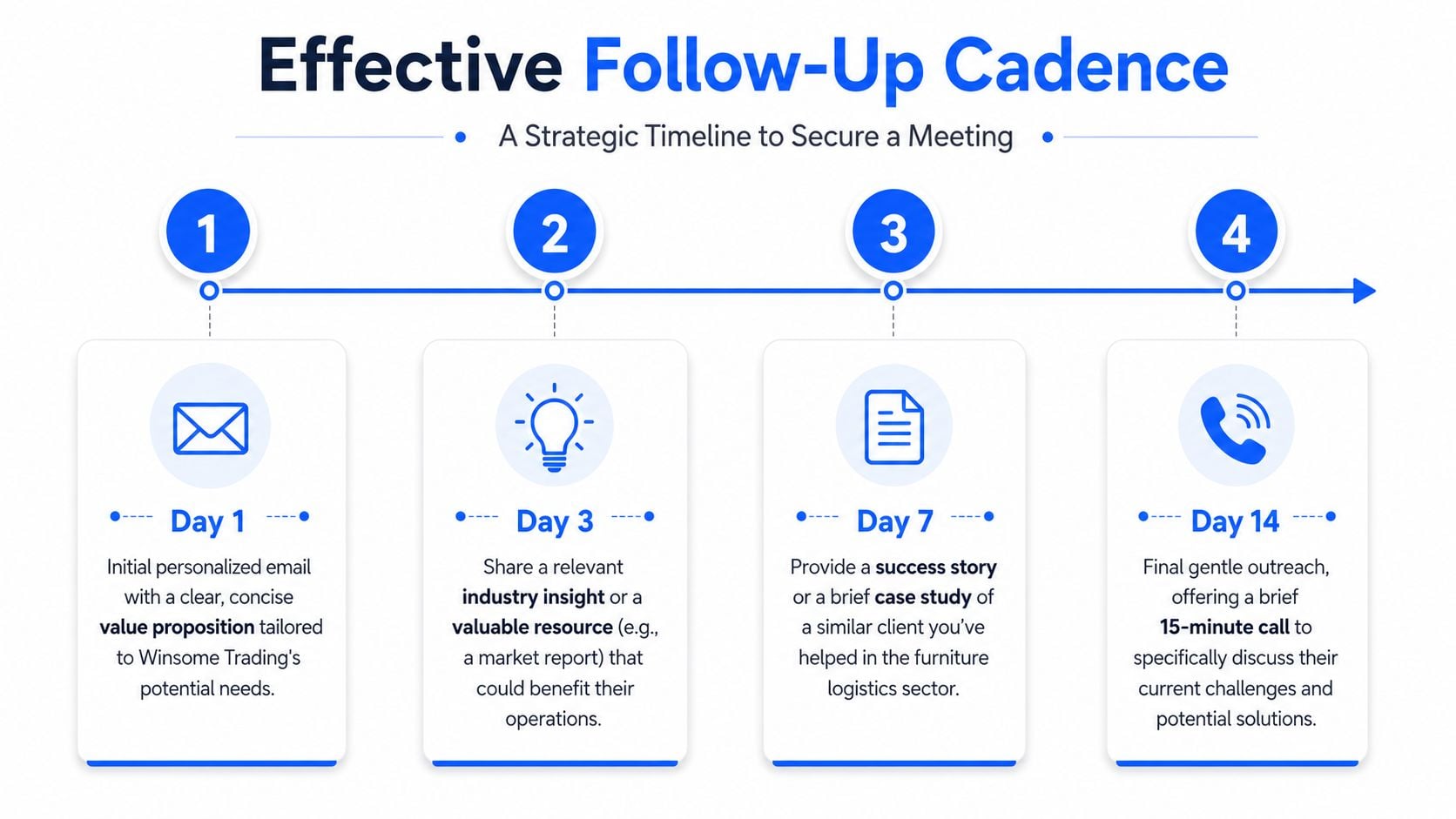
A simple cadence that works
Day 1
Send the personalized note tied to one operational observation.Day 3
Add a useful follow-up. This could be a short comment about a likely lane issue, a packaging concern common in furniture moves, or a question about cross-border coordination.Day 7
Narrow the ask. Offer a short discussion around one issue only, such as inbound scheduling, customs handoff, or warehouse flow.Day 14
Close politely. Let them know you'll step back if timing isn't right, but leave a specific reason to reconnect later.
What not to do
A few follow-up habits kill response rates:
| Avoid this | Do this instead |
|---|---|
| Repeating the same email | Add one new observation or question |
| Sending long reminders | Keep each touch short and specific |
| Pitching every service | Focus on the one issue most likely to matter |
| Chasing everyone at once | Stay coordinated across a small contact group |
Persistence helps only when each touch gives the buyer a new reason to care.
For Winsome Trading Woodinville, the meeting usually comes from disciplined relevance. You identify the account correctly, verify the freight pattern, pick the right owner, and follow up with context instead of noise. That's how booked meetings happen in logistics sales.
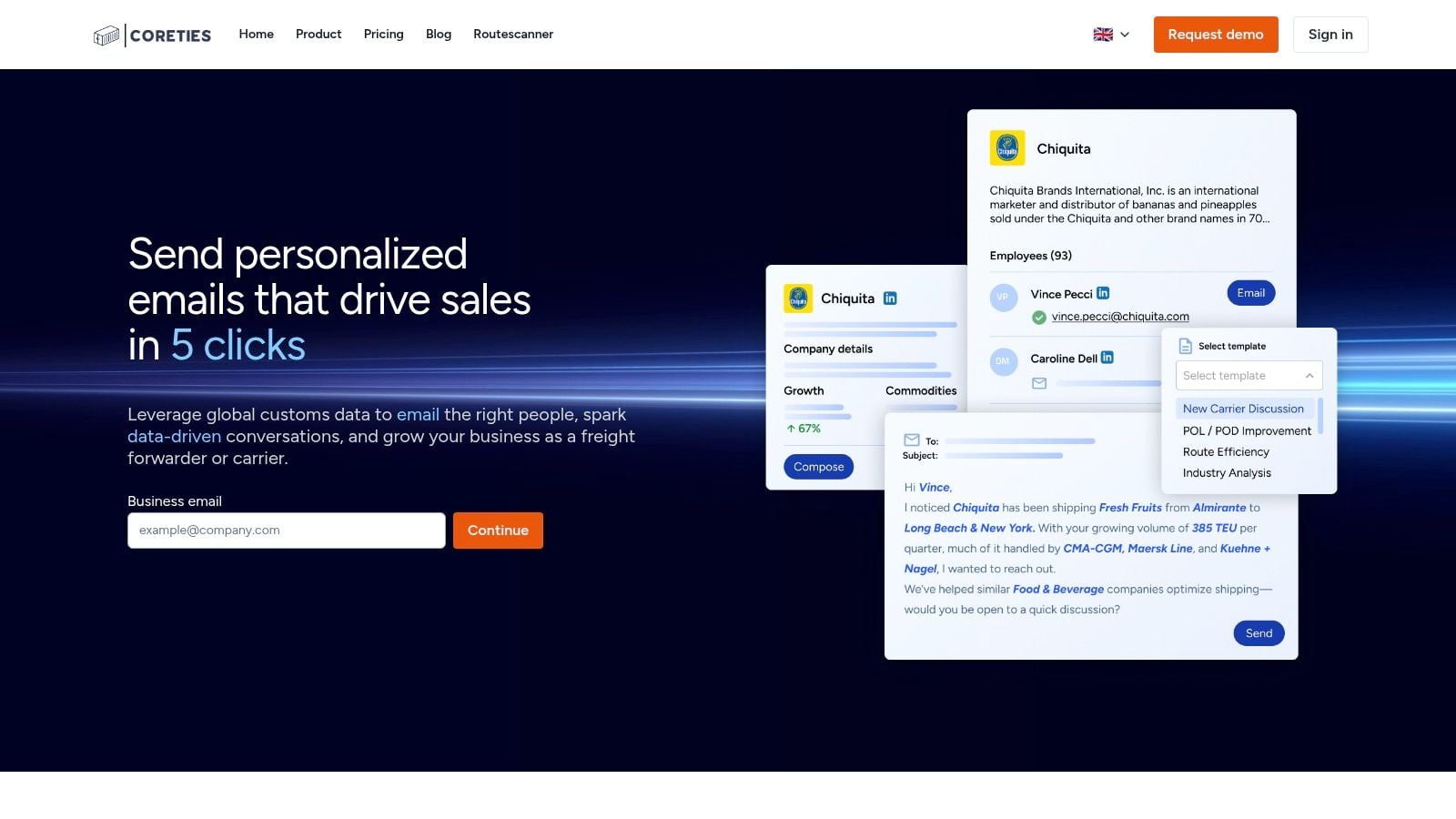
If you want a faster way to turn customs signals into qualified shipper lists, find the right contacts, and launch account-specific outreach, Coreties is built for that workflow. It helps freight teams move from raw trade data to targeted conversations without wasting time on generic prospecting.