Network Optimization: Streamline Logistics for 2026
You're staring at a network that looks busy on paper and expensive in practice. Trucks sit in the wrong places, ocean moves don't line up with warehouse space, customs delays ripple through the week, and every lane seems to need a separate fix. That's where network optimization becomes a logistics discipline, not just an IT […]
You're staring at a network that looks busy on paper and expensive in practice. Trucks sit in the wrong places, ocean moves don't line up with warehouse space, customs delays ripple through the week, and every lane seems to need a separate fix. That's where network optimization becomes a logistics discipline, not just an IT phrase. In freight operations, it means aligning shipment flows, carrier schedules, customs clearance timing, and inventory placement so the network moves with less waste and fewer surprises.
The idea isn't new. The 1973 DARPA Internetting project helped establish the core principle that complex networks work better when they share common protocols across different systems, rather than trying to optimize each piece alone, and that same logic still matters in logistics planning today, even if the assets are trucks, vessels, containers, and warehouses instead of routers and packets. The Internet Society's history of interconnected networks shows how that shift created a scalable internetwork architecture, and freight teams can borrow the same mindset. A strong operating model treats the whole lane network as one system, not a pile of disconnected moves.
That's also why logistics teams need practical data, not generic advice. If you're comparing route design with customs realities and intermodal schedules, a resource like automating supply chain processes can be useful context, especially when you're trying to reduce repetitive work and standardize decisions.
Introduction to Logistics Network Optimization
A freight forwarder might look at a week of bookings and see a healthy pipeline. Then the carrier misses a handoff, the customs hold adds idle time, and a “profitable” lane turns into a margin drain. That's the everyday problem network optimization solves in logistics, it helps you redesign how freight moves so the network supports service levels instead of fighting them.
Why logistics is different from IT network optimization
In IT, network optimization often focuses on latency, throughput, packet loss, and utilization. In logistics, the equivalent challenge is physical, not digital. You're balancing truck capacity, vessel schedules, warehouse cutoffs, customs clearance, and delivery windows, all while one delayed decision can affect the rest of the week.
The logic still rhymes. Modern optimization is an iterative process that uses live and historical traffic data, topology analysis, segmentation, load balancing, bandwidth management, and AI-driven tuning to improve performance and reliability, and the same pattern works for freight flows when you substitute shipment data, route structure, and mode selection for packets and bandwidth. Splunk's overview of network optimization frames optimization as a measurable discipline, not a one-time cleanup. In logistics, that means redesigning lane logic, carrier allocation, and inventory positioning so the network reacts faster to demand and disruption.
Practical rule: If a lane decision can't be tied to cost, service, or asset use, it's probably not a network decision yet.
Logistics teams get the biggest gains when they stop treating customs, routing, and warehousing as separate silos. They start asking where freight should enter the network, which lanes deserve consolidation, and where inventory should sit so downstream moves stay flexible. That's the point where optimization turns into a planning habit, not just a project.
Understanding Network Optimization Goals and KPIs
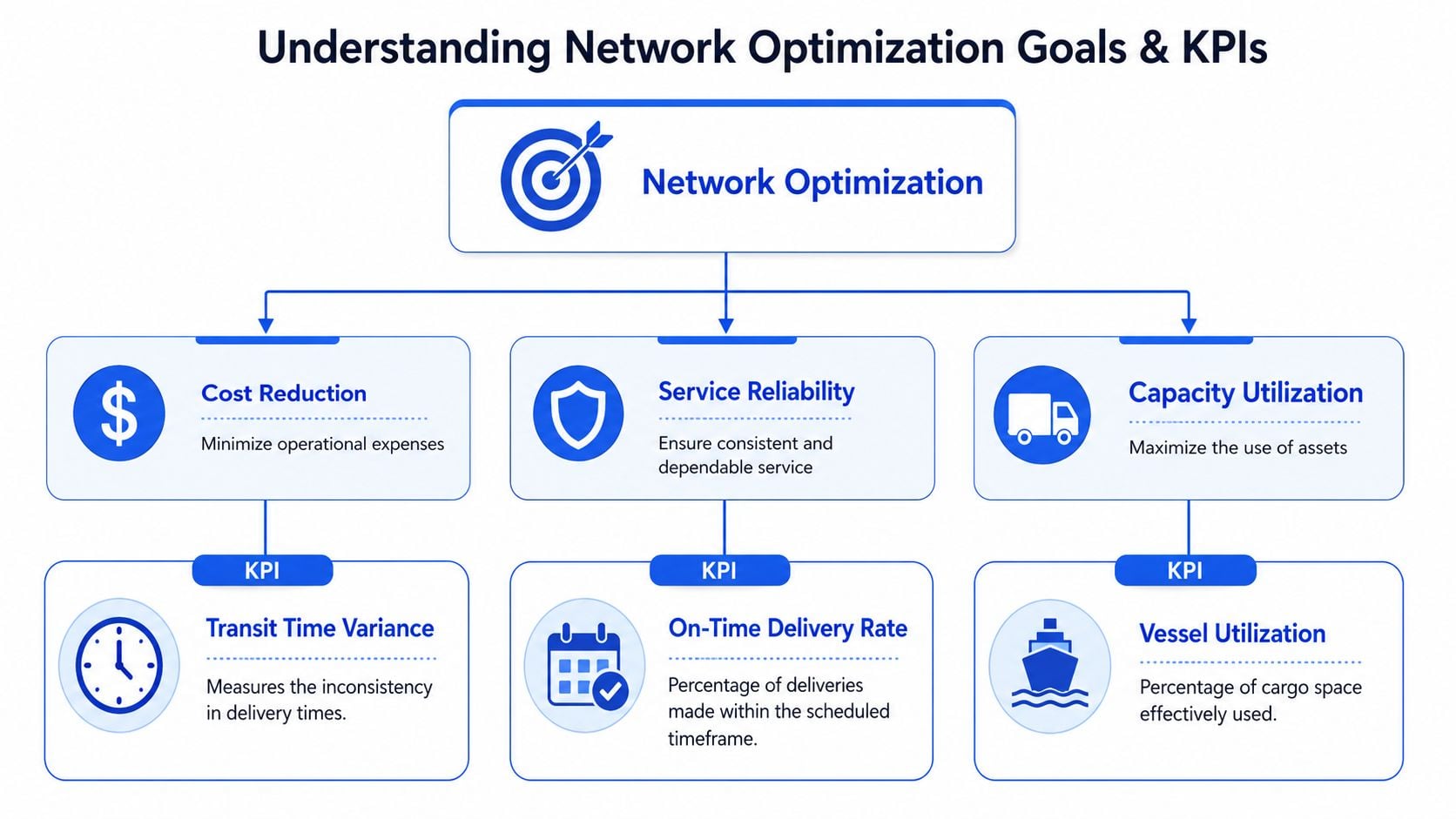
Good logistics planning starts with three goals, lower cost, more reliable service, and better capacity use. Those goals sound obvious until a team tries to measure them and realizes the network has been making tradeoffs for months without anyone naming them. That's why KPI design matters as much as route design.
Translate broad goals into daily operating metrics
Think of a warehouse like a cross-dock. If trucks arrive too early, they block docks. If they arrive too late, the wave misses departure. In the same way, a logistics network needs metrics that show whether timing, consistency, and utilization are working together.
A practical KPI set usually includes transit time variance, on-time delivery rate, trailer fill rate, and total landed cost per shipment. Transit time variance tells you whether a lane is predictable or noisy. On-time delivery rate shows whether the network is honoring customer commitments. Trailer fill rate reveals whether you're moving air instead of freight. Total landed cost per shipment helps teams compare routes fairly, because the cheapest move on paper can become expensive after handling, delay, and rework.
Use those KPIs as decision tools, not dashboard decoration. If a lane has weak trailer fill but excellent service, the fix may be consolidation or schedule alignment. If customs delays keep pushing time windows out, the answer may be to move buffer time upstream or reposition inventory closer to the final market. If dwell time keeps rising, the network may be asking too much from one terminal or one carrier.
For teams that already track lane performance, performance benchmarking is a useful way to compare current lanes against internal standards before changing the network design. The point isn't to chase every metric equally. It's to choose a small set that tells a clear story about where the network is leaking time, money, or capacity.
A KPI should answer one of three questions, can we move it cheaper, can we move it more reliably, or can we move it fuller?
Use thresholds that trigger action
Monitoring only works when it leads somewhere. In operational network programs, teams often watch primary performance indicators such as latency, jitter, throughput, and packet loss in IT settings, and the logistics equivalent is to define alert points for utilization, delay, and capacity strain before the system tips over. That same discipline helps freight teams catch problems early, before a route becomes a recurring exception.
The key is consistency. If everyone uses the same definitions for service reliability, load use, and timing variance, the network becomes easier to improve lane by lane.
Overview of Optimization Methods
There isn't one perfect method for every logistics problem. Some teams need a precise model. Others need a fast answer that's “good enough” before the booking window closes. The best program matches the method to the decision.
Modeling for structure and constraint
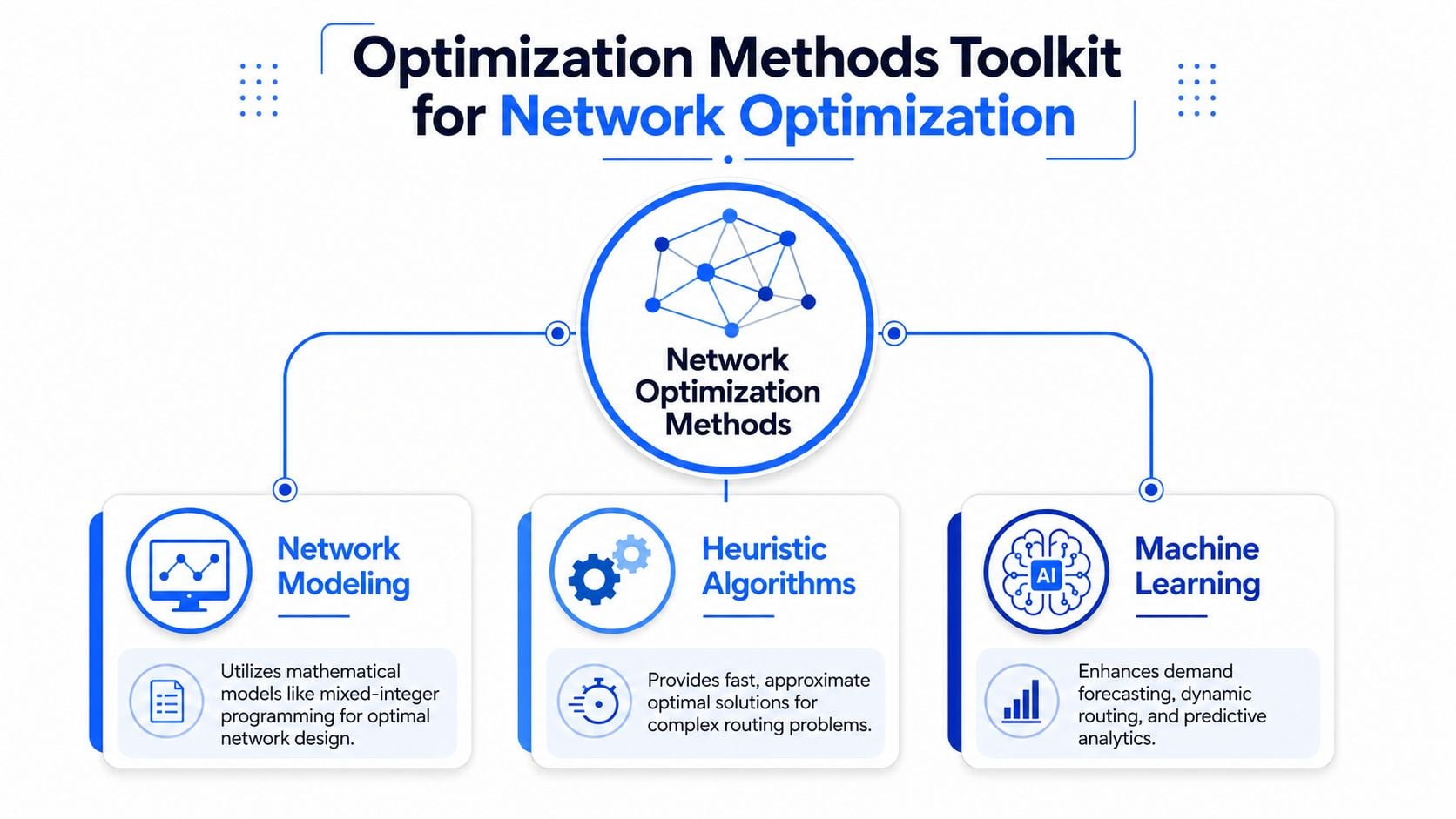
Network modeling gives planners a structured way to test lane design, hub placement, and modal tradeoffs before changing live operations. In logistics, this often means building a mathematical representation of the current network, then asking what happens if volumes shift, a port slows down, or a warehouse changes its cut-off time. Mixed-integer programming is useful when the problem has clear decision variables and strict constraints, like fixed capacity or service windows.
The value of modeling is clarity. You can see which rules really matter and which habits only survive because nobody has challenged them.
Heuristics for speed
Heuristic algorithms are the workhorses for complex freight planning when you need a fast answer. They won't always produce the mathematically best route, but they can produce a strong route quickly, which matters when dispatchers, planners, and customer teams are working against the clock. For example, a heuristic can group shipments by lane similarity, then propose a consolidated load plan that would take too long to discover manually.
That's often enough in daily operations. If a route has to be confirmed now, a practical solution beats a perfect one that arrives after the booking window closes.
Machine learning for prediction
Machine learning is most useful where the network depends on recurring patterns that humans miss. In freight, that might mean predicting demand spikes, spotting likely exceptions, or anticipating where a customs delay will affect a route plan. It doesn't replace planner judgment. It gives planners a better starting point.
The strongest use case is not flashy automation. It's earlier warning, better estimates, and more stable decisions when conditions change.
Constraint programming and multimodal routing
Constraint programming is ideal when the network has many strict requirements, like vessel cutoffs, regulatory rules, asset limits, or customer-specific service commitments. It helps teams keep the plan valid while still exploring options. Multimodal routing sits on top of that logic, blending ocean, air, rail, and trucking into one coordinated plan.
That matters because freight networks rarely move on one mode alone. A strong plan might move the linehaul by ocean, the final leg by truck, and the time-sensitive part by rail or air, depending on the service promise.
The right method is the one that respects the actual constraint you can't afford to break.
Logistics Network Optimization Implementation Roadmap
A freight network doesn't improve because someone redraws a map once. It improves when teams create a repeatable loop, measure it, adjust it, and keep the change alive. That's where the closed-loop lifecycle of Observe, Analyze, Act, Automate fits cleanly into logistics operations, because it connects telemetry to remediation instead of treating optimization like a one-time exercise. ManageEngine's network optimization framework captures that continuous approach well.
Start with current-state visibility
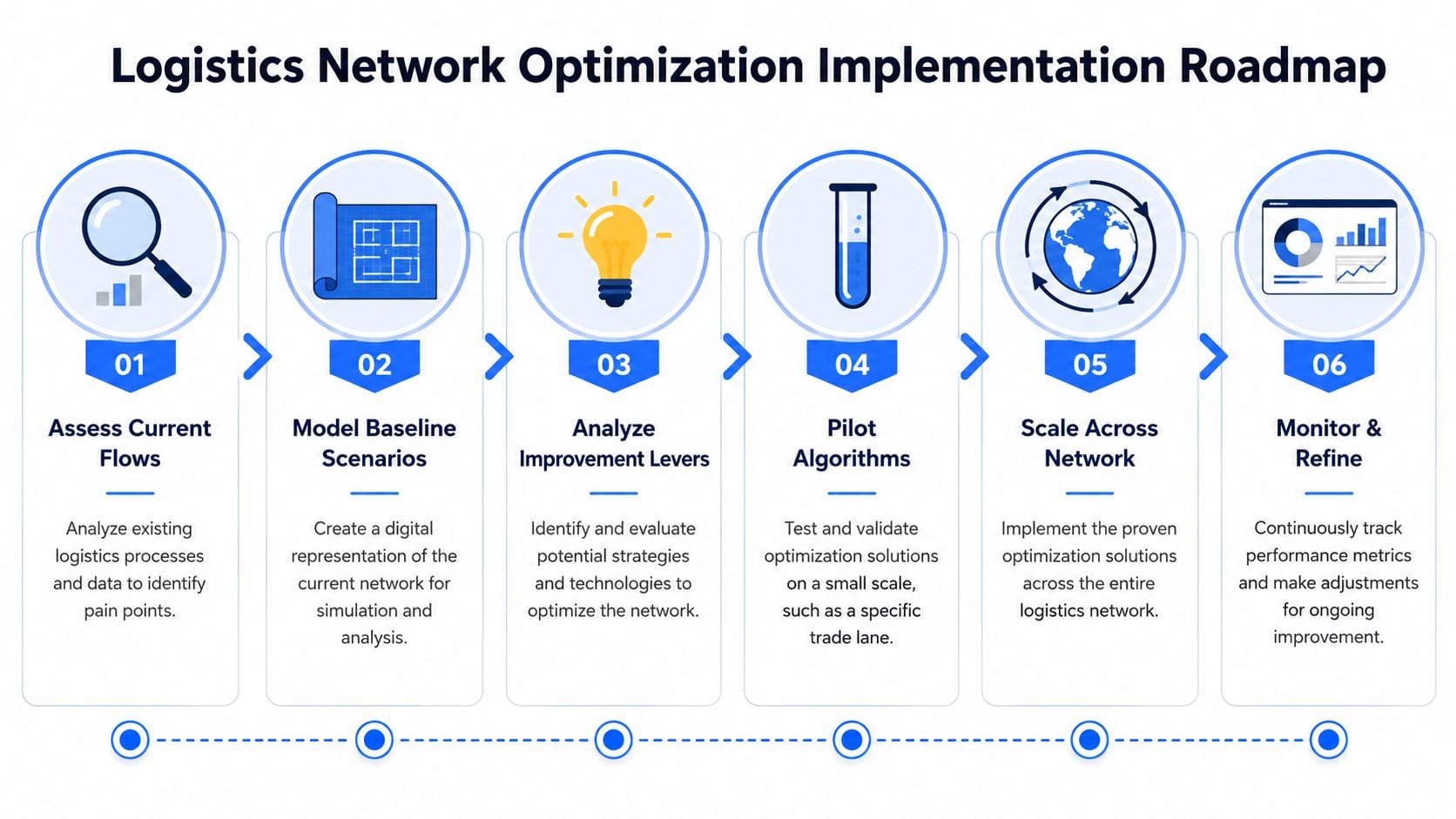
The first job is to map what's really happening, not what the SOP says should happen. That means looking at actual origin-destination flows, handoff points, customs timing, carrier performance, and exception patterns. If planners can't see the current network cleanly, every later decision gets shaky.
Build a baseline you can trust
The second step is a working baseline. Model the current network with the constraints that matter, including transit windows, asset availability, and border timing. This gives you a reference point for comparing every change that follows.
Isolate improvement levers
Once the baseline is stable, teams can test levers such as consolidation, route redesign, mode shifts, or inventory repositioning. A useful approach is to pick the one change most likely to reduce friction in a single lane cluster, then see what results. That's much safer than changing half the network at once and guessing which action caused the result.
Pilot, then scale carefully
A pilot lane is the right place to prove a new routing rule, a new customs buffer, or a different booking cadence. A logistics leader can use a guide for logistics operations teams as a practical reference for sequencing work and keeping the operational rollout disciplined. This implementation timeline is helpful when teams need to sequence the change across stakeholders and systems.
Automate what repeats
The last step is to automate recurring decisions so the team isn't rebuilding the same answer every week. That's where alerts, workflow triggers, and rule-based routing help. The network stays tuned because the system keeps watching for drift.
Implementation advice: Don't automate the first version of a bad process. Automate the version you've already proven works.
Tools and Data Requirements for Network Optimization
Good optimization starts with clean inputs. If the carrier schedule is stale, the customs history is incomplete, or the shipment volume data is inconsistent, even a strong model will give you a weak recommendation. That's why the tool stack matters just as much as the strategy.
Build the stack around the decision you need to make
Route-planning engines help compare scenarios. GIS mapping shows geography, border crossings, and hub spacing. Constraint solvers handle hard rules like capacity or service windows. ML platforms help with forecasting, anomaly detection, and dynamic adjustment. None of those tools work well in isolation if the underlying data isn't aligned.
The most useful data usually comes from four places:
- Carrier schedules: These show when the network can move freight, not when a plan looks convenient.
- Customs clearance records: These reveal where border timing adds friction or uncertainty.
- Shipment volumes: These help planners decide where consolidation is possible and where separate moves make more sense.
- Real-time tracking feeds: These show whether the plan is holding up once freight is in motion.
That's where logistics-specific data sources become powerful. Coreties transforms global customs data into prospect and route intelligence, while Routescanner adds intermodal routing and schedule context, so a team can see lane patterns and service options together instead of in separate tabs. For teams comparing vendors and data partners, DataEngineeringCompanies rankings can be a useful starting point for evaluating data engineering support.
Match the tool to the planning phase
A simple way to think about the tech stack is to align it with the roadmap. Modeling tools help during baseline design. Optimization engines and constraint solvers help during pilot testing. Monitoring platforms support the observe-and-refine cycle. The point isn't to buy every system available. It's to make sure each tool feeds the next decision cleanly.
| Tool or Data | Purpose | Source |
|---|---|---|
| Route-planning engine | Compare route scenarios and consolidation options | Planning software |
| GIS mapping | Visualize geography, hubs, and lane structure | Mapping platform |
| Constraint solver | Enforce capacity, timing, and service rules | Optimization software |
| ML platform | Forecast demand and detect pattern shifts | Data science stack |
| Customs clearance records | Identify border timing and exception patterns | Trade data |
| Carrier schedules | Confirm actual service availability | Carrier and intermodal data |
| Shipment volume history | Support consolidation and capacity planning | Internal ERP and TMS |
| Real-time tracking feed | Monitor execution and flag drift | Visibility platform |
A strong setup also needs governance. Someone has to own data quality, update cadence, and model assumptions. If not, the network starts drifting back toward guesswork.
Software for freight forwarding companies is a useful reminder that software should fit the workflow, not force the team into a plan it can't execute.
Practical Examples and Metrics for Freight Forwarders and Carriers
A freight forwarder and an ocean carrier can both improve with network optimization, but they usually improve different parts of the system. The forwarder cares about timing across modes and customs touchpoints. The carrier cares about how full the vessel or asset network runs without creating avoidable delay.
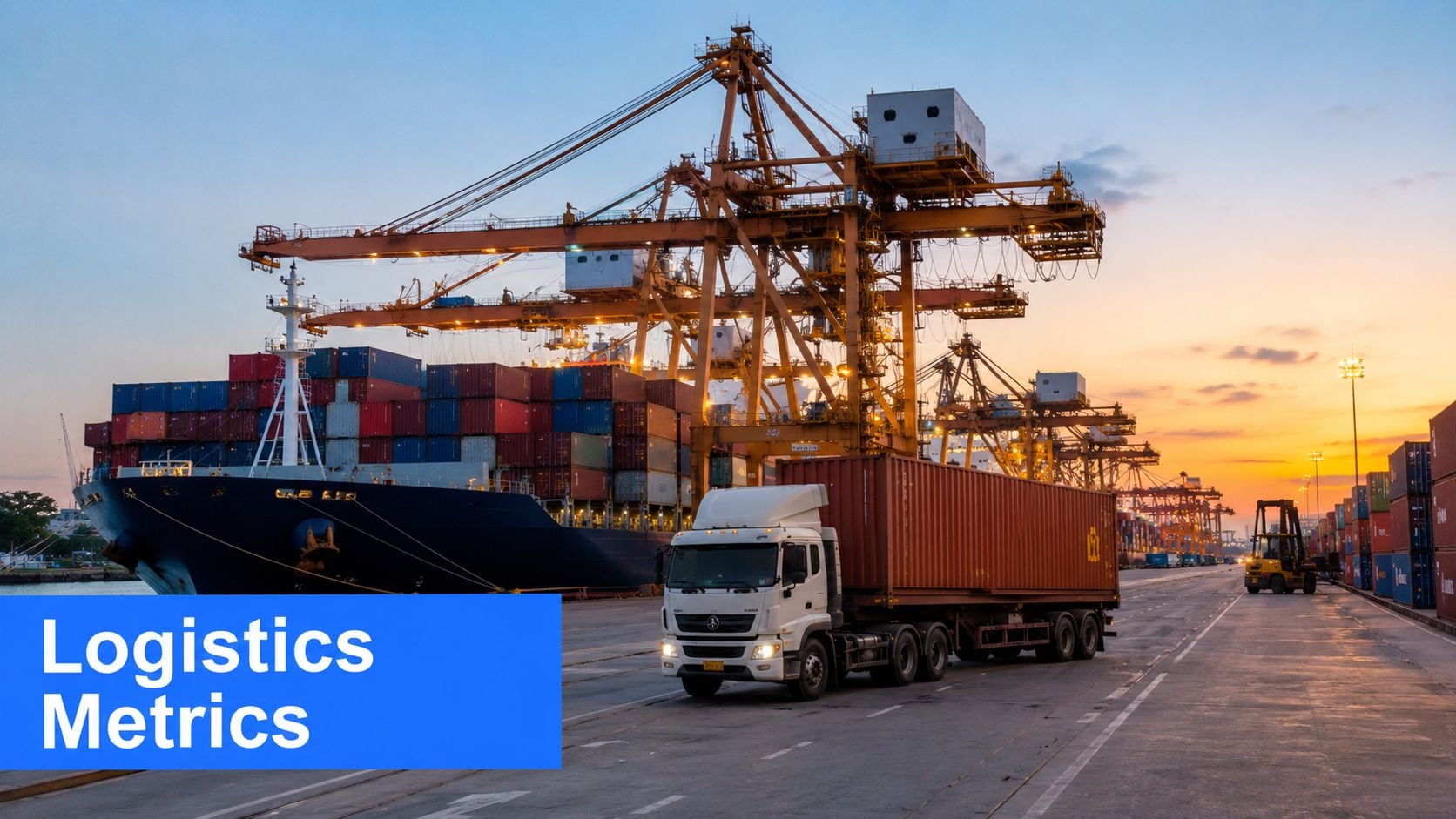
Freight forwarder example
A forwarder starts with a common problem, too many lanes managed with too little lane-level visibility. The planning team uses customs data and intermodal schedule context to identify which shipment patterns keep landing in the same bottlenecks. Then it tightens route choices around the lanes that are most predictable and adds more disciplined timing around handoffs.
The result is usually not one dramatic breakthrough. It's a quieter improvement in how decisions get made. The team sees fewer last-minute reroutes, fewer overpromised handoffs, and better alignment between booking promises and actual transit behavior.
Carrier example
A carrier has a different problem. The network may be moving freight safely, but not making full use of the asset. That's where vessel planning, schedule coordination, and route design come together. If the carrier can align load patterns with the most useful sailings and reduce empty space, the network gets more productive without requiring a totally new fleet plan.
The lesson in both cases is the same. Start with the metric that reflects the pain point, then connect it to one operational change. If the problem is timing, focus on transit stability. If the problem is asset use, focus on fill logic. If the problem is dwell time, focus on where the network is waiting instead of moving.
The most common mistake is trying to improve everything at once. Teams that win usually pick one lane cluster, one decision rule, and one KPI, then expand only after the result is stable.
Conclusion and Next Steps
Network optimization helps freight teams cut waste, improve service, and use assets more intelligently. The fastest path forward is a small pilot built on real customs and routing data, a clear KPI set, and a closed-loop process that keeps refining the network after the first win. If your operation needs sharper lane visibility and more disciplined route planning, start there and make the change repeatable.
For freight teams ready to turn lane data into action, Coreties is worth reviewing as one option for customs-driven prospecting and route intelligence.