Your Guide to the Mediterranean Shipping Line Network
A Mediterranean shipping line is essentially any carrier running sea freight services that touch the Mediterranean Sea, connecting this historic body of water to the rest of the world. Think of the Med not just as a sea, but as a crucial maritime superhighway linking the economic powerhouses of Asia, Europe, and Africa. For any […]
A Mediterranean shipping line is essentially any carrier running sea freight services that touch the Mediterranean Sea, connecting this historic body of water to the rest of the world. Think of the Med not just as a sea, but as a crucial maritime superhighway linking the economic powerhouses of Asia, Europe, and Africa. For any freight forwarder, getting a firm handle on this region isn't just useful—it's key to unlocking some serious commercial opportunities.
Understanding the Mediterranean Shipping Ecosystem
The Mediterranean is far more than just a picturesque body of water; it's a dynamic, high-stakes arena for global trade. Picture it as a massive roundabout for international shipping. Huge container vessels steaming in from Asia meet a web of regional ships crisscrossing between Europe and North Africa.
This convergence creates a complex, yet incredibly rewarding, market. For logistics pros, mapping out this ecosystem is the first step to building a solid business development strategy.
At its heart, this shipping ecosystem is shaped by a few core traits:
- A Strategic Crossroads: Its geography puts it right at the intersection of major East-West and North-South trade routes, with the Suez Canal corridor acting as the main artery.
- Diverse Players: You have the global giants like MSC and Maersk dominating the major lanes. At the same time, a whole host of specialised regional carriers provide the vital feeder services that connect to smaller, niche ports.
- High-Volume Hubs: A network of enormous transhipment ports—think Valencia, Algeciras, and Piraeus—function as the nerve centres, sorting and redirecting millions of containers every year.
The Mix of Global Power and Local Expertise
What really makes this region fascinating is the interplay between global scale and local specialisation. On one side, you have the behemoth carriers orchestrating massive, intercontinental voyages with clockwork precision. Their operations are a masterclass in efficiency and scale.
Take MSC’s expansion in Asia, for example. It’s a perfect case study of how a global player strategically builds a regional stronghold to feed its major trade lanes. When MSC set up its regional headquarters in Singapore back in April 1996, it was a pivotal move. By 2021, it had grown to over 50 offices across 10 Asian markets, creating a powerful network that channels cargo directly into its vital Asia-Mediterranean-Europe services.
On the other side of the coin, you have smaller, more agile carriers. These guys thrive by offering tailored services that the giants might overlook, connecting the major hubs to hundreds of smaller ports scattered across Italy, Greece, Turkey, and North Africa.
For freight forwarders, this dual structure presents a clear opportunity. You can partner with global lines for long-haul reliability and leverage regional specialists for last-mile connectivity, creating a truly comprehensive service offering for your clients.
A Vibrant Territory for Business Growth
At the end of the day, the Mediterranean is a living, breathing landscape of moving cargo, bustling ports, and non-stop commercial activity. Every single container is a potential client, and every trade lane is a new business opportunity.
For anyone in the import and export business, learning to spot the patterns within this ecosystem is the bedrock of successful prospecting. That constant flow of goods is a goldmine of data for pinpointing companies that desperately need reliable logistics partners. By getting to know the key players and the dominant trade flows, you can strategically position yourself to capture a piece of this thriving market.
Getting to Know the Major Players on Mediterranean Routes
The Mediterranean shipping network isn’t some chaotic free-for-all; it’s a highly organised, competitive space where a handful of global titans call the shots. These carriers don't just pass through the region—they set its commercial rhythm. They invest heavily in ports, deploy their largest vessels, and ultimately shape the flow of global trade. For any freight forwarder, understanding who these players are and what they do best is day-one knowledge.
Think of companies like the Mediterranean Shipping Company (MSC), Maersk, and CMA CGM as the architects of the Med's maritime highways. They are the undisputed leaders. Their massive fleets and sprawling global networks mean they can connect the Mediterranean to pretty much any major market on the planet. They form the backbone of the critical East-West trade lanes that act as a conveyor belt for goods moving between Asia and Europe.
But it’s not a complete monopoly. A second, dynamic tier of regional and specialised carriers thrives by filling the gaps left by the mega-carriers. These smaller, more agile lines are the lifeblood of the intra-Med network, providing essential feeder services that link major transhipment hubs like Valencia and Piraeus with hundreds of smaller ports across Italy, Greece, North Africa, and the Black Sea.
The Global Titans of the Med
When you start digging into the major container routes, three names pop up again and again. Their strategic moves send ripples across the entire supply chain, affecting everything from freight rates to port congestion.
Mediterranean Shipping Company (MSC): With deep roots in the Mediterranean, MSC has a natural home-field advantage. It runs one of the world's largest container fleets and offers unmatched port coverage throughout the region. MSC is famous for its aggressive growth and massive investments in terminal infrastructure, which gives it incredible control over its operations.
Maersk: The Danish giant is a force in global logistics, and its Mediterranean presence is no different. Maersk’s game is all about reliability and integrated, door-to-door solutions that go far beyond the port gates. You can see their proactive mindset in action when they strategically reroute services away from congested hubs like Rotterdam to protect their schedules.
CMA CGM: This French carrier has a long history in the Mediterranean. It uses its strategic hub in Marseille-Fos as a powerful springboard into key European and African markets. CMA CGM is particularly dominant on the Asia-Europe trade lane and has earned a reputation for its vast network and customer-focused service options.
These three carriers, along with their alliance partners, own a huge slice of the market. And their scale matters. Recent data shows that during peak season, a vessel delay at a major hub like Antwerp can balloon from 32 hours to 44 hours—a 37% jump. How these titans handle such disruptions directly impacts whether you can deliver on your promises to your clients.
Specialised Services and Regional Experts
Beyond the big three, a whole ecosystem of other carriers has carved out important niches. For example, some lines are known for their superior reefer (refrigerated container) capacity, making them the automatic choice for shipping perishable goods like fruit and pharmaceuticals from Spain or Italy. Others might offer the best, most reliable connections to less-frequented ports in the Eastern Mediterranean or North Africa.
This is a forwarder’s secret weapon. Understanding these specialisations lets you move beyond a one-size-fits-all approach and build truly optimised shipping solutions that perfectly match a client's cargo and destination.
Knowing which carrier excels with hazardous materials, or which one has the most dependable feeder link to a small Greek island, can be the difference between a happy client and a logistical nightmare. This kind of deep market knowledge is what elevates you from a simple booking agent to a truly valuable logistics partner.
Top Carriers on Mediterranean Shipping Lanes At a Glance
To make smart partnership decisions, it helps to see how the major players stack up side-by-side. Each carrier brings a unique set of strengths to the table, and the best choice nearly always depends on the specific demands of your shipment.
This table offers a quick comparison of their key attributes.
| Carrier Name | Primary Mediterranean Trade Lanes | Key Regional Hubs | Noteworthy Specialisations |
|---|---|---|---|
| MSC | Asia-Europe, Intra-Med, Transatlantic | Gioia Tauro, Valencia | Extensive feeder network, large vessel capacity |
| Maersk | Global (all major lanes), North-South | Algeciras, Tangier Med | Integrated logistics, schedule reliability, digital solutions |
| CMA CGM | Asia-Europe, Europe-Africa | Marseille-Fos, Malta | Strong reefer services, extensive African network |
| Regional Carriers | Intra-Mediterranean, Black Sea connections | Piraeus, Istanbul, Genoa | Niche port access, flexible scheduling, specialised cargo types |
Ultimately, having a clear picture of each carrier's strengths, weaknesses, and specialities is crucial. It empowers you to select the right partner not just for one shipment, but to build a resilient and effective strategy for all your Mediterranean business.
Mapping Key Trade Lanes and Strategic Ports
Think of the Mediterranean Sea not as a single body of water, but as a complex web of commercial arteries. For a freight forwarder, knowing these routes is like a taxi driver knowing a city's main roads and back alleys. It’s fundamental to building supply chains that are not just cheap, but also smart and resilient.
These trade lanes are carved out by the forces of global economics, connecting continents and channelling trillions of dollars in goods. They're the invisible conduits that bring your smartphone from Asia to a shop in Europe or move Spanish olives to markets across the world.
When you trace these paths, you start to see the logic behind why certain ports have become so powerful. The entire system is built for efficiency, speed, and connectivity, with each route serving a very specific purpose.
The Dominant East-West Corridor
The most important artery by far is the East-West trade lane. This is the maritime superhighway linking Asia with Europe, and the Suez Canal is its main gateway.
Vessels stream in from the Red Sea and head west, making strategic stops at massive transhipment hubs along the way. This route carries an incredible volume of finished goods—everything from electronics and clothing to car parts—all originating from manufacturing hubs in China, Vietnam, and Southeast Asia.
For any Mediterranean shipping line, mastering this corridor is non-negotiable. It's the highest-volume, highest-value route and the absolute focus for global giants like MSC, Maersk, and CMA CGM.
The diagram below highlights the major carriers that command these vital trade lanes.
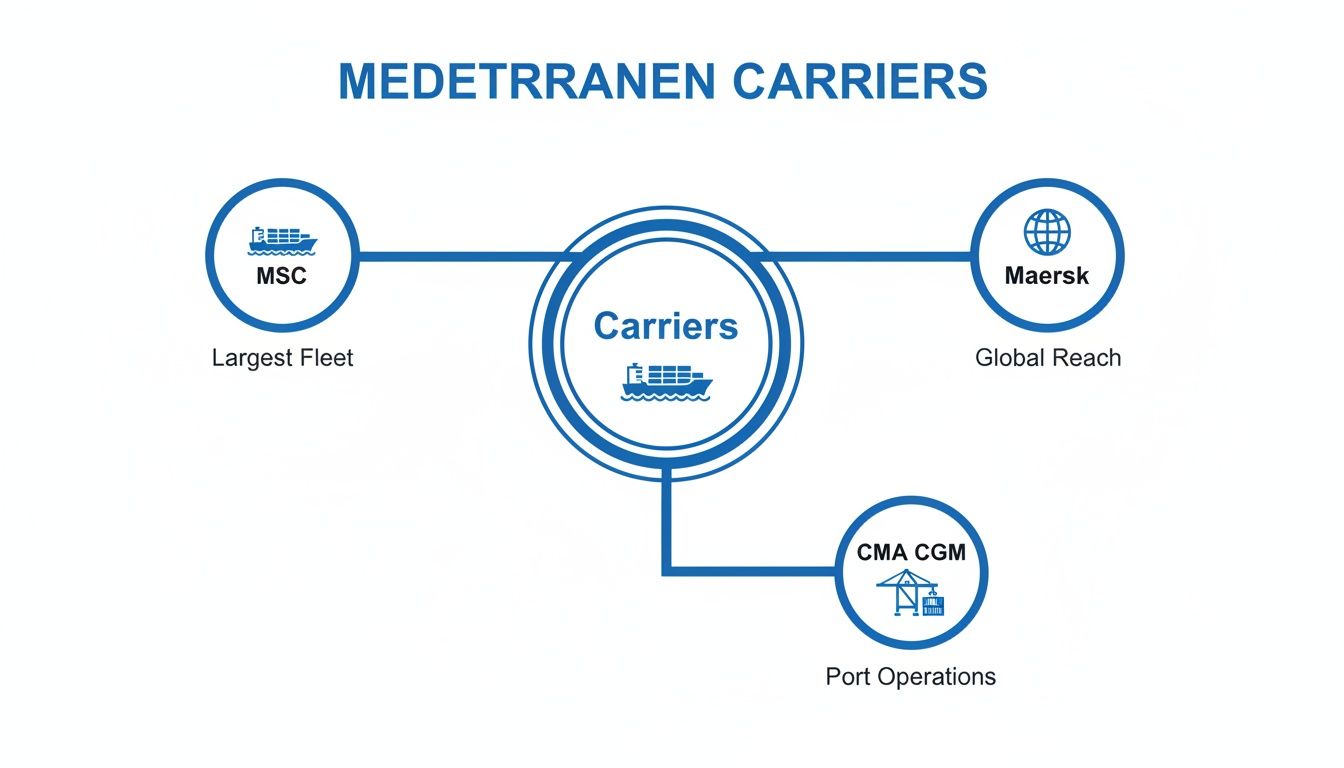
This just goes to show how a few key players anchor the region's shipping network, each playing to their own unique strengths and port strategies.
Crucial North-South and Intra-Med Routes
While the East-West lane grabs the headlines, the North-South corridors are the workhorses of regional trade. These routes connect the industrialised nations of Europe with the booming markets and resource-rich economies of North Africa.
The traffic here flows both ways. Northbound, you'll see a steady stream of commodities and raw materials. Southbound, the ships are filled with machinery, vehicles, and consumer goods, fuelling development across the African continent.
On top of that, a dense web of intra-Mediterranean routes acts as the region's local delivery network. These services, often run by specialised regional carriers, connect smaller ports and islands, making sure cargo from the big hubs gets to its final destination. This network is absolutely essential for getting goods distributed efficiently across all the different economies lining the sea.
Spotlighting the Nerve Centre Ports
Over time, a few ports have emerged as the undisputed nerve centres of the Mediterranean. These aren't just stops; they are highly sophisticated logistics hubs engineered for maximum efficiency. Their importance comes from a perfect mix of geography, world-class infrastructure, and seamless inland connections.
Three ports, in particular, stand out as the region’s premier transhipment hubs:
Port of Algeciras (Spain): Sitting right at the mouth of the Med near the Strait of Gibraltar, Algeciras is the first and last major European call for ships on the East-West lane. Its location makes it a natural sorting centre for cargo moving between Europe, the Americas, and West Africa.
Port of Valencia (Spain): Another Spanish powerhouse, Valencia offers incredible container handling capacity and fantastic road and rail links deep into the Iberian Peninsula and the rest of Europe. It's a critical gateway for imports heading to European consumers.
Port of Piraeus (Greece): Perfectly positioned in the Eastern Med, Piraeus has become the primary entry point for Asian goods destined for Central and Eastern Europe. Its modern infrastructure allows for the lightning-fast transfer of containers from huge ocean liners to smaller feeder vessels.
These hubs act like giant sorting machines. A single massive vessel might drop off thousands of containers, which are then rapidly reloaded onto dozens of smaller ships, each heading to a different final destination. This model squeezes every bit of efficiency out of the primary Mediterranean shipping line services.
Understanding what each port does best is critical. If a client needs to get goods into Central Europe, knowing that Piraeus has strong rail connections can shave days off the transit time. Likewise, for shipments involving Africa, Algeciras often offers the most direct route. This kind of granular knowledge is vital, especially when navigating complex setups like those managed by an importer of record.
Navigating Operational Challenges and Opportunities
Knowing the key players and trade lanes is one thing, but thriving in the Mediterranean shipping market is a whole different ball game. It’s about getting ahead of the real-world operational and commercial curveballs that can derail even the most carefully laid plans. We’re talking about everything from port logjams to the ripple effects of regional instability.
Mastering these factors is what separates a good freight forwarder from a truly great one. It’s about shifting from a reactive "firefighting" mode to a proactive, strategic mindset. That's how you advise clients with confidence and protect your margins in a market famous for its volatility. This practical knowledge is your best defence against the unexpected.
Tackling Port Congestion and Delays
Port congestion is a constant headache across the major Mediterranean hubs. When peak season hits, delays can snowball in a heartbeat. Just look at recent data from European ports, where wait times in hubs like Antwerp shot up from 32 hours to 44 hours in a matter of weeks—that’s a 37% jump. Delays like that create a domino effect, throwing vessel schedules, inland transport, and final delivery dates into chaos.
And this isn't just a local problem. The global transhipment hubs feeding into the Mediterranean are just as critical. Take the MSC-PSA Asia Terminal (MPAT) in Singapore, a massive cornerstone of MSC's Asian operations. Since growing from three berths in 2006 to seven by 2021, MPAT has become a mega-hub cranking through millions of TEUs a year. Its incredible efficiency, which keeps vessel dwell times under 1.5 days, is what keeps the vital Asia-Med trade lane moving. Any bottleneck there would send shockwaves across the entire network.
For forwarders, staying ahead of these logjams means you have to:
- Monitor Port Performance: Keep a close eye on turnaround times and be aware of any potential labour disputes at key hubs like Valencia, Algeciras, and Piraeus.
- Build Route Flexibility: Always have a Plan B. If Valencia is jammed, could a smaller Spanish port or even Marseille work as a temporary fix?
- Communicate Proactively: Tell your clients about potential delays before they become a problem. Better yet, come to them with a solution already in hand.
Managing Commercial Volatility
The commercial side of Mediterranean shipping is just as turbulent. Freight rates can swing wildly depending on seasonal demand, vessel capacity, and what's happening in the global economy. For example, the summer peak for agricultural exports out of Spain and Italy can make reefer containers scarce and send prices through the roof.
Managing this volatility requires a sharp commercial focus. It’s not just about finding the lowest price today, but about securing stable, reliable service for your clients over the long term.
What’s more, the moves made by major carrier alliances (like 2M or Ocean Alliance) have a huge impact. A decision by an alliance to skip a port call to get back on schedule can leave your client's cargo high and dry. Staying on top of these service changes is absolutely crucial for managing risk and giving your customers accurate transit times.
A smart approach mixes a few key strategies:
- Diversify Your Carrier Relationships: Never put all your eggs in one basket. Working with a mix of global giants and smaller, niche regional lines gives you far more options when capacity gets tight.
- Use Rate Management Tools: Platforms that provide real-time rate data are essential. They help you quote competitively while making sure you aren't sacrificing your own margins.
- Understand the Seasonal Rhythms: Know the market's pulse. For those agricultural exports, you need to be booking reefer space well in advance to dodge last-minute price shocks and equipment shortages.
How to Find Shipper Leads on Mediterranean Lanes
Knowing the carriers and trade lanes crisscrossing the Mediterranean is a great start, but how do you turn that market intelligence into actual business? For a freight forwarder, the constant hum of activity at ports like Valencia, Piraeus, and Algeciras is more than just commerce—it’s a live, flowing database of potential clients. The trick is knowing how to tap into it.
This is where a modern approach to prospecting makes all the difference. Forget cold calls and dusty contact lists. Today’s savvy logistics teams use customs data to see exactly which companies are moving goods along specific Mediterranean routes. It transforms lead generation from a guessing game into a precise, data-backed strategy, letting you focus only on prospects who have a proven need for your services.
From Data to Deals: A Modern Playbook
The old way of finding leads was a grind. You'd spend hours manually searching for companies, guessing who the right contact might be, and firing off generic emails that mostly went unanswered. Now, platforms built for logistics prospecting can do the heavy lifting, turning raw trade data into qualified, ready-to-contact leads in a fraction of the time.
This technology allows you to sift through the entire universe of shippers and zero in on your ideal clients. You can filter for companies based on criteria that actually matter to your business.
- By Port of Call: Instantly pull up a list of every company that has recently moved cargo through key Med hubs like Genoa or Marseille.
- By Commodity Type: Hone in on businesses shipping specific products, whether it's automotive parts out of Turkey or agricultural goods from Spain.
- By Shipping Line: Find companies that frequently use a particular Mediterranean shipping line, giving you a perfect, informed way to start a conversation.
This is what it looks like in practice—filtering a massive database of customs records to surface highly relevant shipper leads based on their real-world shipping patterns.

By using filters like these, you’re no longer just finding random companies. You're discovering businesses with a clear, active need for freight forwarding on the very lanes you specialise in.
Pinpointing the Right Decision-Makers
Of course, finding the right company is only half the battle. The next, crucial step is getting in front of the right person—the logistics manager, supply chain director, or procurement head who actually signs the contracts. A powerful prospecting platform takes the guesswork out of this by integrating contact data directly with the customs information.
This means once you’ve identified a promising shipper, you can instantly find the names, job titles, LinkedIn profiles, and verified email addresses of the key decision-makers. It’s a game-changer, saving you countless hours of manual research and ensuring your pitch actually lands in the right inbox.
The goal is to shift from broad, impersonal outreach to sharp, data-backed conversations. Mentioning a specific trade lane they use or a recent shipment shows you've done your homework and immediately signals that you understand their business.
This targeted approach dramatically boosts your chances of getting a response. If you're looking to build out your operation, you can learn more in our guide to starting an import-export firm.
Crafting Outreach That Converts
With a list of qualified leads and their direct contact info, the final piece is writing a message that actually gets read. This is where your market knowledge and data insights truly shine. Instead of a generic "we can handle your shipping" email, you can lead with undeniable value.
For example, since Mediterranean Shipping Company opened its Singapore office in 1996, it has become a cornerstone of Southeast Asia's logistics network. As the port handled a record 39.9 million TEU in 2024, Singapore's customs data has become a goldmine. Forwarders can see that MSC-handled shipments are up 15% year-over-year and then filter for leads on high-growth lanes like SG-Mediterranean (which makes up 12% of MSC's local traffic). Armed with this insight, you can send hyper-targeted emails to decision-makers in booming trade corridors. You can read more about MSC's data and its potential on Datalastic.com.
Here’s a simple, three-step framework for your outreach:
- Reference a Specific Data Point: Kick things off by mentioning their activity on a Mediterranean lane (e.g., "I noticed your company recently shipped from Valencia…").
- Offer a Clear Value Proposition: Connect their activity to a solution you provide (e.g., "…we specialise in that lane and have helped similar companies cut transit times by 15%.").
- End with a Simple Call to Action: Make it easy for them to say yes (e.g., "Would you be open to a brief chat next week to discuss your current setup?").
By combining powerful data tools with smart, personalised communication, you can transform your prospecting efforts on every Mediterranean shipping line and build a predictable pipeline of new business.
Your Top Questions About Mediterranean Shipping, Answered
Jumping into any major trade region will always stir up a few questions. The Mediterranean, with its unique mix of global superhighways and complex local networks, is certainly no different. If you're a freight forwarder looking to really get a handle on this market, getting clear, straightforward answers is the first step to building a winning strategy and advising your clients like a pro.
This section gets right to the point, tackling some of the most common questions about operating on a Mediterranean shipping line. We'll cover everything from the key ports to the commercial realities on the ground, giving you practical insights you can use immediately. Think of it as your quick-reference guide for sharpening your focus and making smarter decisions.
Which Are the Biggest Transhipment Hubs in the Mediterranean?
When it comes to transhipment, three ports stand out as the undisputed heavyweights and strategic nerve centres of the Mediterranean: the Port of Valencia and the Port of Algeciras in Spain, and the Port of Piraeus in Greece. These three hubs truly form the backbone of the region's container logistics.
It's no accident they're on top. The major carriers all favour them for a few critical reasons: they have deep-water berths that can handle the biggest vessels on the water, they're kitted out with advanced cargo-handling tech, and they run massive feeder networks. These networks are the real secret sauce, acting like spokes on a wheel to connect the hubs with hundreds of smaller ports all over the Med, North Africa, and the Black Sea.
Their geographic locations are also perfect, acting as natural pivot points for cargo flowing between Asia, Europe, and the Americas. For a freight forwarder, tapping into these hubs unlocks a huge number of routing options. But be warned—it also means you need to plan carefully to get ahead of potential congestion, which can snarl things up fast during peak season.
How Do Carrier Alliances Affect My Options on Mediterranean Shipping Lines?
Carrier alliances like 2M, Ocean Alliance, and THE Alliance have a massive impact on services across every Mediterranean route. By letting carriers pool their resources and share vessel space, these partnerships offer some serious upsides, like much broader port coverage and more frequent sailings than any single line could ever manage on its own.
For you as a freight forwarder, that translates directly into more choices and, often, better rates for your clients. You get to tap into a combined network with incredible reach. The flip side, however, is that this consolidation can water down the service differences between carriers in the same alliance. The vessel might be operated by one line, but it’s probably carrying boxes for all its alliance partners.
This tight integration also creates a shared risk. A major disruption hitting one member—say, a port strike or a big vessel delay—can trigger a domino effect, throwing off the schedules of every partner on that service loop. It's crucial to know who's allied with whom when you're quoting options to a shipper so you can manage their expectations.
What Are the Primary Commodities Shipped on Mediterranean Routes?
The cargo mix flowing through the Mediterranean is incredibly diverse, which makes sense given the varied economies it connects. You can generally break down the commodity flows by direction, which is a great way to understand what the market needs.
- Eastbound traffic leaving Europe for Asia and beyond is often packed with high-value manufactured goods, chemicals, pharmaceuticals, and specialised machinery.
- Westbound traffic coming in from Asia is dominated by consumer electronics, clothing, furniture, toys, and all sorts of other finished goods heading for European shelves.
- Intra-Mediterranean trade is full of agricultural products. We're talking olive oil from Greece, wine from Italy, and fresh produce from Spain, plus a lot of automotive parts moving between different manufacturing plants.
- North-South trade between Europe and Africa typically sees commodities like cocoa, oil, and minerals heading north, with vehicles, industrial equipment, and consumer goods flowing south.
Knowing these cargo flows is more than just trivia. For a forwarder, it's a prospecting roadmap. It helps you target specific industries and companies that you know have a real need for logistics services on these lanes.
How Can I Find Reliable Routing Information for Mediterranean Services?
Let's be honest: manually checking every carrier's website for schedules and routes is a slow, painful, and outdated way of doing things. In a market where speed and accuracy give you the edge, you need a much better solution to stay in the game.
The most effective way forward is using logistics platforms that pull in multi-carrier routing insights. For example, tools that plug into services like Routescanner give you a complete picture of the market on a single screen. This lets you compare end-to-end routing options—including transit times, service frequencies, and intermodal connections—across different shipping lines all at once.
A tool like this gives you the power to build competitive and solid quotes for shippers using real-time, consolidated data. It's worlds better than trying to piece everything together from ten different sources, helping you answer client requests faster and with a lot more confidence.
Ready to transform your prospecting strategy on Mediterranean shipping lines? With Coreties, you can access verified customs data to find high-value shippers, identify key decision-makers, and craft data-driven outreach that gets results. Stop guessing and start connecting with qualified leads today. Discover your next opportunity at Coreties.