Your Guide to a Modern Import and Export Business
At its heart, an import and export business is all about connecting the dots on a global map. It’s the essential link that gets products from a manufacturer in one country into the hands of a customer in another. This line of work is far more than just moving boxes; it's a dynamic field that […]
At its heart, an import and export business is all about connecting the dots on a global map. It’s the essential link that gets products from a manufacturer in one country into the hands of a customer in another. This line of work is far more than just moving boxes; it's a dynamic field that involves managing complex logistics, navigating a maze of regulations, and strategically building profitable trade routes.
Understanding the Global Trade Ecosystem
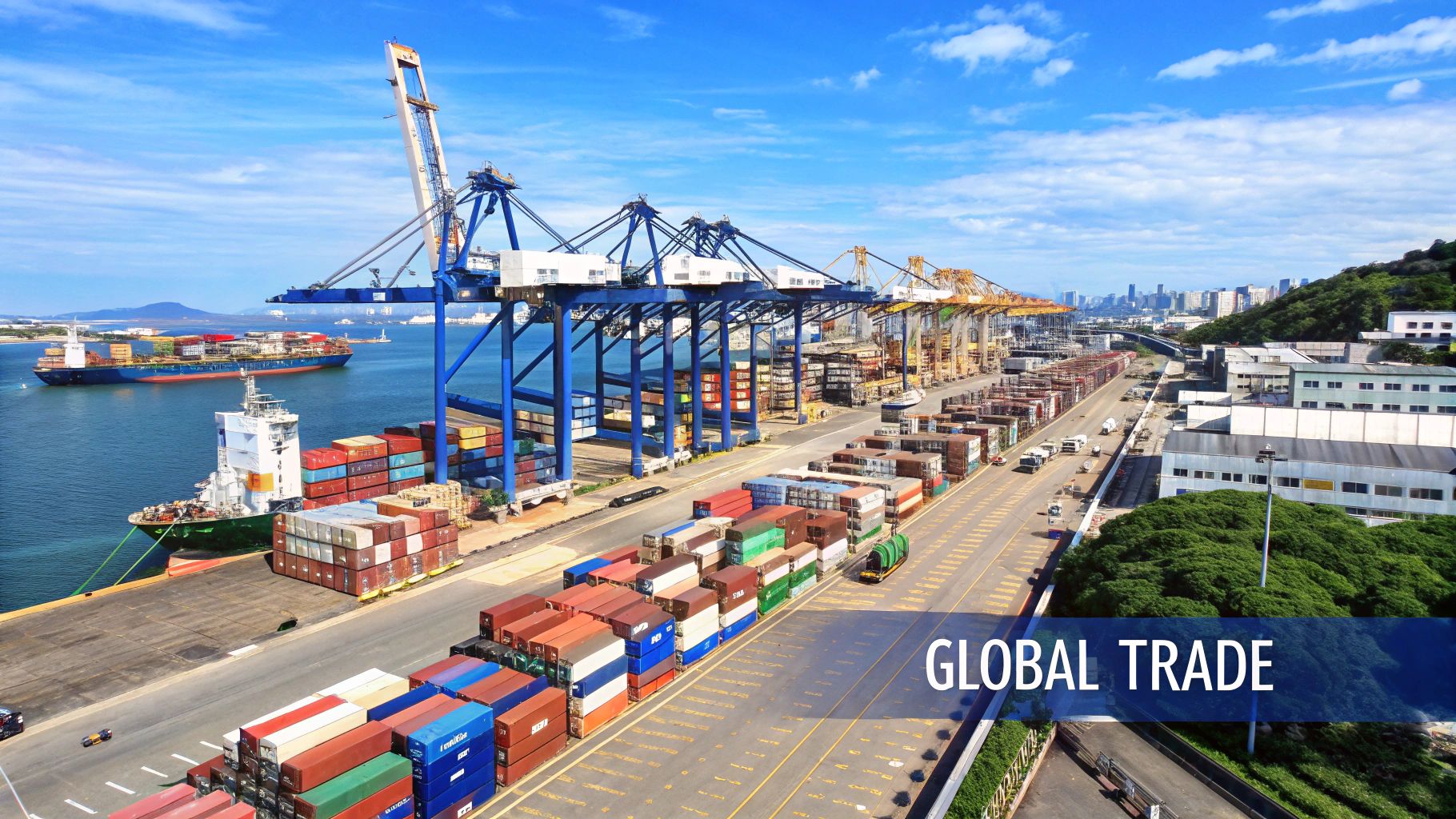
Think of the global economy as a sprawling, bustling marketplace. The import-export business acts as the network of roads, shipping lanes, and flight paths that allows this marketplace to thrive. It ensures that the electronics assembled in one part of the world can reach a store shelf thousands of miles away.
This whole system is driven by the timeless principles of supply and demand. One country might have a surplus of coffee beans, while another is a leader in producing high-tech machinery. The job of an import-export professional is to spot these opportunities and create value by bridging the gap between supply and demand across borders.
The Key Players and Their Roles
To succeed in this industry, you have to understand who does what. The global supply chain is a finely-tuned machine, and if one part fails, the entire process can grind to a halt, leading to costly delays and unhappy clients.
The entire process hinges on a handful of key players, each with a specific job to do. Without this clear division of labour, getting a product from Point A to Point B would be nearly impossible. Let’s look at who’s who in this ecosystem.
Key Players in the Import and Export Ecosystem
| Player | Core Function | Primary Responsibility |
|---|---|---|
| Exporter | Seller/Producer | Finds international markets and ships goods out of their home country. |
| Importer | Buyer/Distributor | Brings foreign goods into their country for resale or manufacturing. |
| Freight Forwarder | Logistics Coordinator | Arranges the entire shipping process, from booking cargo space to managing documentation. |
| Customs Broker | Compliance Specialist | Ensures shipments clear customs by preparing and submitting required declarations and paying duties. |
| Carrier | Transportation Provider | Physically moves the goods via sea, air, rail, or road (e.g., shipping lines, airlines). |
As you can see, each player has a critical role that keeps the gears of global trade turning. It's a team sport. While these roles are distinct, a single company can sometimes wear multiple hats, acting as both an importer and an exporter. For a closer look at their specific functions, you can learn more about the differences between an exporter and importer in our detailed guide.
Let's quickly unpack the three most central roles:
- Exporters: These are the sellers. They could be manufacturers or producers looking to expand their reach beyond their own country's borders and tap into new international markets.
- Importers: These are the buyers. They might be retailers sourcing products to sell in their stores, or a factory that needs raw materials from abroad to make their own goods.
- Freight Forwarders: Think of them as the travel agents for cargo. They don't own the ships or planes, but they are the logistics experts who orchestrate the entire journey, finding the best routes and rates to get goods from origin to destination smoothly.
At its heart, global trade is about connection and coordination. A successful import and export business excels not just at buying and selling, but at managing the intricate web of relationships between suppliers, buyers, and logistics partners to deliver goods efficiently and reliably across the globe.
This collaboration is what fuels international commerce. It's not just for massive corporations, either. In 2022, small and medium-sized businesses were responsible for an incredible 43% of the United States' exported goods. Every one of those businesses relied on this ecosystem of importers, exporters, and forwarders to connect with their customers. Understanding how these pieces fit together is the first step to navigating this exciting industry.
Choosing the Right Business Model for You
Starting an import and export business isn't a case of just picking a product and finding a buyer. The way you structure your business—your model—is the bedrock of your entire operation. It dictates how much money you need to start, the risks you’ll face, and how you'll make your profits.
Think of it as choosing your role in the global supply chain. Are you the hands-on owner of the goods, a strategic sales partner, or a well-connected dealmaker? Each path has its own challenges and rewards. Let's dig into the three main models to see which one lines up with your resources and ambition.
The Export Management Company (EMC)
Imagine you're the outsourced international sales team for a local company. That’s essentially what an Export Management Company (EMC) does. You don't buy the products yourself. Instead, you represent domestic businesses that want to go global but don't have the know-how or the people to pull it off.
Your job is to do the heavy lifting: find overseas buyers, craft the marketing strategy, handle the tangled web of logistics, and manage all the export paperwork. Your income comes from a commission on the sales you close. For example, an EMC in Singapore might team up with local snack makers to get their products onto shelves in Australia and the Middle East, managing everything from brand positioning to the final shipment.
The EMC model is a fantastic starting point if you're a natural salesperson with a flair for international marketing. It’s a lower-risk way to get your foot in the door because you’re not shelling out cash for inventory.
Your main investment here is time, effort, and building a solid network. It’s an excellent way to learn the ropes of international trade without the financial headache of holding stock.
The Import/Export Merchant
This is what most people picture when they think of an import/export business. As a merchant, you're a direct player, buying goods from a manufacturer in one country and selling them in another. You take full ownership of the products, from the factory floor to the customer's hands.
This means you're on the hook for everything—paying for the goods upfront, arranging and insuring the freight, and, most importantly, finding someone to buy it all. It’s a high-stakes game. But with that higher risk comes the potential for a much bigger payoff. Since you own the inventory, you set the price and keep the entire profit margin.
A perfect example is a merchant who spots a growing trend for sustainable bamboo furniture in Europe. They’d buy a container load directly from a supplier in Vietnam, handle the import process into Germany, and then sell the furniture to retail chains or even directly to shoppers online.
- Pros: High profit potential and total control over your products and pricing.
- Cons: Needs a serious amount of starting capital and carries a high risk if the products don't move.
- Best For: Entrepreneurs with solid financial backing and a very strong belief in their chosen product and market.
The Agent or Broker
The agent or broker is the ultimate matchmaker. In this model, you never touch or own the goods. Your entire business is built on connecting a buyer who needs something with a seller who has it. Once the deal is done, you collect a commission or a flat fee for making the introduction.
Financially, this is the leanest and lowest-risk way to operate. Your greatest assets are your contact list and your reputation for being reliable. For instance, a broker might find out a large construction firm in Singapore needs a specific grade of steel beams. They then use their network to connect the firm with a manufacturer in South Korea that can produce them. Once the contract is signed, the broker gets paid their agreed-upon fee.
So, which path is yours? It all comes down to your personal circumstances. A broker can get started with little more than a phone and a solid network. A merchant, on the other hand, needs a detailed business plan and deep pockets. Take a hard look at your capital, your contacts, and your appetite for risk to choose the model that gives your new import and export business the best shot at success.
Getting to Grips with International Compliance and Paperwork
Diving into the world of import/export means you’ve got to learn the language of global trade. This isn't about speaking French or Mandarin; it's about mastering the language of documents, codes, and very specific rules. It might look like a mountain of paperwork at first, but every single document has a vital job to do. Think of them as passports for your products, letting them move smoothly from one country to another.
Nailing this part of the business isn't just about ticking off boxes on a checklist. It's about keeping your shipments moving, dodging hefty fines, and building a solid reputation for being a reliable operator. Get it wrong, and your cargo could be stuck in a customs warehouse for weeks, racking up storage fees and leaving your customers seriously unhappy. Get it right, and you turn a massive potential headache into a real competitive edge.
The Must-Have Documents for Any Shipment
Every international shipment, no matter how big or small, relies on a core set of documents. These papers tell the complete story of your goods: who sent them, what they are, where they're headed, and what they're worth. They are the absolute foundation of trade compliance.
Let’s break down the big three:
- Commercial Invoice: This is your main bill of sale. It lays out the products, their value, and the payment terms agreed between you and the buyer. Customs officials use this to figure out exactly how much duty and tax is owed.
- Bill of Lading (B/L) or Air Waybill (AWB): Essentially, this is the contract between you (the owner of the goods) and the shipping company. It does three things: acts as a receipt for the cargo, confirms the transport agreement, and serves as the document of title—meaning whoever has the original B/L owns the goods.
- Packing List: This is a detailed inventory of everything inside your shipment. It breaks down the contents of each carton, including weights and dimensions. This helps customs officers check your cargo quickly without having to rip everything open.
While these three are the bedrock, you might need extra paperwork like a Certificate of Origin or special import licences, depending on what you're shipping and where it's going.
Your paperwork is basically the shipment's DNA. The Commercial Invoice is its financial identity, the Bill of Lading is its travel history, and the Packing List is its physical makeup. Together, they create a clear, verifiable story that keeps customs happy and your goods on the move.
Speaking the Universal Language of Trade
Once you've got the basic documents down, there are two universal systems you need to understand to trade effectively: Harmonized System (HS) codes and Incoterms. Knowing how these work is non-negotiable for accurate customs declarations and crystal-clear contracts. They prevent the kind of simple misunderstandings that can completely derail a shipment.
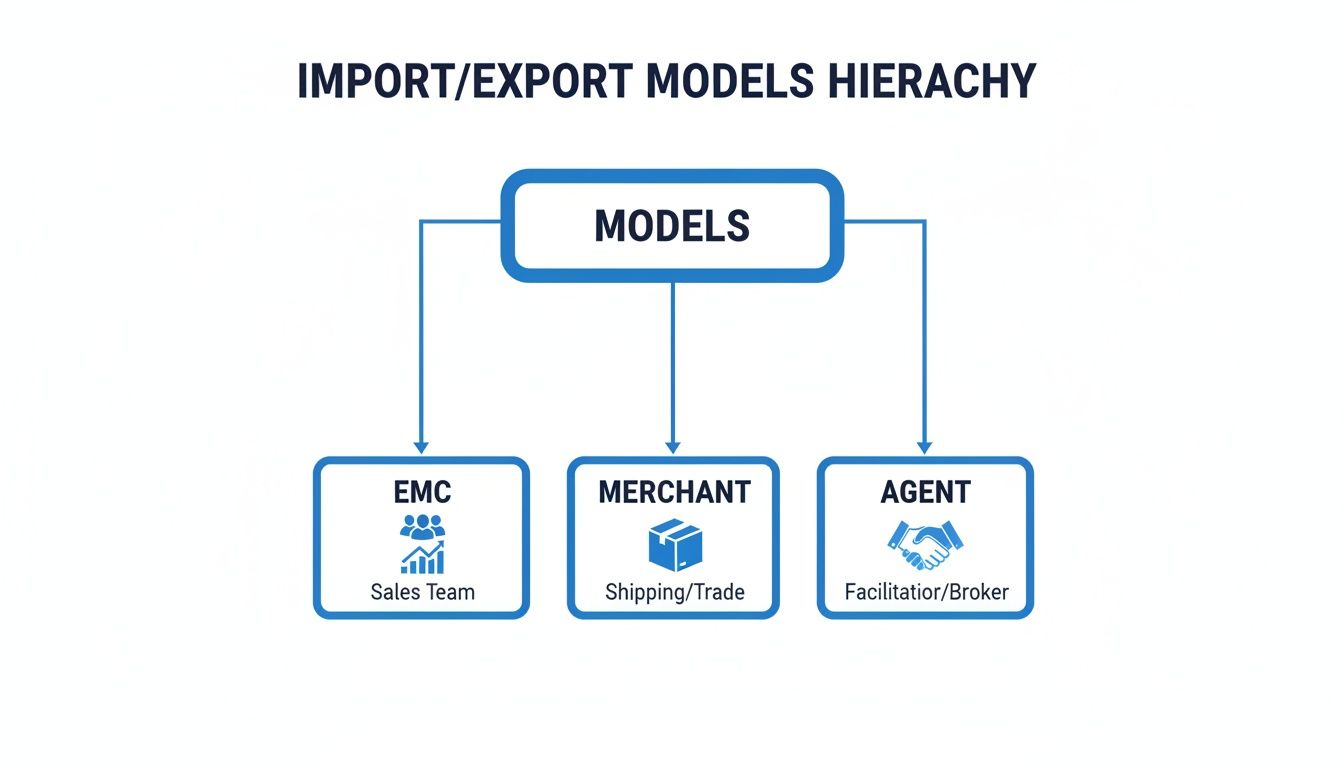
This image helps to visualise the different hats you can wear in this industry, which we touched on earlier. Each role, from the hands-off Agent to the all-in Merchant, comes with its own set of responsibilities when it comes to logistics and compliance.
What Are HS Codes?
Think of the Harmonized System (HS) Code as a universal barcode for every product on the planet. It's a global standard that customs authorities use to classify goods and apply the correct duties and taxes. Getting this code right is absolutely critical. One wrong digit can get your shipment flagged, re-inspected, and slapped with surprise fees.
Demystifying Incoterms
Incoterms are a set of official commercial terms that define the responsibilities of sellers and buyers. Published by the International Chamber of Commerce (ICC), these simple three-letter codes (like FOB, CIF, or EXW) spell out exactly who is responsible for the goods at every step of the journey. They clarify who pays for shipping, insurance, and customs clearance, and precisely when the risk transfers from one party to the other. Agreeing on the right Incoterm from the start is key to avoiding arguments and financial headaches down the line.
Mastering these systems gives you the confidence to navigate the often-choppy waters of global trade. For a deeper dive into who holds the legal liability at the border, it’s also useful to understand the Importer of Record and its compliance duties.
Mastering Logistics and Choosing Your Partners
Once your paperwork is in order, the next mountain to climb is the physical journey of your goods. Logistics is the real engine of your import and export business—the incredibly complex art of moving products across oceans, continents, and borders.
Figuring out the right way to ship and picking the best partners to handle it is one of the most critical decisions you'll make. It’s a constant balancing act between speed, cost, and the nature of your cargo. Get it wrong, and you could see your profit margins vanish or face reputation-damaging delays.
Selecting Your Mode of Transport
At its core, there are three main ways to move goods around the world: by sea, air, and land. Understanding the trade-offs of each is the key to building a supply chain that's both cost-effective and reliable enough to keep your customers happy.
- Ocean Freight: This is the undisputed workhorse of global trade, responsible for moving over 80% of all international goods by volume. It's by far the cheapest option for large, heavy, or non-urgent shipments, but you pay for that with time—it’s also the slowest.
- Air Freight: When speed is everything, you turn to air freight. It’s the go-to for high-value, perishable, or time-sensitive goods. Just be prepared for the price tag, as this premium service comes at a significantly higher cost.
- Land Freight: Using trucks and trains, land freight is essential for moving goods within a continent or across the border to a neighbouring country. It offers a great mix of flexibility and decent speed for regional trade.
Often, the smartest solution isn't just one of these but a combination, a strategy known as intermodal transport. A classic example is having goods arrive at a port via a container ship and then finish their journey to an inland warehouse by truck.
The Critical Role of a Freight Forwarder
Think of a freight forwarder as the travel agent for your cargo. They are the logistics experts who take on the headache of managing the entire shipping process for you, navigating the maze of international transport so you don’t have to.
A great freight forwarder does much more than just book space on a ship or plane. They are the orchestrator of the entire journey. They’ll negotiate freight rates, arrange the transport, prepare documentation, and track your shipment from start to finish. For any serious import and export business, this partnership is absolutely vital.
A reliable logistics partner is more than a vendor; they are an extension of your business. Their expertise can save you money, prevent costly delays, and provide the operational backbone needed to scale your global trade activities effectively.
Choosing the right one isn't about chasing the lowest price. You need a true ally with a solid global network, modern tracking technology, and genuine expertise in the specific trade lanes you'll be using.
Vetting Your Logistics Partners
A strong supply chain is built on carefully chosen partners. When you’re evaluating freight forwarders or carriers, you need to dig deeper than just the price on the quote. You're assessing their capability, their reliability, and the quality of their service to ensure your goods are in safe hands.
Here’s what to look for during your selection process:
- Experience and Specialisation: Have they handled your type of product before? Do they have a proven track record in the countries you’re shipping to and from? A forwarder that excels with perishable goods will have a completely different skillset than one that focuses on heavy machinery.
- Network and Reach: A strong global network of agents and partners isn’t just a nice-to-have; it’s essential. This ensures they can manage your shipment smoothly from door to door, even when things go wrong.
- Technology and Visibility: Can they give you real-time tracking and clear updates? Modern logistics runs on data, and you need a partner whose systems give you a clear window into where your shipment is at all times.
- Customer Service and Communication: When a problem pops up—and it will—you need a partner who is responsive and proactive. Check their reviews and ask for references to see how they handle pressure.
This vetting process helps you build a resilient business. This is especially true in a major hub like Singapore, a nation whose economy lives and breathes global trade. In 2022, Singapore's exports of goods and services hit an astonishing 186.55% of its GDP, a figure that speaks volumes about the logistics expertise required to manage that flow. You can find more about Singapore's powerful trade ecosystem on Statista. By choosing partners with a proven track record in such demanding environments, you're setting your own business up for success.
Finding Profitable Products and Untapped Markets
Any successful import and export business is built on a foundation of smart choices. While passion for a product certainly helps, the businesses that last are launched with solid, verifiable data, not just a gut feeling. Guesswork is an expensive habit in this industry; making calculated decisions from day one is what sets you up for real growth.
The trick is to start thinking less like a speculator and more like a market analyst. Instead of asking, "What products do I like?" the better question is, "Where is there proven demand that isn't being properly met?" The answers are hiding in plain sight, buried within global trade statistics and customs data. This information is essentially a map of the global marketplace, showing you exactly what’s moving, where it’s going, and who is moving it.
Using Data to Spot Opportunities
Global customs data gives you a surprisingly transparent look into the supply chains of businesses all over the world. By digging into this information, you can essentially reverse-engineer successful trade routes. You can see which companies are importing specific goods over and over, pinpoint high-volume shipping lanes, and uncover niches your competitors have completely overlooked.
Think of it this way: instead of trying to find a needle in a haystack, you get a magnet that pulls the needle right to you. This kind of intelligence points you towards genuine market needs, helping you avoid sinking cash into products with weak demand or trying to muscle into markets that are already saturated.
This data-driven approach lets you:
- Identify High-Demand Products: See which commodities are being imported or exported in huge volumes to specific countries.
- Analyse Competitor Activity: Uncover who your competitors are shipping to and from, giving you a peek into their core markets.
- Find Underserved Niches: Discover products with growing demand but only a handful of established suppliers in a particular region.
- Validate Business Ideas: Confirm there’s a real, existing market for a product before you invest a single dollar.
From Raw Data to Actionable Insights
Of course, just having the data isn't enough; you need to know what to do with it. Let's say a freight forwarder analyses customs records and finds a company that imports large quantities of electronic components from Taiwan to Singapore every month. This isn't just a random fact—it's a qualified lead. Armed with this knowledge, the forwarder can approach that importer with a very specific, value-driven proposal.
The most powerful move you can make in the import and export business is replacing "I think" with "I know." Data intelligence transforms your strategy from hopeful guesses into targeted actions based on real-world shipping activities.
This level of detail makes your outreach immediately relevant. You can reference their exact shipping needs in your first conversation, which makes your business sound well-informed and genuinely capable of solving their specific logistics challenges.
This approach works especially well in sophisticated trade hubs. Take Singapore, for example. Its merchandise trade landscape reveals a clear structure that creates specific opportunities for freight forwarders. In 2021, Singapore's total imports were valued at over $406 billion USD. The commodity data shows that electrical machinery made up the lion's share of these imports at $137.87 billion, with industrial machinery following at $59.91 billion.
These categories create consistent, high-volume shipping demand, meaning steady business for forwarders who specialise in machinery and high-tech logistics. You can explore more of Singapore's trade statistics on globalEDGE to see for yourself.
By diving into these numbers, you get to skip the generic sales pitches. You can start conversations based on a clear understanding of a potential client’s business, which is how you build the foundation for a strong, long-term partnership. This is how a modern import and export business thrives.
Using Trade Data to Generate High-Quality Leads
For any logistics pro, global trade data isn't just for market research—it's a goldmine brimming with qualified leads. An import and export business is built on relationships, and this data is basically a treasure map pointing you straight to the most valuable connections. It lets you ditch the cold calls and start having strategic, informed conversations that build real trust and, ultimately, win business.
Think about it. This completely flips the script from guessing who might need your services to knowing exactly who does. By digging into customs data, a freight forwarder can spot a company that's consistently importing goods on a specific lane, find the right person to talk to, and craft a message that actually resonates.
Imagine knowing precisely what a potential client ships, how often they ship it, and from which port. That knowledge allows you to approach them not with a generic "we move freight" pitch, but with a highly specific solution. You can point out a more efficient route or a cost-saving opportunity in your very first email, showing your value right from the get-go.
Turning Data into Actionable Opportunities
The whole process kicks off when you start spotting patterns in shipping manifests and bills of lading. For instance, a sharp freight forwarder might notice a huge volume of automotive parts flowing into Singapore from Germany. That single insight is a powerful jumping-off point for prospecting.
From there, they can use a platform like Coreties to dive deeper, filtering these shipments to pinpoint the exact companies involved. Instead of casting a wide, inefficient net, they can zoom in on businesses that match their ideal customer profile—maybe those shipping at a certain frequency or volume.

This is what turning raw data into an organised prospect list looks like. With just a few clicks, a sales professional gets a clear view of who's shipping what, and from where, transforming a sea of information into a clear list of potential clients.
Crafting a Data-Driven Outreach
Once you’ve zeroed in on a promising prospect, it’s time for targeted outreach. The data you’ve gathered gives you all the context you need to make your message personal and genuinely relevant. It even helps you find verified contact details for the actual decision-makers, like a logistics manager or supply chain director.
So, instead of a generic email, your outreach could look something like this:
"Hi [Contact Name], I noticed your company regularly imports automotive components from Hamburg to Singapore. We specialise in this trade lane and have helped similar businesses reduce their transit times by up to two days. Would you be open to a brief chat about optimising this route?"
This approach works so well because it’s grounded in the prospect's real, day-to-day business activities. It shows you've done your homework.
This method is especially powerful in major trading hubs. Take Singapore, for example—it's a massive player, with exports hitting S$60.95 billion in a single recent month. That trend is set to continue, which means there are huge opportunities for forwarders who can pinpoint the right clients within this massive market.
By using data, you’re swapping speculation for certainty. If you want to dig deeper into finding and verifying a company's shipping activities, check out our guide on how to look up a company's import and export history.
Frequently Asked Questions
Jumping into global trade for the first time? It's natural to have a few questions. Let's break down some of the most common ones that come up when people are looking to start their own import and export business.
How Much Money Do I Need to Start?
This is the big question, and the honest answer is: it depends entirely on the path you choose. Your starting capital will land in one of three buckets.
- Low Capital (Agent/Broker): This is the most accessible route. Since you're not buying any stock yourself, your main costs are for setting up the business, a bit of marketing, and building your network.
- Moderate Capital (EMC): As an Export Management Company, you'll need a bit more cash. Think marketing campaigns, travel to meet clients, and general running costs. The good news is you still don't have the huge expense of purchasing goods.
- High Capital (Merchant): Taking the merchant path requires the most significant investment, by far. You’ll need a healthy bankroll to buy inventory upfront, pay for international shipping, cover customs duties and taxes, and possibly handle warehousing.
To get a real number, you absolutely need to create a detailed business plan. Map out every single cost you can think of, from sourcing your first product to getting it into the customer's hands.
How Do I Find Reliable Suppliers and Buyers?
Your entire business is built on the quality of your partners. Finding trustworthy suppliers and buyers is everything, and it takes a bit of legwork and smart vetting.
A fantastic place to start is by visiting international trade shows for your specific industry. Nothing beats a face-to-face meeting. Online B2B platforms like Alibaba and Global Sources are also incredibly useful, but you have to do your homework. Always ask for references, dig into their business history, and—this is non-negotiable—order samples before you even think about a large order.
Finding the right partner isn't just a transaction; it's a strategic alliance. A reliable supplier ensures product quality, while a dependable buyer ensures steady cash flow. Both are critical for long-term stability and growth in the competitive world of global trade.
What Are the Biggest Risks in This Business?
The biggest headaches in global trade usually come from three areas: logistics, money, and red tape. Supply chain meltdowns, like a backed-up port or a delayed ship, can cost you a fortune. On the finance side, currency exchange rates can swing wildly and take a surprise bite out of your profits.
Another major risk is simply not getting paid. To avoid this, insist on secure payment methods like a Letter of Credit (L/C). This is essentially a guarantee from a bank that you'll get paid once you've held up your end of the deal. And always, always get comprehensive cargo insurance to cover your goods if they get lost or damaged on their journey.
Finally, you have to be meticulous about customs rules. One tiny mistake on a form can lead to hefty fines and your shipment being stuck for weeks. The best way to sidestep these issues is to work with experienced freight forwarders and customs brokers. They know how to navigate the system and keep your business moving smoothly.
Ready to turn global trade data into high-quality leads? Coreties helps you find and connect with the right shippers, turning market intelligence into real business opportunities. Discover your next customer today at https://coreties.com.