Mastering Sales Intelligence Tools for Logistics
You can feel the old logistics sales routine wearing your team down. A rep gets a spreadsheet of importers, searches LinkedIn, calls the main switchboard, reaches the wrong contact, leaves a voicemail, sends a generic email, and repeats it all afternoon. By Friday, there's activity everywhere and very little pipeline that deserves a forecast discussion. […]
You can feel the old logistics sales routine wearing your team down. A rep gets a spreadsheet of importers, searches LinkedIn, calls the main switchboard, reaches the wrong contact, leaves a voicemail, sends a generic email, and repeats it all afternoon. By Friday, there's activity everywhere and very little pipeline that deserves a forecast discussion.
That approach breaks down fast in freight. Shippers don't buy because you called first. They buy because you understood their lane, recognized a service gap, reached the right person, and made a relevant offer before another forwarder did. In logistics, timing and context beat volume.
That's why sales intelligence tools matter. Used well, they replace blind prospecting with a working view of who ships what, where they move it, who likely owns the decision, and when outreach has a real reason behind it.
The End of Cold Calls in Logistics
A freight rep once could get away with persistence alone. Buy a list, call through the front desk, ask for the transportation manager, and hope the account had a tender coming up. Today that method burns hours and creates noise. Most logistics teams already know the pain. The problem isn't effort. It's weak targeting.
In freight forwarding and carrier sales, the bad version of prospecting looks familiar:
- Wrong company fit: Reps chase businesses that don't move the modes, origins, or volumes the team serves well.
- Wrong contact level: They find a CEO or founder when the conversation belongs with procurement, transportation, import operations, or supply chain.
- Wrong timing: Outreach lands after a routing decision is already made, after a contract is locked, or during a period when the shipper isn't reviewing providers.
- Wrong message: Emails talk about “end-to-end logistics solutions” instead of a concrete lane, customs pattern, or service issue the prospect already feels.
That's why the old playbook produces motion, not momentum.
A better workflow starts before the first email. Reps build a target list from actual shipping behavior, narrow by trade lane or product movement, identify decision-makers, and then tailor outreach around the account's logistics reality. If your team still struggles with contact discovery, this guide on how to find decision-makers in target accounts is a practical place to tighten the front end of the process.
Practical rule: In logistics sales, a smaller list with real lane relevance usually beats a larger list built from generic industry filters.
Cold calling isn't dead because calls stopped working. It's ending because random calls stopped working. The teams winning freight contracts aren't just working harder. They're entering conversations with better data.
What Sales Intelligence Means for Freight and Shipping
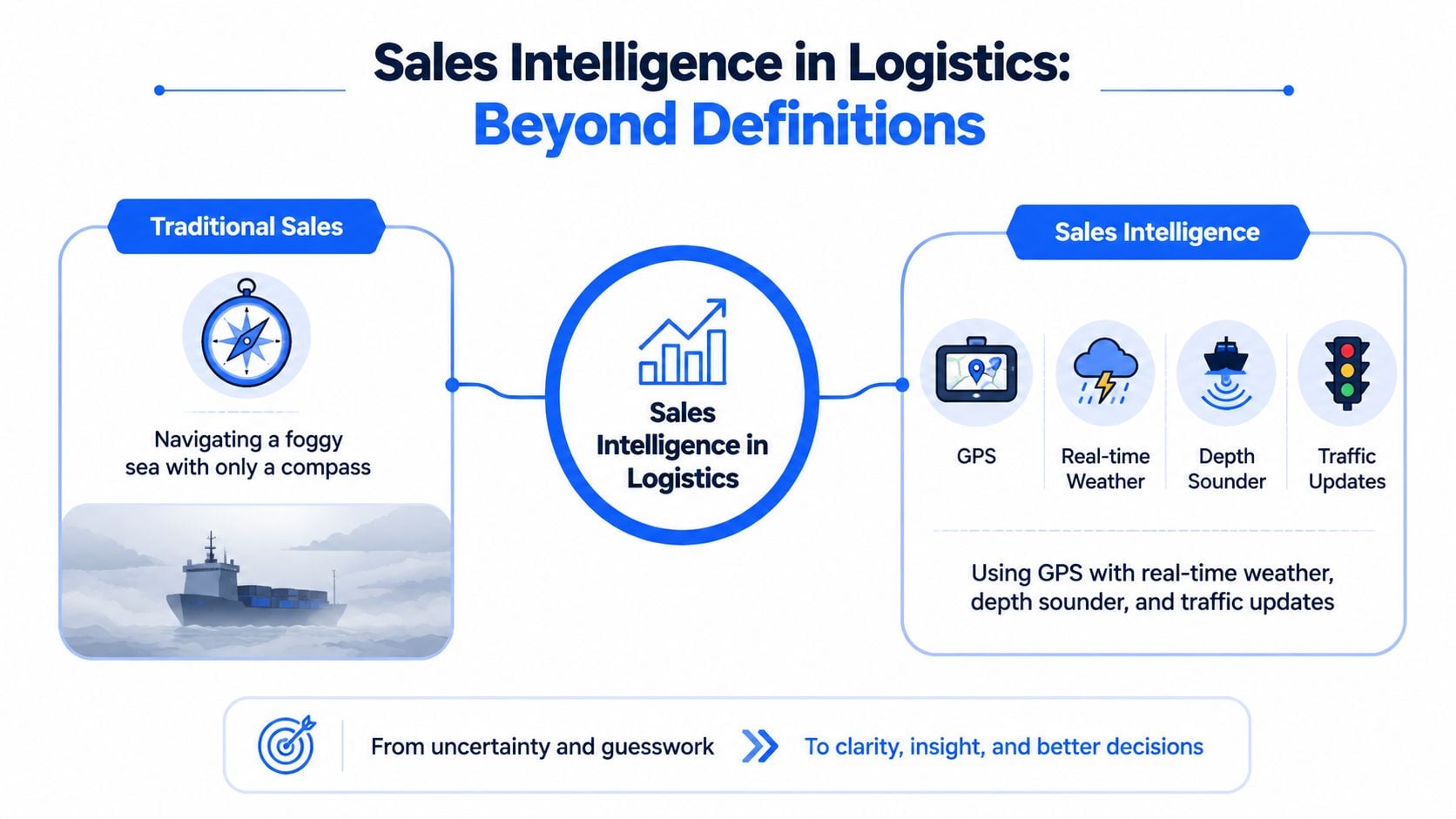
For logistics teams, sales intelligence is the difference between a paper road atlas and a live satellite navigation system. The atlas tells you where roads exist. The live system shows traffic, weather, detours, and which route still makes sense right now. Freight sales works the same way.
Traditional prospecting gives you names and company records. Modern sales intelligence tools give you operating context.
According to Outreach's explanation of what sales intelligence is, the category evolved from simple databases into platforms that combine contact data, firmographics, intent signals, and CRM integrations. IBM describes it as the systematic collection of data to improve sales. In practical terms, that means a logistics seller can stop treating prospecting as list building and start treating it as account selection.
From records to operating insight
A generic contact database might tell you a company is an importer in the consumer goods space. That's not enough to win freight. A logistics-focused intelligence workflow should help your team answer better questions:
- What does this shipper move?
- Which origin-destination patterns matter most to them?
- Who likely owns forwarding, carrier procurement, or customs coordination?
- What changed recently that makes outreach relevant now?
That last point is where average prospecting falls apart. Reps often know who the company is, but not why the account deserves attention this week.
Why the definition matters in logistics
In freight, relevance comes from operational context. If you know a shipper's likely lanes, mode preferences, geography, and internal buyer roles, you don't send a vague introduction. You lead with a useful point of view. That could be a consolidation opportunity, a service alternative, a routing idea, or a faster way to cover a problematic lane.
Sales intelligence in logistics isn't about owning more records. It's about turning fragmented market information into a reason to contact a shipper.
That's also why generic B2B advice often misses the mark for freight teams. Logistics sellers need more than titles and email addresses. They need a current view of trade flow, account fit, and buying context. Without that, prospecting stays reactive.
Must-Have Features and Data Sources for Logistics Sales
A logistics sales team shouldn't buy a general database and assume it becomes industry-specific because a vendor added “transportation” as a filter. Freight sales needs deeper operating data. If the platform can't help your reps understand lanes, shipment patterns, and supply chain ownership, it won't change performance in a meaningful way.
The strongest sales intelligence tools work because they join multiple data layers. IBM's overview of sales intelligence notes that contact, firmographic, intent, and deal signals become more useful when fused into one view, and that machine learning can use historical sales data to rank accounts by fit and buying likelihood. For logistics teams, that matters because no single dataset explains whether an account is worth pursuing.
What logistics teams actually need
Here are the capabilities that move the needle in freight sales.
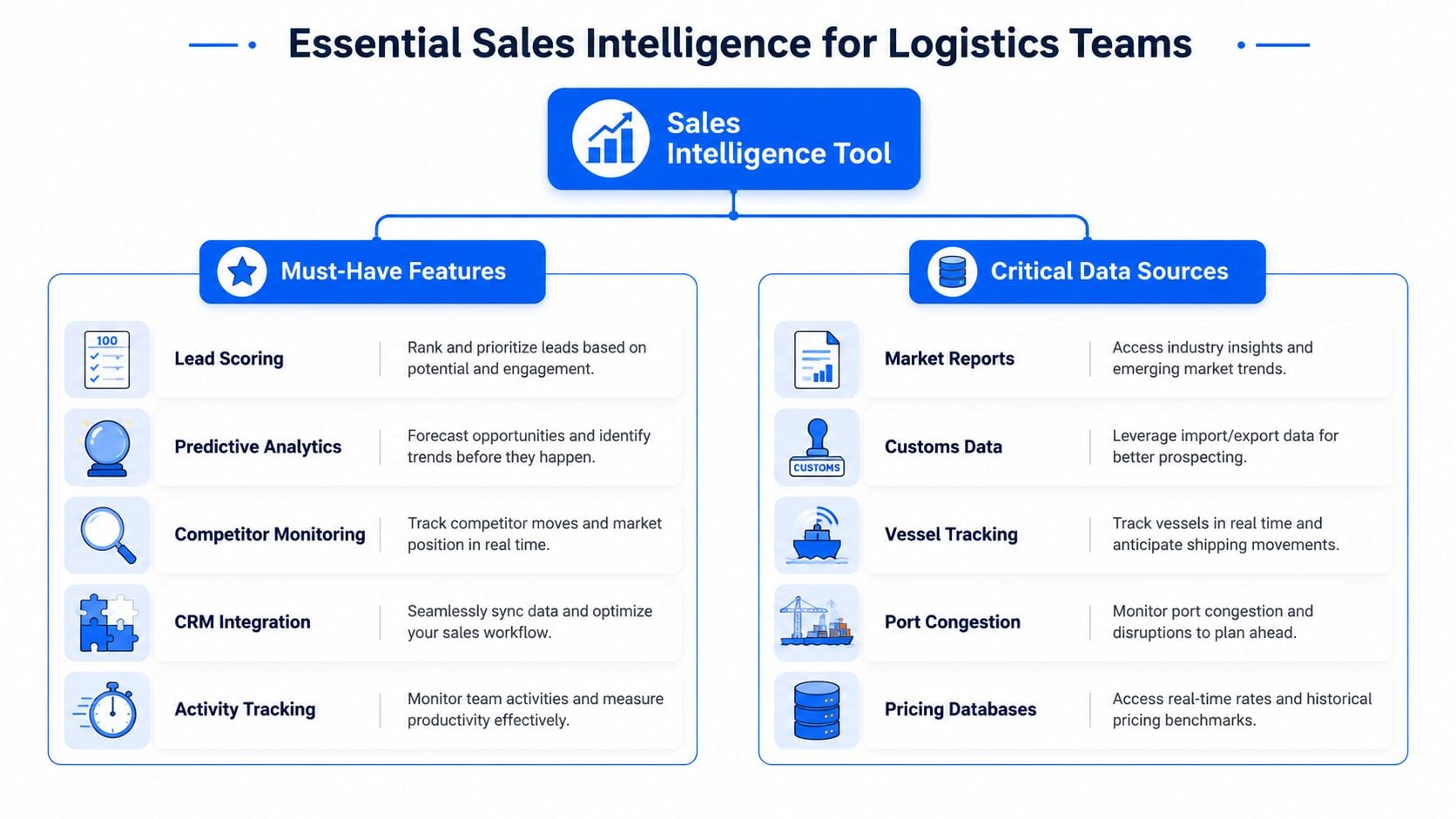
Customs and shipment visibility: This is the anchor dataset for many forwarding and carrier teams. Customs data helps reps identify who is importing, what categories they move, and which trade flows deserve attention. It's one of the clearest ways to move from abstract industry targeting to actual shipper discovery. If you want a broader view of how these datasets support prospecting, this overview of supply chain databases for sales teams is worth reviewing.
Lane-level filtering: “Retail” or “manufacturing” isn't precise enough. Reps need to isolate accounts by origin, destination, mode, region, and shipment pattern so they can build a service offer around actual movement.
Decision-maker coverage below the C-suite: In logistics, the useful contact is often the person managing transportation procurement, import operations, sourcing logistics, or distribution planning. A tool that only surfaces executive leadership will slow the sales cycle down.
CRM integration: If reps must export CSV files, manually enrich records, and copy activity back into the CRM, adoption drops. The tool needs to fit the daily sales motion, not sit beside it.
Nice features versus useful features
Some features look impressive in a demo but don't matter much in freight unless the underlying data is relevant.
| Feature type | Useful in logistics when | Weak in logistics when |
|---|---|---|
| Lead scoring | It reflects lane fit, shipment profile, and buyer role | It scores generic industry fit only |
| Predictive signals | They help reps prioritize active accounts | They produce rankings with no operational explanation |
| Competitor monitoring | It reveals service gaps or disruption opportunities | It offers broad market alerts with no account tie-in |
| Activity tracking | It shows whether outreach is moving the account | It becomes a dashboard of rep busyness |
Why customs data changes the conversation
Customs data is a real differentiator because it grounds sales activity in trade behavior, not assumptions. If you can see who imports from a specific origin, or which companies appear active on a lane your team already serves well, you can build a prospecting strategy around actual freight movement.
That's what many tools still miss. They tell you who fits your ideal customer profile in theory. Logistics teams need to know who resembles a customer in motion.
From Data to Deals Logistics Use Cases
The shift from research to revenue happens when reps use data to create a specific offer. In freight, that usually starts with a lane, a service problem, or a buyer already showing activity.
One practical example is building a target list around a new trade lane push. Say your team wants more inbound business from Southeast Asia into the US Midwest. Instead of buying a broad importer list, you filter for shippers with relevant origin patterns, narrow by commodity or product group, and then route outreach to transportation or import contacts. The message is no longer “We're a global forwarder.” It becomes “We've identified your Vietnam-origin flow and have a stronger option for this lane.”
Three use cases that actually fit freight sales
Use case one. Build an LCL or consolidation prospect list
A forwarder launching a focused service can identify importers with shared origin markets and build outreach around consolidation, transit control, or destination handling support. This works best when the rep knows the traffic pattern before the first touch.
Use case two. Target accounts during service disruption
If a shipper's current provider is struggling with consistency on a lane, a rep can move quickly with a credible alternative. In freight, timing matters as much as price. A relevant message during disruption gets read. A generic capability deck usually doesn't.
Use case three. Plan a territory visit around account quality
A field seller heading into Chicago, Rotterdam, or Singapore shouldn't book meetings based on whichever accounts happen to be nearby. Geo-search and account mapping let the rep build a route around high-fit shippers, current opportunities, and adjacent targets worth dropping in on.
When timing becomes the advantage
Intent signals matter most when they help reps act faster. Crunchbase's guide to sales intelligence and intent-driven prospecting explains that intent systems track research behavior across large web footprints and can surface accounts actively evaluating a category. In logistics, that doesn't replace customs or lane data. It complements it.
A shipper may match your lane strategy, but still not be ready for a conversation. Intent data adds a timing layer. If an account starts showing signs of active evaluation, reps can move from static prospecting to event-triggered outreach.
If your team can explain both the shipper's freight pattern and the reason for reaching out now, the conversation feels informed instead of intrusive.
That's where deals start. Not with more names. With better reasons.
An Evaluation Checklist for Your Next Sales Tool
Most sales intelligence tools look strong in a demo. Filters are smooth. Maps move fast. The dashboard is clean. None of that tells you whether the platform will help your team win freight contracts.
A better evaluation process starts with one question. Does this tool improve a bottleneck your logistics team already feels?
The market leaders have built serious data infrastructure. ZoomInfo says its platform is built on 500 million contacts, 100 million companies, and 1.5 billion+ data points processed daily in its GTM Context Graph, as noted in this review of top sales intelligence tools. That scale matters. But for a freight team, scale alone doesn't guarantee useful lane targeting, cleaner account selection, or better contact relevance.
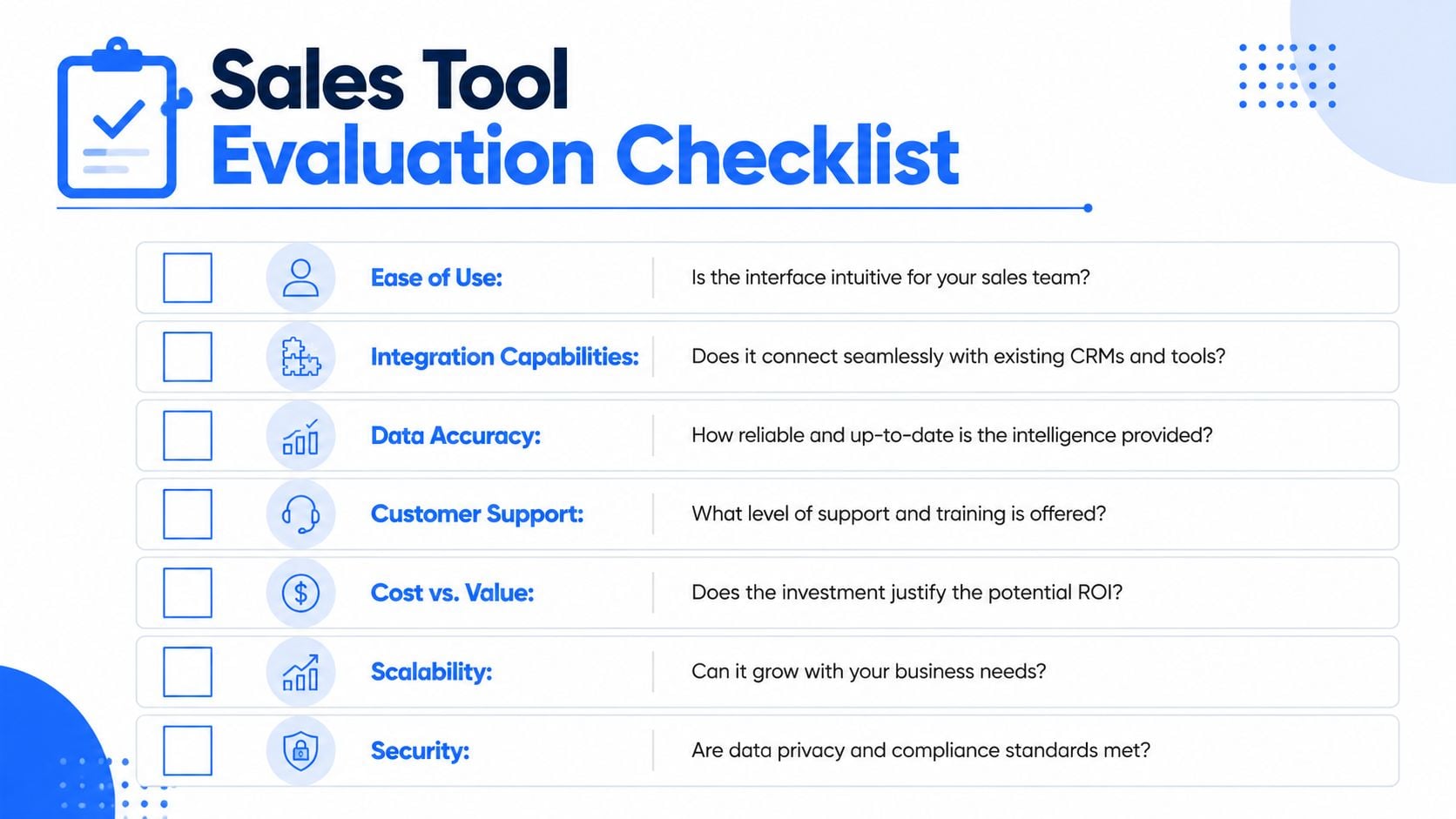
A practical buying scorecard
Use a simple red-yellow-green score across these areas:
- Data fit: Does the platform understand logistics entities, shipper behavior, and trade-lane targeting well enough to support real prospecting?
- Contact relevance: Can reps find supply chain, transportation, procurement, and import/export contacts, not just senior executives?
- Workflow speed: Can the team go from account discovery to outreach without bouncing across multiple tools?
- Territory usefulness: Does it support geographic planning, lane clustering, or field-sales routing in a way that reflects how your team sells?
- Integration quality: Will it sync with your CRM and existing process without creating manual cleanup?
- Signal trust: Can your reps tell why an account was prioritized, or does the system just produce opaque rankings?
- Adoption risk: Will your team use it after the first month?
Questions to ask in the demo
Don't ask vendors for a generic walkthrough. Make them prove fit.
| Ask this | Why it matters |
|---|---|
| Show me how to find importers on a specific lane | Reveals whether the product supports logistics targeting or just broad firmographics |
| Show me the buyer roles available for an account | Confirms contact depth where freight decisions really sit |
| Show me how records stay current | Exposes refresh discipline and practical usability |
| Show me the CRM handoff | Tells you whether the workflow will stick after launch |
A useful outside perspective can also help your team compare prospecting categories before you buy. This roundup from Fypion Marketing on best sales prospecting tools is a solid reference for framing the broader context.
Buyer test: If a vendor can't demonstrate a real freight workflow in the demo, assume your reps will have to build that workflow themselves.
That usually means slower adoption and a weaker return.
Implementation and Measuring Your ROI
Teams often lose the value of a good tool in the first month. Not because the software is bad. Because rollout is vague, ownership is unclear, and nobody defines what “working” means for the sales floor.
The fastest path to ROI is to connect the tool to one concrete bottleneck. Avoma's guidance on how to evaluate sales intelligence tools makes this point well: the actual buying question isn't “which tool is best,” but whether the tool improves a specific constraint such as account prioritization or outreach personalization. In logistics, that usually means better lane targeting, faster account research, or more relevant outreach to shipper-side decision-makers.
Start narrow or adoption will stall
Don't launch with every mode, every region, and every rep at once. Start with one use case your team already understands.
Examples that work well:
- A lane-based pilot: Assign one trade lane or shipper segment to a small team and compare the quality of conversations against the old process.
- A territory planning pilot: Give field reps a defined geography and require account selection through the new tool before trips are booked.
- A contact-quality pilot: Focus only on improving access to the right buyer roles for a set of named accounts.
If your team needs a planning model for rollout, this guide to an implementation timeline for sales adoption can help map ownership and sequencing.
Measure business movement, not just rep activity
A weak rollout measures emails sent. A strong rollout measures whether the team is producing better opportunities.
Track outcomes such as:
- Qualified accounts created: Are reps identifying more accounts that fit your service strengths?
- Time to first meaningful meeting: Are sellers reaching a relevant buyer faster?
- Message relevance: Are outreach notes and emails tied to lanes, origins, or supply chain context?
- Pipeline quality: Are opportunities entering the CRM with a clear freight problem to solve?
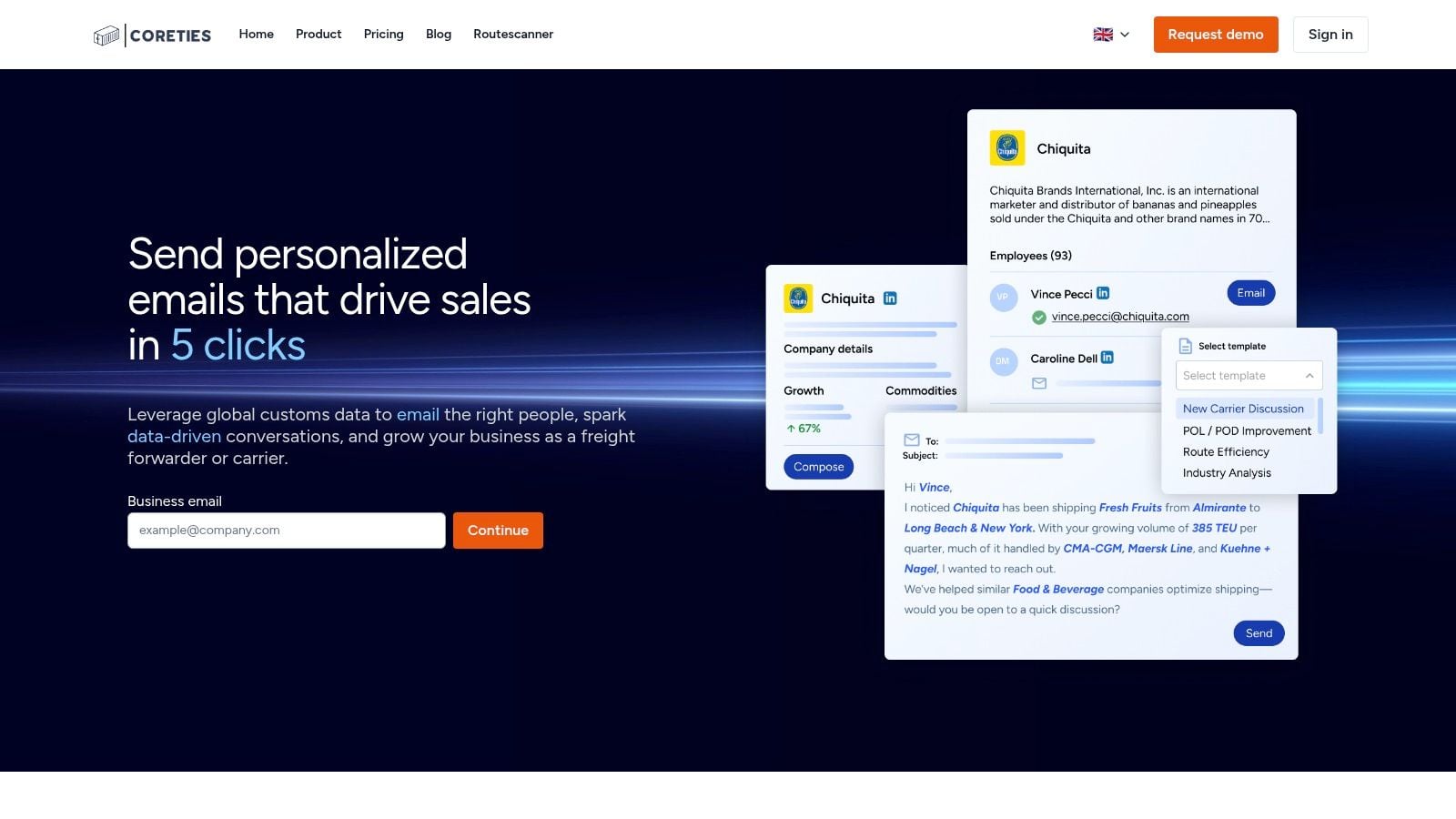
Coreties says customers report up to 30x gains in outreach efficiency, with teams spending about an hour to send 30+ customized emails versus a single message with traditional methods, according to the publisher information provided for this article. The number matters less than the lesson. Efficiency improves when the workflow reduces research time and makes personalization easier at the moment of outreach.
Here's a useful way to pressure-test adoption internally.
If the tool saves clicks but doesn't improve targeting, it won't last. If it improves targeting but creates extra admin, reps will route around it. The tool has to make the right action faster.
Build Your Future-Proof Logistics Sales Engine
The logistics teams that keep chasing generic lead lists will stay busy and frustrated. The teams that win consistently are building a sales engine around better account selection, sharper timing, and outreach grounded in actual freight movement.
That's the fundamental shift behind sales intelligence tools. They move the job from contact hunting to opportunity design. A rep stops asking, “Who can I call today?” and starts asking, “Which shippers fit our network, where is the service gap, and who owns the decision?” That's a stronger commercial posture for any forwarder, carrier, NVOCC, or 3PL.
What durable teams do differently
- They target by lane, not just industry
- They look for operational relevance before writing outreach
- They build workflows that sales reps will use every day
- They treat data quality and signal confidence as commercial issues, not just technical ones
For leaders trying to improve output without forcing more activity onto already stretched teams, this startup guide on sales productivity offers a useful outside lens on productivity discipline and workflow design.
The future-proof logistics sales organization won't be the one with the biggest list. It will be the one that can spot the right shipper sooner, understand the freight context faster, and start a better conversation before competitors do.
Coreties helps freight forwarders, carriers, and logistics sales teams turn customs data into qualified prospect lists and personalized outreach. If you want a faster way to find shippers by lane, identify the right decision-makers, and contact them with messages tied to real shipping patterns, explore Coreties.