Your Definitive Guide to Printed Circuit Board HS Code Classification
When it comes to customs classification, the primary printed circuit board HS code you need to know is 8534. This single heading is the universal starting point for bare, unpopulated printed circuits, covering their global trade as essential electronic components. Understanding Printed Circuit Board HS Codes The Harmonized System (HS) code is simply a standardised […]

When it comes to customs classification, the primary printed circuit board HS code you need to know is 8534. This single heading is the universal starting point for bare, unpopulated printed circuits, covering their global trade as essential electronic components.
Understanding Printed Circuit Board HS Codes
The Harmonized System (HS) code is simply a standardised numerical method for classifying products that are being traded internationally. Customs authorities all over the world rely on it to identify goods, assess the correct duties and taxes, and gather trade statistics. For anyone working in logistics, from freight forwarders to customs brokers, getting this classification right is a core part of the job.
Getting the printed circuit board HS code wrong can have serious knock-on effects. A simple mistake can lead to shipment delays, unexpected fines, and a lot more attention from customs officials than you'd like, ultimately disrupting supply chains and inflating costs.
The Role of HS Codes in Global Trade
Managed by the World Customs Organization (WCO), the HS code system functions as a universal economic language for goods. This framework simplifies trade by providing a consistent structure that over 200 countries and economies follow.
For a logistics hub like Singapore, which plays a pivotal role in the high-value electronics trade, accuracy is everything. Singapore handles 1.39% of the total global exports of printed circuit boards, making it the 11th largest exporter in the world and highlighting its specialisation in the sector. You can learn more about Singapore's role in the global PCB market.
Bare PCBs vs Assembled PCBAs
One of the most fundamental distinctions in PCB classification is understanding the difference between a bare board and one that's been assembled. This is where many of the classification challenges begin.
- Bare Printed Circuit Board (PCB): This is an unpopulated board. It consists of only the insulating substrate and the conductive tracks. These products fall clearly under HS heading 8534.
- Printed Circuit Board Assembly (PCBA): This is a PCB that has been populated with electronic components like resistors, capacitors, and integrated circuits. Once populated, its classification shifts away from HS 8534 and is determined by its ultimate function.
This guide is designed to be a detailed reference to help you navigate these classifications, making sure your shipments are compliant and clear customs without a hitch.
Deconstructing HS Heading 8534 for Bare PCBs
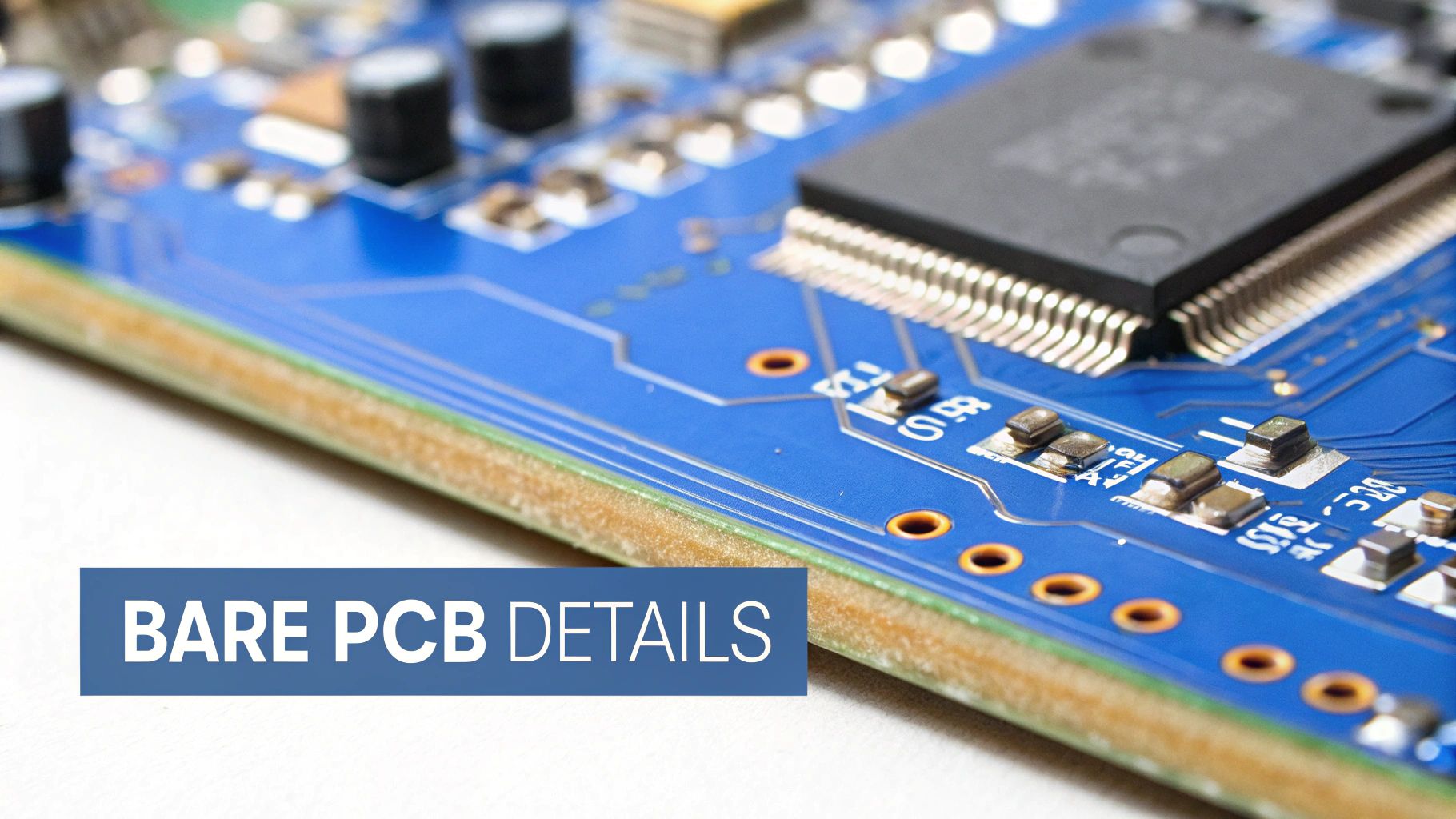
When you're classifying electronics for international trade, getting it right is everything. For bare, or unpopulated, printed circuits, the Harmonized System has a dedicated home: HS Heading 8534. This is the one and only starting point for any circuit board before a single electronic component has been soldered on.
It's really important to grasp what customs officials mean by a "printed circuit" under this heading. The official definition zeroes in on circuits made on an insulating base using any printing process (like etching) or by "film circuit" technology. This covers the conductive tracks, pads, and contact points—the roadmap for the components—but crucially, not the components themselves.
Put simply, if you're shipping a board that's just the substrate with its copper pathways, its customs journey starts and stops with HS Heading 8534. Making this distinction upfront helps avoid costly mix-ups where bare boards get misclassified under a heading intended for fully assembled electronic products.
Core Criteria for Classification Under 8534
For a PCB to fall neatly under heading 8534, it has to tick a few specific boxes. Customs authorities are essentially looking for an insulating base material combined with one or more layers of conductive elements.
The essential features they check for are:
- An Insulating Base: This is the non-conductive foundation, typically made from materials like FR-4 (a glass-reinforced epoxy laminate), polyimide, or other plastics.
- Conductive Elements: These are the copper foil tracks, lands, and pads that have been formed on the base through a process like printing or etching.
- Absence of Components: The board must be completely bare. It cannot have any mounted active or passive components, such as resistors, capacitors, diodes, or integrated circuits.
A common grey area I see is with boards that have connectors or simple hardware attached. Generally, if these parts are purely for mechanical structure and don't add to the electronic function, the board can often still be classified under HS 8534. However, this can be tricky and often depends on national customs interpretations, so it pays to be careful.
How Layer Count Influences Subheadings
Within HS Heading 8534, the classification gets more specific based on the board's complexity—namely, its layer count. This detail is absolutely critical for drilling down to the correct six-digit subheading, which is the level recognised by customs agencies worldwide.
The main breakdown is between:
- Single-Sided Circuits: These are the most basic, with conductive tracks on only one side of the insulating base.
- Double-Sided Circuits: Here, you'll find conductive patterns on both sides of the substrate.
- Multilayer Circuits: These are more complex, with more than two layers of conductive material separated by insulating layers, all laminated together.
For instance, a simple single-layer board for a toy and a complex eight-layer motherboard for a server both begin their classification journey under HS 8534. However, they will ultimately land in different, more specific subheadings based on that layer count. Nailing this detail is a vital step in ensuring your customs declaration for a printed circuit board HS code is spot-on. For a deeper dive into this, you can find more on PCB HS Code classifications.
How to Classify Multilayer and Flexible PCBs
When you move beyond simple single and double-sided boards, you get into the more complex world of multilayer and flexible PCBs. These are not your run-of-the-mill components; they're higher-value and require a closer look during classification to get them right.
It's easy to get this wrong. The Harmonized System has specific subheadings under the main HS code 8534 just for them, and customs officials are looking for precise details. Getting the technical definitions mixed up is a classic mistake that can really complicate a customs declaration.
The most important thing to remember is that multilayer and flexible circuits are two completely different beasts. A multilayer board is all about its internal conductive layers, whereas a flexible circuit is defined by its bendy base material. Nail down that distinction, and you're on the right track.
Distinguishing Multilayer PCBs
So, what exactly is a multilayer printed circuit board? Simply put, it's a board with three or more layers of conductive copper, all sandwiched together with insulating material. You find these in sophisticated electronics—think computer motherboards, servers, and high-end networking gear—where you need to pack a ton of connections into a tiny space without signal interference.
For customs, the magic number is often the layer count. This is where the classification gets specific.
The Harmonized System splits them up like this:
- HS Code 8534.00.10 is generally the code for circuits with more than four layers.
- HS Code 8534.00.90 is the go-to for boards with four layers or fewer.
Let's make that practical. A standard four-layer motherboard for a desktop PC? That's going to be classified under 8534.00.90. But an advanced, ten-layer server board with intricate routing would fall under 8534.00.10, reflecting its higher complexity and value.
Classifying Flexible Circuits
Next up are Flexible PCBs, which you'll also hear called flex circuits. These are built on a pliable base material, usually polyimide, which lets them bend, twist, and fit into tight or oddly-shaped spaces. They're essential in things like cameras, wearable tech, and many medical devices.
While they also fall under the main HS heading 8534, the focus for customs officials shifts from layer count to the material itself. They need to verify that the board is genuinely "flexible" by nature.
Getting this right is especially critical when you consider where most PCBs come from. The Asia-Pacific region dominates, churning out around 91% of the world's PCBs. Powerhouses like China, Taiwan, and South Korea are at the forefront of both rigid and flex tech, as highlighted in these global PCB manufacturing statistics and trends.
For anyone shipping these components, correctly identifying a flexible board from this massive manufacturing hub is key. It ensures your paperwork is in order, duties are calculated correctly, and your shipment doesn't get stuck in customs.
Bare PCBs vs Populated PCBAs: A Critical Distinction
When it comes to customs classification, one of the most common—and costly—mistakes boils down to a single question: are there components on the board? The difference between a bare Printed Circuit Board (PCB) and a populated Printed Circuit Board Assembly (PCBA) is the most crucial factor in finding the correct printed circuit board HS code. Getting this wrong can lead to serious delays, fines, and headaches.
A bare PCB, which falls squarely under HS Heading 8534, is just that—bare. It’s the foundational board made of insulating material, etched or printed with conductive tracks and pads, but completely unpopulated. Think of it as the blueprint for an electronic device, waiting for the functional parts to be added.
The Concept of "Essential Character"
The moment you solder even a single electronic component onto that board—be it a tiny resistor, a capacitor, or a complex integrated circuit—it’s no longer a simple PCB. It has become a PCBA. This act of "populating" the board fundamentally changes its identity in the eyes of customs.
The board loses its character as a mere "printed circuit" and now takes on the essential character of the device it's designed to be. This is a game-changer for classification. The item's HS code moves completely away from HS Heading 8534 and is instead determined by the PCBA's main function or its role as a part of a larger machine.
Deciding Between HS 8534 and Other Headings
To steer clear of misclassification, you have to assess the board's state at the time of shipment. Is it bare, or does it have components that give it a specific function?
To help, here's a straightforward table breaking down the key differences.
HS Code Decision Framework: PCB vs PCBA
| Characteristic | Bare PCB (HS 8534) | Populated PCBA (Varies) |
|---|---|---|
| Component Status | Unpopulated. No electronic components mounted. | Populated. At least one electronic component is mounted. |
| Functionality | Serves as a base for mounting components; has no function on its own. | Has a specific function defined by its components (e.g., sound card, controller). |
| Customs Identity | Classified as a "Printed Circuit" by its physical nature. | Classified by its "essential character" or its role as a part of a machine. |
| HS Heading | Always 8534. | Varies based on function (e.g., HS 8473 for computer parts, HS 8517 for telecom parts). |
This framework should make it clear: if components are present, you need to look beyond HS 8534.
This flowchart illustrates how to navigate the subheadings within HS 8534 based on physical traits like layers or flexibility, but remember the first and most important step is determining if the board is populated at all.
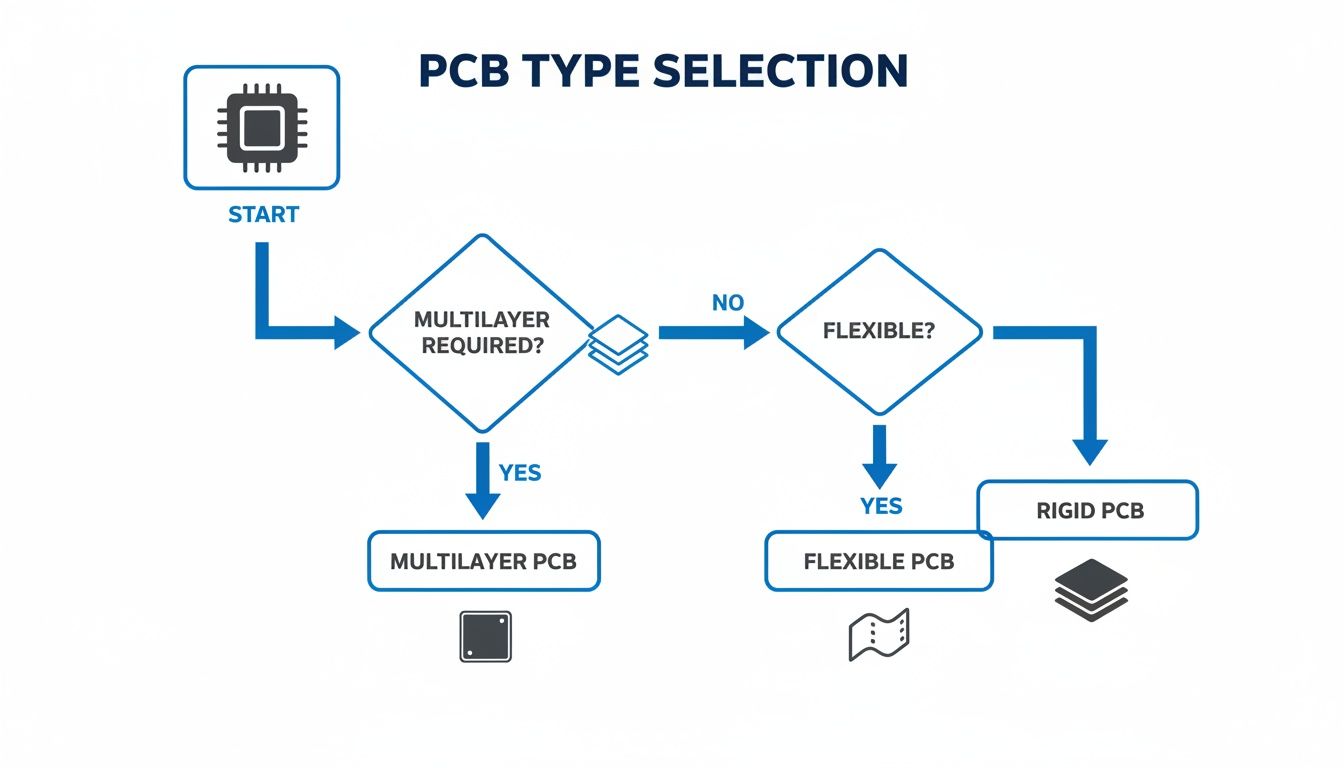
The key takeaway is that while layers and flexibility help you find the right code for a bare PCB, the presence of any component shifts the classification out of this heading entirely.
A Common Pitfall: A frequent error is classifying a PCBA under 8534 just because it looks like a circuit board. Always remember: if it has components, its function dictates the code. For instance, a bare motherboard is HS 8534, but an assembled graphics card is considered a computer part under HS 8473.
This isn't just an academic exercise. The global market for PCBAs is booming, making accurate classification more important than ever. Projections show the printed circuit board assembly market is set to reach $148.42 billion by 2032, growing at a CAGR of 6.11%. That means a higher volume of these complex goods crossing borders. You can read the full research about the circuit card assembly market to get a better sense of the growth drivers.
Ultimately, this distinction isn’t a mere technicality; it’s a core principle of the Harmonized System. By correctly identifying your board as either a bare PCB or a functional PCBA, you ensure compliance, avoid costly penalties, and keep high-value electronics moving smoothly across the globe.
Common Classification Mistakes to Avoid
Getting the printed circuit board HS code wrong can be a costly affair, leading to customs delays, surprise duties, and sometimes even hefty fines. Navigating the Harmonized System is all about the details—it's often the small oversights that cause the biggest headaches. Knowing what the common mistakes are is your first line of defence for ensuring compliance and keeping your shipments moving.
The most frequent and expensive error is classifying a populated Printed Circuit Board Assembly (PCBA) under HS code 8534. This heading is strictly for bare, unpopulated boards. The moment components are soldered on, the board's "essential character" changes, and its classification must shift to reflect its final function, like a computer part under HS 8473.
Misinterpreting Board Characteristics
Beyond the populated vs. bare distinction, many errors come from simply misinterpreting the physical nature of the board. These details are what determine the correct subheading within HS 8534, so getting them right is crucial.
Two areas that consistently cause confusion are the layer count and the board's flexibility:
- Ignoring Layer Count: It's easy to overlook the difference between a single-layer, double-layer, or multilayer board. But a complex ten-layer board destined for a server is classified differently than a standard four-layer board, which can directly impact its tariff rate. You must always confirm the number of conductive layers.
- Confusing Flexible and Rigid Circuits: Flexible circuits, often made from materials like polyimide, have their own classification rules. Mistaking a rigid-flex board or a fully flexible circuit for a standard rigid one is a classic declaration error. For customs officials, the material composition is a primary identifier.
Here's a pro tip: always get the detailed technical specification sheets from your supplier before the goods ship. This paperwork provides clear, undeniable proof of the board's construction, layer count, and materials, giving you the confidence to select the correct printed circuit board HS code.
Proactive Tips for Compliance
Staying out of trouble with customs comes down to diligence and having the right information. Relying on old data or just making an assumption is asking for a shipment to get flagged. To cut down on your risk, build these simple practices into your logistics process.
First, make it a habit to check the latest official Harmonized Tariff Schedule for the destination country. HS codes get updated, and local customs authorities can have their own interpretations, so staying current is non-negotiable.
Second, be crystal clear in your product descriptions on the commercial invoice. Don't just write "Printed Circuit Board." Instead, use something like "Bare 8-Layer Rigid PCB for Server Motherboard" or "Unpopulated Flexible PCB for Digital Camera." This detail helps customs officers verify your classification at a glance. Just as you'd need to be specific when identifying HS codes for various auto parts, this level of precision is key for specialised goods. Be precise and proactive, and you'll sidestep most classification errors before they even happen.
Essential Shipping Documents for PCBs
Nailing the right printed circuit board HS code is a huge step, but it's only half the story. If your paperwork isn't in order, even a perfect code won't prevent your shipment from getting stuck in customs. For any international PCB shipment, there’s a core set of documents that customs authorities need to see for a clear, verifiable record of your goods.
Think of the commercial invoice, a detailed packing list, and the bill of lading (or air waybill) as the three pillars of your shipment's documentation. Each one has a specific job—from proving the transaction’s value and itemising the contents to outlining the transport contract. When it comes to something as specific as PCBs, you simply can't afford to be vague on these forms.
Detailing PCBs on Your Paperwork
When you're filling out the commercial invoice, a lazy description like "electronics parts" just won't cut it. That's a classic red flag for a customs inspection. Your description needs to be specific enough for a customs officer to understand exactly what they're looking at, without needing an engineering degree.
For instance, instead of just "PCB", try being more descriptive:
- "Bare Multilayer Printed Circuits, 6 Layers, Unpopulated"
- "Unpopulated Flexible Printed Circuits for Medical Device"
This level of detail instantly connects your goods to HS Heading 8534 and clears up potential questions before they're even asked. Adding the material composition, like "FR-4 glass epoxy," provides even more backup for your chosen classification. While the shipper usually prepares this, a good freight forwarder will make sure everyone is on the same page. This ties directly into the responsibilities of the consignee, a crucial role you can understand better by reading about the role of the Importer of Record.
Here's a pro tip: always include a technical datasheet with your shipping documents. It provides undeniable proof of the board’s specs—like layer count and material—and gives customs an easy way to verify your declared HS code, helping to speed things along.
At the end of the day, all your documentation needs to tell one consistent, transparent story. The description on the commercial invoice, the details on the packing list, and the actual goods in the box must all match the printed circuit board HS code you've declared. Getting this right from the start is the best way to minimise compliance risks and keep your valuable electronics moving across borders without costly delays or fines.
Frequently Asked Questions About PCB HS Codes
Working with the Harmonized System can be tricky, especially when you're dealing with something as specific as printed circuits. I get a lot of questions on this, so I've put together answers to the most common ones to help you clear up any confusion and classify your goods confidently.
Let's dive into the nuances, from country-specific codes to how parts for larger machines are handled. These answers should help you sidestep common classification mistakes.
What Is the Main Difference Between HS Code 8534 and Other Electronics Codes?
The single most important thing to remember about HS code 8534 is that it’s exclusively for bare, unpopulated printed circuits. That’s it. It covers the board itself, before a single electronic component has been mounted onto it.
The moment you add components, it becomes a Printed Circuit Board Assembly (PCBA), and its classification changes completely. At that point, it’s no longer an 8534 product. Instead, the new HS code for the populated board is determined by its main purpose or "essential character," which will land it under a different heading in chapters like 84, 85, or 90.
How Do I Classify a PCB That Is a Part for a Larger Machine?
This really comes down to one question: is the PCB bare or populated? If you're shipping a bare PCB that's meant to be a spare part, it almost always stays classified under its own heading, HS 8534.
However, if it's a populated PCBA that acts as a specific, identifiable part of a machine—say, a dedicated controller board—it’s usually classified under the "parts and accessories" heading for that machine. For instance, a PCBA designed for a specific machine tool would likely fall under HS 8466.
A word of advice: always check the section and chapter notes in the Harmonized Tariff Schedule for the country of import. Those notes provide the final legal word on how to classify parts and accessories, and following them is non-negotiable for compliance.
Are There Country-Specific Variations for PCB HS Codes?
Yes, and this is a critical detail that trips a lot of people up. The first six digits of an HS code (the subheading, like 8534.00) are the same worldwide, thanks to the World Customs Organization.
Beyond those first six digits, countries add their own suffixes for national tariff and statistical needs. This is where it gets specific.
- The United States uses a 10-digit Harmonized Tariff Schedule (HTS) code.
- The European Union uses an 8-digit Combined Nomenclature (CN) code.
- Gulf Cooperation Council (GCC) countries use a 12-digit code.
So, while the core classification under 8534 is universal, you absolutely must use the full, country-specific code for your destination to make a correct and compliant customs declaration.
Finding and connecting with the right shippers doesn't have to be a guessing game. Coreties transforms global customs data into targeted lead lists, so you can reach decision-makers with data-driven outreach. Find qualified prospects and streamline your sales process with Coreties.