A Freight Forwarder’s Guide to HS Code Malaysia
Think of an HS Code as a universal passport for your products. It’s a simple, standardized language that tells customs authorities worldwide exactly what you’re shipping, no matter the local dialect. For anyone in freight forwarding or logistics dealing with Malaysia, getting this code right isn't just a box-ticking exercise. It's the difference between a […]
Think of an HS Code as a universal passport for your products. It’s a simple, standardized language that tells customs authorities worldwide exactly what you’re shipping, no matter the local dialect.
For anyone in freight forwarding or logistics dealing with Malaysia, getting this code right isn't just a box-ticking exercise. It's the difference between a smooth delivery and a shipment getting bogged down in costly delays.
Why HS Codes Are a Cornerstone of Malaysian Trade
In logistics, the term "HS code" is more than just customs jargon; it’s the bedrock of global trade. An HS code is a globally recognised system that classifies every product imaginable with a specific number. This allows customs officers to instantly identify goods, assess the right duties and taxes, and collect trade data.
Without the correct code, your shipment is essentially a mystery box. Imagine trying to clear customs with a manifest that just says "electronics." Is it a smartphone? A batch of microchips? A kid's toy? Each one is treated differently, with its own taxes and regulations. The HS code cuts through that confusion with a precise, universally understood classification.
Malaysia takes this a step further by using the ASEAN Harmonised Tariff Nomenclature (AHTN). It’s an eight-digit system built on top of the international six-digit standard. This regional layer ensures consistent tariff and trade rules across all ASEAN member countries, which is a massive help for streamlining trade within this bustling economic bloc.
For freight forwarders, mastering the Malaysian HS code system isn't just about compliance. It's a strategic advantage that lets you give clients accurate cost estimates, sidestep delays, and ultimately deliver a much better service.
When you nail the classification with the correct hs code malaysia, you unlock some major benefits:
- Precise Duty and Tax Calculation: You ensure that you and your clients are paying the exact amount required—no costly overpayments or nasty penalties for under-declaring.
- Faster Customs Clearance: A correct code lets customs officials quickly process your shipment, dramatically lowering the risk of it being pulled aside for inspection.
- Access to Trade Agreements: Proper classification is your ticket to benefiting from preferential tariffs under agreements like the ASEAN Trade in Goods Agreement (ATIGA).
- Better Business Analytics: All that trade data, neatly organised by HS codes, gives you powerful insights into market trends and your own shipping volumes.
How to Find the Right HS Code in Malaysia
Figuring out the correct HS code for a shipment in Malaysia isn’t a guessing game; it’s a methodical process. Your go-to resource should always be the official HS Explorer portal, which is managed by the Royal Malaysian Customs Department (JKDM). This is the single source of truth for classifying any goods moving in or out of the country.
Think of the HS Explorer as the ultimate product encyclopaedia for customs. Instead of leafing through a massive, dusty book, you can search digitally to find the exact 8-digit AHTN code your shipment needs. For anyone in logistics dealing with Malaysian trade, getting comfortable with this tool is non-negotiable.
Starting Your Search on the JKDM Portal
First things first, head over to the HS Explorer website. The portal is built around a keyword search function, so you’ll need a good description of your product to get started. My advice? Don't just stick to one term.
For instance, if you're shipping rubber gloves, try searching for "rubber gloves," but also "nitrile gloves" or even "surgical gloves." Using a mix of common and technical terms gives you the best shot at landing in the right section of the tariff schedule. Your initial goal is just to find the right chapter—the broad category—before you start digging deeper.
Here’s what the HS Explorer's main search page looks like. This is where your journey begins.
As you can see, it’s a straightforward search bar where you pop in your product description to kick off the lookup.
Navigating the Chapters and Headings
Once you’ve put in a keyword, the portal will present a list of potential chapters and headings. This is where your own product knowledge really comes into play. You have to read the descriptions for each one and decide which category fits your goods best.
Let’s stick with the rubber glove example to see how this works in practice:
- Initial Search: A search for "rubber gloves" will likely point you towards Chapter 40, which covers "Rubber and articles thereof."
- Narrowing Down: Within Chapter 40, you’ll scan the headings for something more specific. You'd quickly find heading 4015, which is for "Articles of apparel and clothing accessories (including gloves, mittens and mitts), for all purposes, of vulcanised rubber other than hard rubber."
- Pinpointing the Subheading: From there, it's about drilling down even further. You’d look at the subheadings under 4015 until you find the perfect match, like 4015.11.00, which specifically covers "Surgical gloves."
This step-by-step filtering is how you move from a very general category to a precise product code, ensuring your classification is accurate. The system is designed to be logical. If you're handling regional trade, you'll notice the process is quite similar elsewhere; our guide on Singapore Customs HS codes breaks down the same logic for another key ASEAN hub.
Final Verification and Confirmation
After navigating through the subheadings, you'll land on a specific 8-digit AHTN code. The portal will show you this final code along with a detailed product description.
Crucial Tip: Never skip this final check. Read the official description and compare it meticulously against your product's actual specifications—its material, function, and form. Does it match perfectly? A single digit off in the HS code can trigger customs inspections, fines, or serious delays. This final verification is your last line of defence against expensive mistakes.
Decoding the Structure of a Malaysian HS Code
An HS code isn't just a random string of numbers. Think of it as a product's universal passport, telling customs officials its entire story, from its general family down to its specific identity. For anyone moving goods in and out of Malaysia, getting this code right is non-negotiable. It’s the key to smooth clearance and avoiding costly, frustrating delays.
The entire system is built on a global foundation: the Harmonized System (HS). This is a six-digit code maintained by the World Customs Organization (WCO) and used by over 200 countries. It creates a common language for trade, ensuring a product is understood in the same basic way whether it's arriving in Port Klang or Rotterdam.
But Malaysia, being part of ASEAN, takes it a step further. We use an eight-digit system called the ASEAN Harmonised Tariff Nomenclature (AHTN). This system simply adds two more digits to the global six-digit code, providing a layer of detail specific to our region. This extra precision is vital for managing trade agreements and tariffs among ASEAN member states.
Breaking Down the Digits
Each pair of digits in an AHTN code acts like a funnel, narrowing down the classification from broad to incredibly specific. It’s a bit like finding an address: you start with the state, then the city, the street, and finally the exact house number.
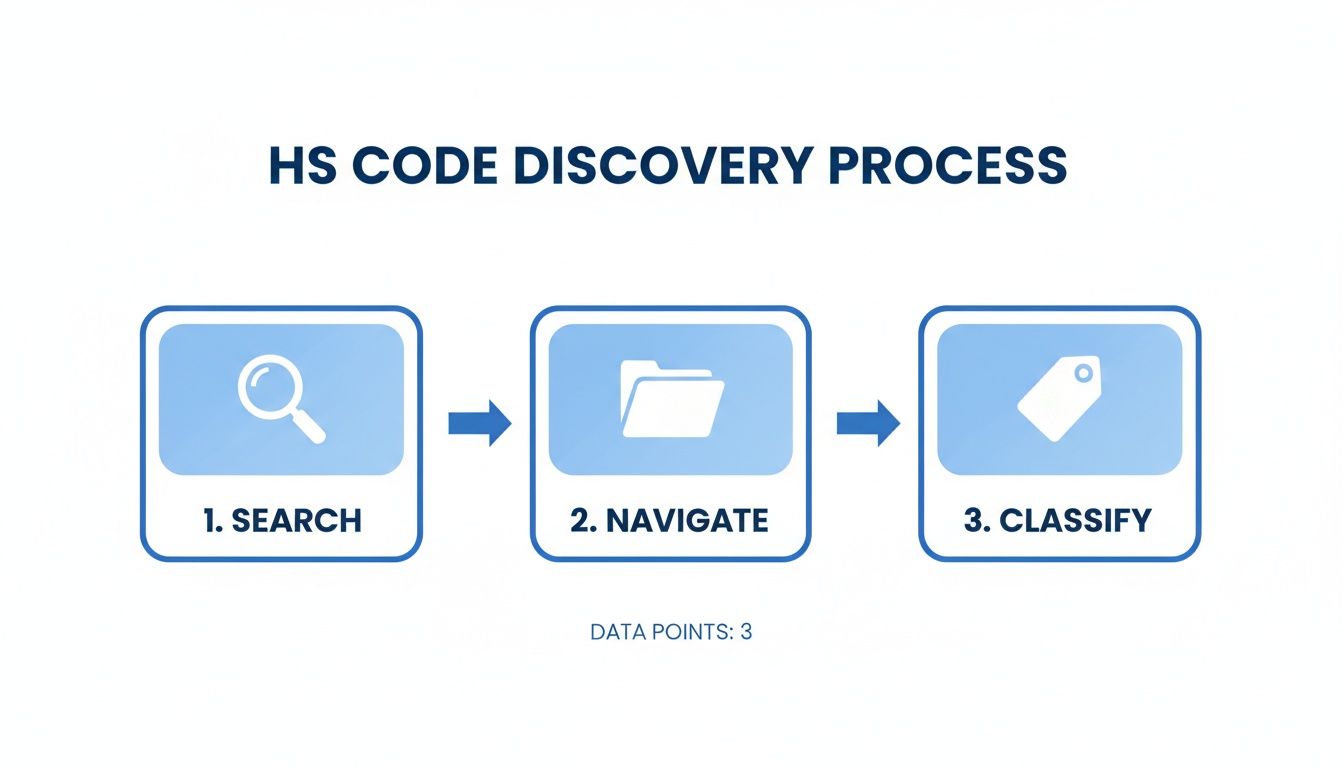
This logical flow—searching, navigating, and then classifying—is the fundamental process every forwarder and shipper needs to master.
To really get a feel for this, let's look at an example for an electronic integrated circuit. The code for this item is HS 8542.31.
Here's how that number is constructed, piece by piece.
Breakdown of an 8-Digit Malaysian AHTN Code
| Code Segment | Example (HS 8542.31) | Description |
|---|---|---|
| Chapter | 85 | The first two digits. This places the item in a very broad category, like "Electrical machinery and equipment." |
| Heading | 8542 | The next two digits. This narrows it down to "Electronic integrated circuits." |
| Subheading | 8542.31 | The final two digits of the global code. This specifies "Processors and controllers." This is the standard 6-digit WCO code. |
This six-digit code, 8542.31, is the universal identifier. But for entry into Malaysia, we need the full eight-digit AHTN code.
The Final ASEAN Layer
The last two digits are what make the code specific to our region. For this particular integrated circuit, the full AHTN code might be 8542.31.00. These final digits are the ASEAN subheading, providing the granularity needed for regional trade rules.
This layered structure means a customs officer in Malaysia, Thailand, or Vietnam can instantly understand a product's classification with the same clarity. For those of us in logistics, mastering this hierarchy isn't just about compliance; it's about turning a simple code into a tool that makes trade faster, smoother, and more predictable.
HS Code Examples for Malaysia's Top Exports
Theory is one thing, but seeing how the classification process works in the real world is where it all starts to click. To really get a handle on the HS code Malaysia system, let's walk through the classification for three of the country's export powerhouses: palm oil, semiconductors, and wooden furniture. These are the kinds of goods that freight forwarders see every single day, and the logic behind their codes reveals the core principles you can apply to almost any product.
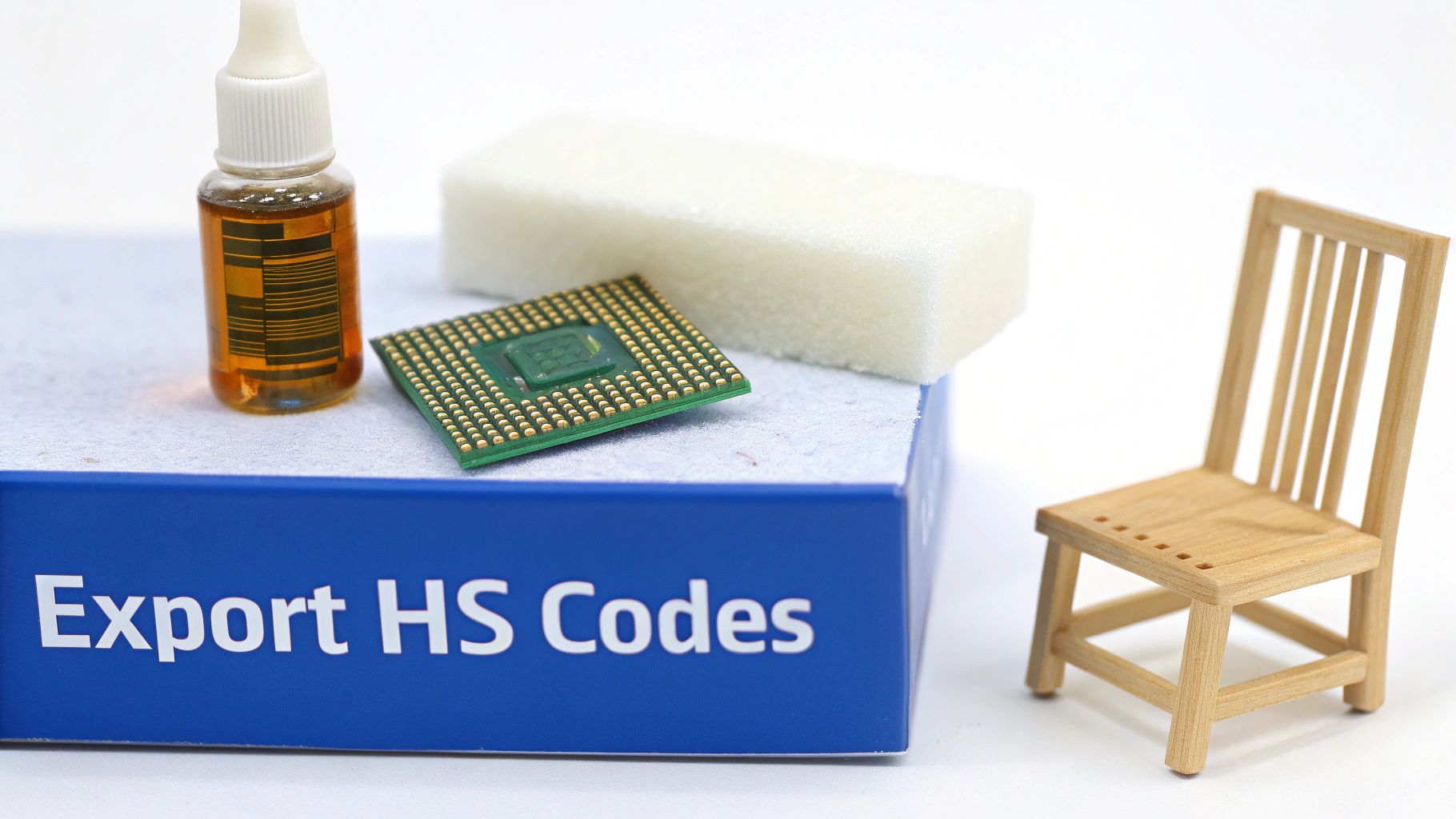
These examples aren't just about finding a code; they're about understanding the why. Once you grasp the reasoning, you go from being someone who just looks up codes to an expert who can advise clients with real confidence.
Classifying Palm Oil
Palm oil is a massive part of the Malaysian economy, but how you classify it completely depends on its state. Are you shipping it crude, refined, or as a fractionated product? Each one gets a different HS code.
Let’s take a common export: refined palm oil.
- Chapter 15: This is our starting point, covering "Animal or vegetable fats and oils and their cleavage products." Makes sense.
- Heading 1511: This zooms in on "Palm oil and its fractions, whether or not refined, but not chemically modified." We're getting closer.
- Subheading 1511.90: This final step identifies the product as "Other," which in this context means it's refined (since crude oil is specifically listed under 1511.10).
So, the full AHTN code for refined palm oil will be built on the 1511.90 heading. This distinction is absolutely critical, as crude and refined oils often face different export duties and government regulations.
Classifying Semiconductors
As a global hub for semiconductor assembly and testing, Malaysia ships a staggering volume of electronic components. These tiny, incredibly complex products need pinpoint-accurate classification.
Let's look at a standard integrated circuit, or microchip.
- Chapter 85: This is the go-to chapter for "Electrical machinery and equipment and parts thereof."
- Heading 8542: This heading is specifically for "Electronic integrated circuits."
- Subheading 8542.31: Now we're drilling down to the specific type: "Processors and controllers, whether or not combined with memories, converters, logic circuits, amplifiers, clock and timing circuits, or other circuits."
The resulting international six-digit code is 8542.31. For Malaysia, the full AHTN code would add two more digits for regional detail, like 8542.31.00. If you handle a lot of electronics, our guide on the printed circuit board HS code is a great resource for getting into the nitty-gritty of this vital category.
The key takeaway here is specificity. A vague description like "computer parts" on your customs declaration is a recipe for delays. The HS system forces you to classify a product based on exactly what it is and what it does—is it a processor, a memory chip, or a simple diode?
Classifying Wooden Furniture
Wooden furniture is another major Malaysian export, and its classification really drives home the importance of a product's final form. A shipment of raw timber, processed planks, and a finished dining table are all classified differently.
Let's classify a finished wooden dining table.
- Chapter 94: This is the chapter for "Furniture; bedding, mattresses… and similar furnishings."
- Heading 9403: This covers "Other furniture and parts thereof."
- Subheading 9403.60: This one narrows it down to "Other wooden furniture."
So, a wooden dining table gets classified under 9403.60. But if you were shipping the raw timber needed to make that table, you’d be looking at Chapter 44 ("Wood and articles of wood"). This perfectly illustrates a core principle of HS classification: the degree of processing and the product's final use are what determine its code.
How HS Codes Impact Malaysian Tariffs and Duties
The HS code you assign to a shipment is so much more than a number on a form. It's the key that unlocks the financial side of customs clearance in Malaysia, directly determining the taxes and duties your goods will face upon arrival.
Think of it this way: the moment your shipment hits the border, that code tells customs officials exactly what import or export duty rate to apply. It also dictates the Sales and Service Tax (SST) and whether any special anti-dumping duties are triggered. Get it wrong—even by a single digit—and you could be looking at a cascade of problems, from surprise tax bills and heavy fines to painful shipment delays that can derail your entire schedule.
Turning Classification Into a Competitive Advantage
Getting your HS codes right isn't just about playing defence and avoiding penalties. It's a strategic move. When you truly get the hang of the Malaysian HS code system, you can offer clients advice that genuinely impacts their costs, turning your service from a simple transport solution into a financial one.
For example, a deep understanding of the code nuances might reveal opportunities for serious savings. Certain goods could qualify for lower duty rates or even complete exemption if they fall under one of the Free Trade Agreements (FTAs) Malaysia has signed.
By proactively guiding your clients to the most favourable—and still 100% compliant—HS code, you're not just moving a box. You're demonstrating expertise that builds trust and makes you an essential partner in their business.
The Role of HS Codes in Regional Trade
The financial weight of HS codes becomes crystal clear when you look at high-volume trade routes. Take the bustling corridor between Malaysia and its top export partner, Singapore. These codes are the backbone for classifying billions of dollars worth of goods flowing between the two nations.
Singapore accounts for 16.03% of Malaysia's total exports, a figure valued at a staggering $50.45 billion. This highlights just how intertwined their economies are within ASEAN. Electrical and electronic products, typically found in HS chapters 84 and 85, are the main event here, making up over 40% of these shipments. You can explore comprehensive export data for a closer look at these trade dynamics.
For these goods, proper classification is the ticket to leveraging powerful agreements like the ASEAN Trade in Goods Agreement (ATIGA), which can often bring tariffs down to zero. This is a massive responsibility, usually handled by a specific entity. To understand who that is, check out our guide on the Importer of Record.
Common HS Code Mistakes and How to Avoid Them
Getting an HS code wrong, even by a single digit, can snowball into a world of logistical pain. We're talking about costly fines, frustrating shipment delays, and a lot of time wasted sorting things out. Knowing where people usually trip up is the best way to make sure your declarations are spot on every time.
One of the biggest culprits is a lazy product description. A shipper might jot down "machine parts" or "electronics," but to a customs officer, that's practically meaningless. What kind of part? What does the electronic device do? Each possibility has its own unique HS code, and a vague description is an open invitation for a customs inspection.
Another classic mistake is getting the primary function wrong, which is especially tricky when you're dealing with products that do more than one thing.
The Challenge of Multi-Function Devices
Think about something like a modern smartwatch. It tells the time, yes, but it also tracks your heart rate, sends messages, and plays music. So, is it a watch (Chapter 91), a medical device (Chapter 90), or a communication device (Chapter 85)?
This is where the Harmonized System's General Rules of Interpretation (GRIs) come in. They're the official rulebook, and they tell us to classify a product based on its principal function—the core feature that gives the item its essential character. For the smartwatch, its data processing and communication features are arguably more central than its simple time-telling ability, pointing you towards Chapter 85. Classifying it purely as a timepiece would be a major misstep.
To sidestep these common pitfalls, here are a few solid practices to build into your process:
- Get Granular with Descriptions: Forget generic labels. Be specific. What's it made of? What’s its main job? What are its secondary functions? Who is the end-user? The more detail, the better.
- Lean on the GRIs: The General Rules of Interpretation aren't just suggestions; they are the framework for correct classification. Getting familiar with them is non-negotiable for tackling complex items.
- Check for Updates: The AHTN isn't set in stone. The tariff codes and classifications are updated every few years. Always make sure you're referencing the most current version from the Royal Malaysian Customs Department's portal.
Pro Tip: When in doubt, provide more documentation than you think you need. Attaching technical spec sheets, product manuals, or detailed invoices can give a customs officer everything they need to confirm your classification on the spot. This simple, proactive step can save you from a world of delays and position you as a credible, expert partner.
Common Questions About Malaysian HS Codes
When you're dealing with customs clearance day in and day out, a few key questions always pop up. Here are the straightforward answers to what freight forwarders and shippers most frequently ask about the Malaysian HS code system.
What’s the Deal with 6-Digit vs. 8-Digit Codes?
Think of it like a global language with a local dialect. The first 6 digits of an HS code are universal, set by the World Customs Organization. This means a product's 6-digit code is recognised pretty much everywhere, from Singapore to Spain.
But Malaysia, as part of ASEAN, takes it a step further. We use the 8-digit ASEAN Harmonised Tariff Nomenclature (AHTN). The first six digits are the standard global code, but the last two digits add a layer of detail specific to the ASEAN region. This extra detail helps ensure everyone in the trading bloc is on the same page, applying the same tariffs consistently.
Where’s the Best Place to Check Malaysian Import Duties?
Don't rely on third-party sites or outdated charts. Your single source of truth should always be the Royal Malaysian Customs Department's (JKDM) HS Explorer portal.
Once you've nailed down the correct 8-digit AHTN code for your shipment, just pop it into the portal. It will show you the latest import duties, Sales & Service Tax (SST), and any other taxes that apply. Customs rates change, so make checking the official portal a non-negotiable step in your process.
Getting the HS code wrong isn't just a simple mistake. It can snowball into major headaches like frustrating customs delays, paying the wrong amount of duty (which can lead to fines), or, in the worst-case scenario, having your goods seized. Nailing the classification is the bedrock of smooth customs clearance in Malaysia.
So, What Actually Happens If I Mess Up the HS Code?
Using the wrong HS code is one of the most common—and costly—mistakes in logistics. At best, you’re looking at shipment delays while customs officials sort out the discrepancy.
More often, it leads to financial pain. If you’ve underpaid duty, you’ll face fines and back-payments. If you’ve overpaid, good luck trying to claim that money back. In serious cases, customs can seize the entire shipment. It’s a compliance issue that can damage your reputation and your bottom line, so there's simply no room for error.
Finding and engaging the right shippers in Malaysia is essential for growth. Coreties transforms global customs data into targeted prospect lists, helping your sales team connect with qualified decision-makers in just a few clicks. Streamline your outreach and build your pipeline faster at https://coreties.com.