A Freight Forwarder’s Guide to Harmonized Code for Clothing
If you’ve ever wondered how customs officers worldwide can tell a container full of t-shirts from one packed with dress shirts, the answer is the Harmonized System (HS) code. For clothing, this universal numeric code is the key to smooth international shipping. The most important thing to get right from the start is the difference […]
If you’ve ever wondered how customs officers worldwide can tell a container full of t-shirts from one packed with dress shirts, the answer is the Harmonized System (HS) code. For clothing, this universal numeric code is the key to smooth international shipping.
The most important thing to get right from the start is the difference between Chapter 61, which covers knitted or crocheted garments, and Chapter 62, for woven garments. Think t-shirts versus jeans. Nailing this basic distinction is your first line of defence against expensive shipping headaches.
What Are Harmonized Codes for Clothing?
Imagine an HS code as a product's universal passport. It's a standardised language that lets a customs officer in Singapore and another in the United States know exactly what's inside a box without ever having to open it. For freight forwarders dealing with apparel, getting the harmonized code for clothing right isn't just a technicality—it’s absolutely central to your business.
Getting it wrong kicks off a nasty domino effect.
- Shipment Delays: The wrong code immediately raises a red flag, often leading to manual inspections that leave cargo sitting at the port.
- Incorrect Duty/Tax Calculation: The code is what determines the Goods and Services Tax (GST) and any other duties owed.
- Financial Penalties: Customs can, and will, issue fines for non-compliance, which directly eats into your profits.
- Damaged Client Trust: Shippers count on your expertise for a seamless process. A simple coding error can quickly break that trust.
Here in Singapore, the global 6-digit codes are expanded into the 8-digit ASEAN Harmonised Tariff Nomenclature (AHTN). This system, managed by Singapore Customs, adds an extra layer of detail for trade within the region. For instance, a simple cotton T-shirt falls under HS code 6109.10, while a pair of women's woven jeans is classified under 6204.62.
This level of precision is vital for clearing the immense volume of goods moving through hubs like PSA Singapore Terminals, which saw over 37 million TEUs in 2023. Understanding these codes is also crucial for calculating GST liability, currently set at 9% for most clothing imports. You can learn more about how Singapore applies these codes to manage its imports and exports.
At its core, the entire HS code system for clothing hinges on one fundamental question: Is the fabric knitted or woven? That single detail decides which chapter—and which set of rules—applies to your garment.
To make this crystal clear, here’s a quick guide to the two main chapters for apparel.
Quick Guide to Clothing HS Code Chapters
The table below breaks down the primary distinction between the two main HS chapters for clothing. Use it as a quick reference to guide your initial classification.
| HS Chapter | Type of Clothing | Common Examples |
|---|---|---|
| Chapter 61 | Knitted or Crocheted | T-shirts, sweaters, sweatshirts, polo shirts, leggings |
| Chapter 62 | Woven (Not Knitted) | Jeans, dress shirts, suits, blouses, trousers, jackets |
Knowing the difference between these two chapters is the foundation of accurate apparel classification. It’s the starting point from which all other details, like material and garment type, follow.
How to Read an HS Code Like a Pro
At first glance, a harmonized code for clothing can look like a random string of numbers. But it’s not random at all. Each digit tells a detailed story about the garment, much like how a postal address can guide a letter from a broad region right down to a specific doorstep. Learning to read this structure is the key to classifying apparel with confidence.
The entire system is built on a global standard from the World Customs Organization (WCO). This foundation is a 6-digit code that’s recognised by customs authorities worldwide, giving everyone a consistent starting point.
Of course, countries often need more detail. In Singapore, that 6-digit base is extended to an 8-digit ASEAN Harmonised Tariff Nomenclature (AHTN) code. Those extra two digits provide more regional specificity, which helps fine-tune duty calculations and trade analysis right here in Southeast Asia.
Breaking Down the Code Structure
Think of an HS code as a family tree. It starts with a broad ancestor (the Chapter) and gets more specific with each new generation (the Heading and Subheading). Every pair of digits adds another layer of crucial detail.
Here’s how the first six digits break down:
- First two digits (Chapter): This is the highest level, identifying the broad category. For clothing, this will almost always be Chapter 61 (knitted) or Chapter 62 (woven).
- Next two digits (Heading): This narrows it down to the type of product within that chapter, like "T-shirts" (6109) or "Trousers" (6204).
- Final two digits (Subheading): This provides the final layer of detail, often specifying the material or intended wearer, such as "of cotton" (6109.10).
This simple flowchart shows how apparel classification branches out from that very first decision point.
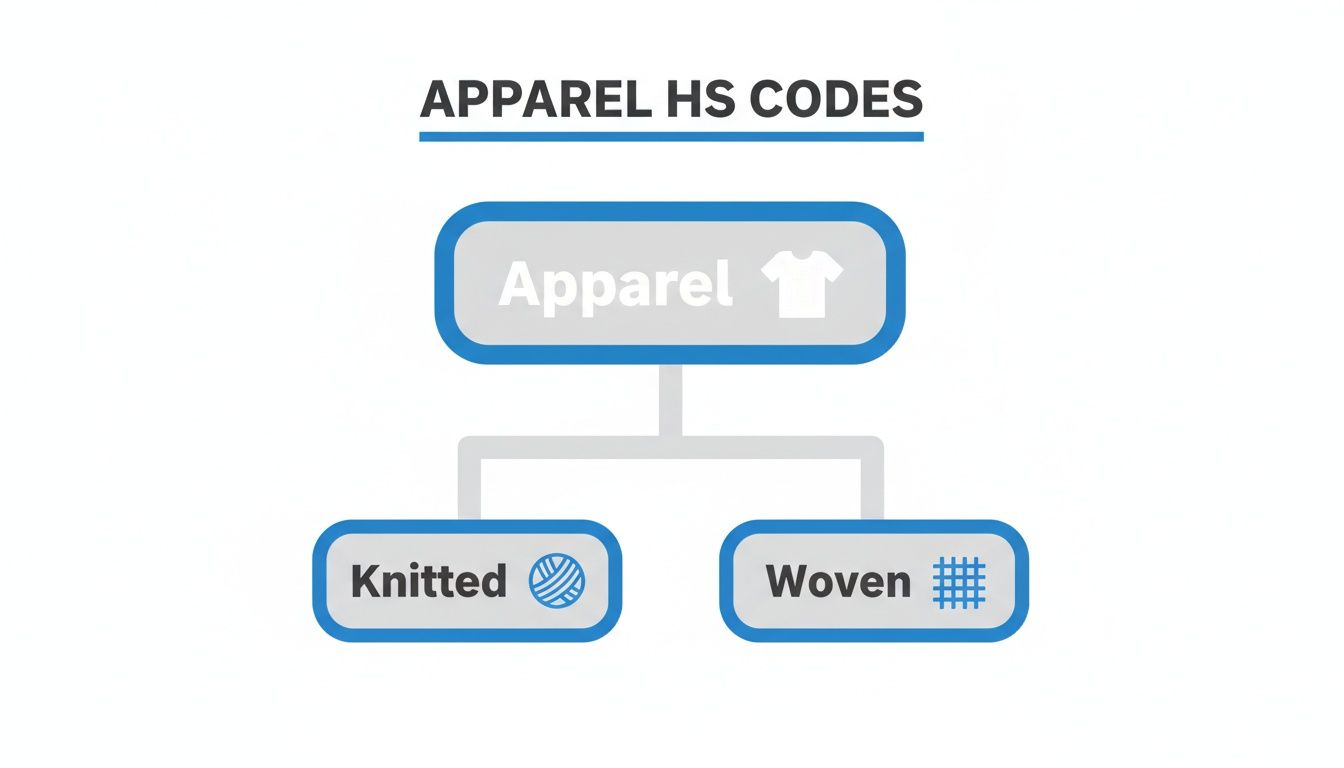
As you can see, the fundamental split between knitted (Chapter 61) and woven (Chapter 62) is the most critical first step in finding the right harmonized code for any piece of clothing.
Putting It All Together: An Example
Let's decode 6109.10.00, the AHTN code for a simple cotton t-shirt, and see how this works in practice.
- 61: The garment is from Chapter 61, telling us it’s knitted or crocheted.
- 09: Within that chapter, it falls under Heading 09, which is for "T-shirts, singlets and other vests."
- 10: The Subheading specifies the material is "of cotton."
- 00: These are the final two digits specific to the AHTN, adding another layer for regional classification.
By reading the numbers in pairs, you can deconstruct any code and understand the exact characteristics of the garment it represents. This skill transforms a confusing number into a clear and precise product description.
The Golden Rules of Clothing Classification
Knowing the difference between Chapters 61 and 62 is a great start, but real-world apparel shipments are rarely that simple. What happens when a hoodie is made of a cotton-polyester blend? Or when a two-piece suit is shipped as a single unit? These are the kinds of details where costly mistakes happen.
To really master the harmonised code for clothing, you have to move beyond basic definitions and start applying a set of "golden rules." These principles, laid out by customs authorities, give us a consistent framework for classifying even the most ambiguous garments. Getting them right isn't just good practice; it's a legal requirement.
Rule 1: The Predominant Material by Weight
So many garments these days are made from blended fabrics to get the right mix of comfort, durability, or style. When you’re faced with a blend, classification comes down to a simple but strict rule: the material that makes up the greatest percentage of the garment's weight dictates its classification.
Take a t-shirt that's 60% cotton and 40% polyester. Since cotton is the heaviest component, the t-shirt gets classified under a subheading for cotton garments within Chapter 61. If you flip that ratio—60% polyester and 40% cotton—it would fall under a man-made fibre subheading instead.
This rule is a massive compliance checkpoint. Getting HS codes right under Chapters 61-62 is legally mandated, and errors can easily trigger audits, delays at Tuas or Changi Cargo, and hefty fines. With upcoming WCO updates hinting at significant penalties for misclassification, this is especially true for blends. The final code, like 6109.90 for man-made fibre T-shirts, all comes down to what material weighs the most. You can dig deeper into how to find the correct code for your goods on the Singapore Customs website.
Rule 2: Classifying Clothing Sets
Apparel is often sold and shipped in sets, like suits or tracksuits. When items are packaged together for retail sale as a single unit, they are generally classified under a single HS code. That code usually corresponds to the set's primary or most defining garment.
Think of a men's two-piece suit with a jacket and trousers made from the same woven fabric. The entire set gets classified under the heading for suits, such as 6203.11 (of wool or fine animal hair). You wouldn't classify the jacket and trousers separately.
But, of course, there are conditions to meet:
- The items have to be put up together for retail sale.
- They must be made of the same fabric and style.
- The set must contain a specific number and type of garments as defined in the tariff notes.
When classifying a set, think of it as a single product. The HS code should reflect the complete unit as the consumer would buy it, not its individual components.
Rule 3: When Specific Features Change Everything
Sometimes, a seemingly minor detail can completely change a garment's classification. Features like zippers, pockets, or even the type of waistband can push an item from one subheading to another, often with very different duty implications.
A classic example is the line between trousers and shorts. A standard pair of men’s woven cotton shorts might fall under 6203.42. But, if those same shorts have specific features that officially qualify them as swimwear, they’d get reclassified under a completely different heading, 6211.11.
This is precisely why a detailed commercial invoice is your best friend. It’s not enough to list "trousers." You need specifics like "men's woven cotton trousers with a zipper fly." This level of detail gives you the power to verify the shipper's code, prevent compliance headaches, and ultimately prove your expertise and build trust with your clients.
Common HS Codes for Apparel and How to Find Them
Knowing the classification rules is half the battle. The other half is applying them quickly and accurately to the dozens of shipments that come across your desk every day. This is where having a reliable list of common codes and knowing where to verify them becomes essential.
While every garment has its own specifics, most fall into predictable patterns. You don't need to memorise every single harmonised code for clothing, but getting familiar with the most common ones gives you a massive head start. It's the kind of experience that helps you spot a potential error on a shipper's declaration from a mile away.
A Practical Reference Guide
To help you get started, we've put together a quick reference table. These aren't just theoretical codes; they are the practical, 8-digit AHTN codes used in Singapore for some of the most frequently shipped apparel items your team will actually see.
Common Clothing Items and Their Singapore HS Codes (AHTN)
| Clothing Item | Material | Construction | Example AHTN Code |
|---|---|---|---|
| T-Shirt | Cotton | Knitted | 6109.10.00 |
| Women's Blouse | Polyester | Woven | 6206.40.00 |
| Men's Trousers | Cotton (Jeans) | Woven | 6203.42.00 |
| Sweater/Pullover | Man-made fibres | Knitted | 6110.30.00 |
| Men's Suit Jacket | Wool | Woven | 6203.31.00 |
| Women's Dress | Silk | Woven | 6204.41.00 |
Think of this table as a handy cheat sheet. It's a great starting point, but always remember it's no substitute for proper verification using official resources, especially when dealing with a new or unusual product.
How to Verify Any HS Code
Just taking the shipper's provided code at face value is a risky game. The best approach is to equip your team with the tools to verify codes themselves. This transforms a simple administrative task into a proactive service that adds real value for your clients and protects your business from compliance headaches.
Thankfully, Singapore Customs offers some excellent, free-to-use tools for this.
- HS/CA Product Code Search Engine: This should be your go-to resource. You can search by a keyword like "t-shirt" or pop in a known HS code to pull up its official description, duty rates, and any other relevant controls.
- Customs Rulings Database: For those trickier items, this database is a goldmine. It contains past classification decisions made by Singapore Customs, giving you clear examples of how they’ve handled unusual or complex garments before.
Using these official tools is like having a direct line to the customs authority. It takes the guesswork out of the equation and gives you a documented, defensible reason for your classification choice—something that's invaluable if a shipment is ever questioned.
By teaching your team how to find and verify this information themselves, you build genuine expertise within your organisation. It reduces your reliance on third-party data that could be outdated or just plain wrong. This proactive stance not only leads to smoother customs clearance but also cements your reputation as a knowledgeable and trustworthy logistics partner.
You can dive deeper in our complete guide covering every aspect of the HS code for garments.
The Real Business Cost of Incorrect Classification
Getting the harmonised code for clothing right is so much more than a box-ticking exercise. Think of it less as paperwork and more as a direct threat to your profitability, client relationships, and operational flow. It's one of those small details that can quietly unleash a cascade of expensive, time-consuming problems.
In a fast-paced hub like Singapore, the consequences are swift and serious. A simple misclassification can trigger a full customs audit, leading to significant shipment delays at the port. Instead of clearing customs smoothly, your client's cargo is suddenly stuck, racking up demurrage fees while you scramble for answers. This hits your bottom line and your reputation at the same time.
The Financial Domino Effect
Beyond the delays, the financial penalties can be steep. An incorrect code often leads to errors in calculating the 9% Goods and Services Tax (GST), which can mean underpayment and subsequent fines from IRAS. A seemingly minor mistake can have a painful financial sting, quickly turning a profitable shipment into a loss-making headache.
Let's look at a real-world example. Imagine mixing up knitted trousers (Chapter 61) with woven ones (Chapter 62). Classifying knitted trousers (6104.62) as woven (6204.62) doesn't just risk a GST miscalculation at 9%. It could also lead to customs holds or even fines from the World Customs Organization.
An error like this can easily delay an ocean shipment by 2-5 days in Singapore. For any importer or forwarder, that's a major disruption. You can find more insights on how HS code accuracy impacts apparel importers on Commenda.io.
A single wrong digit doesn't just create a compliance issue; it erodes client trust. When a shipment is delayed and fined, the shipper looks to their forwarder for accountability.
This is where the responsibility of the freight forwarder becomes critical, often blurring the lines with the duties of the Importer of Record. We dive deeper into the complexities of this role in our guide on what it means to be the Importer of Record.
Ultimately, accurate classification is the bedrock of efficient and reliable logistics. It protects your revenue, strengthens client confidence, and prevents you from constantly putting out avoidable operational fires. It solidifies your status as an expert partner, not just a service provider.
Turning HS Code Data Into High-Value Shipper Leads
Getting the harmonized code for clothing right is obviously crucial for customs compliance. But for a freight forwarder, that’s just scratching the surface. The real opportunity is hidden in the data itself.
Every import declaration filed is public information, and it tells a detailed story: who is shipping what, where it's coming from, and how much of it they’re moving. This isn’t just noise; it's a treasure map for anyone in logistics. By tapping into this data, you can stop waiting for quotes and start actively pursuing the clients who are a perfect fit for your services.
From Data Points to Qualified Prospects
Let's say your speciality is handling large apparel shipments. Instead of cold-calling a long list of companies, imagine you could pull up a list of every business in Singapore that imported over 10,000 kg of women's blouses last month. That’s the power of transforming raw customs data into genuine business intelligence.
Platforms like Coreties are built to do exactly this. They comb through millions of customs records and organise them into a simple, searchable database. This lets you filter for new business opportunities with pinpoint accuracy.
You can zero in on shippers based on what actually matters to your operations:
- Specific HS Codes: Target companies that import the exact products you handle best, whether it's knitted sweaters (HS 6110) or woven jackets (HS 6202).
- Shipment Volume: Forget small-time shipments. Filter for importers moving goods above a certain weight or value to focus on high-value accounts.
- Trade Lanes: Find prospects importing from countries or regions where you have the strongest network and most competitive rates.
- Consistency: Track import frequency to identify businesses with steady, reliable shipping needs.
This focused approach means your sales team isn't wasting time on dead ends. They’re engaging with prospects who are already qualified.
Turning Insights Into Conversations
Of course, finding the right company is only half the battle. You still need to talk to the right person. Modern data platforms bridge this gap, linking shipment records to verified contact details for decision-makers in logistics and supply chain roles.
When you use customs data, you’re no longer just another forwarder asking for their business. You walk into the conversation as a strategic partner who already understands their shipping patterns and pain points.
This approach gives you a massive advantage before you even pick up the phone.
You can see just how straightforward it is to pinpoint companies importing specific types of apparel, turning a sea of data into a clean, actionable prospect list. To dig deeper, you can explore how to find high-value prospects using an HS code filter and see how it can sharpen your lead generation. It’s a smart way to build a stronger, more sustainable sales pipeline.
Got Questions About Clothing HS Codes? We’ve Got Answers.
When you're dealing with international shipping for clothing, the same questions about harmonised codes pop up time and time again. Let's tackle some of the most common ones that freight forwarders and shippers run into, clearing up any confusion so you can classify with confidence.
What's the Real Difference Between an HS Code and an HTS Code?
Think of it like a global language versus a local dialect.
The HS (Harmonised System) code is the universal foundation—a 6-digit standard from the World Customs Organisation (WCO) that's understood everywhere. It’s the reason a cotton t-shirt is fundamentally classified the same way whether it's heading to Tokyo or Toronto.
An HTS (Harmonised Tariff Schedule) code is what individual countries build on top of that foundation. For example, Singapore uses the 8-digit AHTN. It takes the first six universal HS digits and adds its own two for more granular detail, which helps in calculating precise duties and gathering specific trade data.
Who's Actually on the Hook for the Right HS Code?
Legally, the buck stops with the importer of record. They are the ones who are ultimately responsible for the accuracy of everything on that customs declaration, including the HS code. If duties, taxes, or penalties are due, they're the ones who have to pay up.
But that’s where you, as a freight forwarder or customs broker, come in. Your role is much more than just moving boxes; you're a trusted advisor. Verifying codes isn't just a box to tick—it's a critical service that protects your clients from expensive hold-ups and fines. Getting it right proves your value and builds the kind of trust that keeps clients coming back.
While the importer holds the legal liability, the forwarder’s expertise is the first line of defence against compliance issues. Proactive verification protects both your client and your reputation.
How Often Do These Clothing Codes Actually Change?
The HS system isn't set in stone. The WCO overhauls the entire framework roughly every five years to keep up with new products, materials, and global trade shifts. The last major updates, for instance, were in 2017 and 2022.
On top of that, individual countries or trading blocs can tweak their own tariff schedules, like Singapore’s AHTN, even more often. This is why it's absolutely crucial to work with the most current version of the tariff schedule for any country you're shipping to. Using outdated information is a surefire way to run into compliance headaches.
Stop guessing and start targeting the right shippers. Coreties transforms complex customs data into a simple, powerful tool for finding qualified leads. Discover high-value importers, access decision-maker contacts, and grow your business faster. Learn more at Coreties.