Your Guide to the Harmonized Code for Books
A book shipment stuck at customs is a nightmare for any logistics team. The culprit is often a simple mistake—a miskeyed digit in the Harmonized System (HS) code. For books, you're generally looking at Chapter 49, with specific codes like HS 4901 covering most printed books and brochures. Getting this right from the start is […]

A book shipment stuck at customs is a nightmare for any logistics team. The culprit is often a simple mistake—a miskeyed digit in the Harmonized System (HS) code. For books, you're generally looking at Chapter 49, with specific codes like HS 4901 covering most printed books and brochures. Getting this right from the start is the key to sailing through customs.
Why the Harmonized Code for Books Matters
Think of the Harmonized System as a universal language for global trade. It's like a library's Dewey Decimal System, but for every physical product crossing a border. Every item, from a children's picture book to a university textbook, is assigned a specific numerical code. This code tells customs officers in any country exactly what’s inside the box, ensuring everyone speaks the same language when it comes to tariffs, taxes, and regulations.
For anyone managing freight, this isn't just about ticking a box for compliance. It’s about keeping shipments moving. The wrong harmonized code for books can trigger a cascade of problems: red flags, physical inspections, outright rejections, and hefty financial penalties. That little string of numbers has a direct impact on your schedule, your budget, and your client's happiness.
The Cost of Inaccuracy
Getting the code wrong isn't a minor slip-up; it has real, measurable consequences. Here in Singapore, we use the 8-digit ASEAN Harmonised Tariff Nomenclature (AHTN). According to Singapore Customs, in 2022 alone, errors in declarations under HS Chapter 49 resulted in over 5,000 audit interventions.
Those weren't just friendly corrections. These mistakes led to a staggering SG$12.5 million in penalties and caused more than 150,000 hours of extra processing delays. The accuracy of this single code is critical, and you can get a better sense of how these codes are structured by reviewing our guide to Singapore Customs HS codes.
A Tool for Growth
But let's look beyond the risks. A solid grasp of the harmonized code for books can actually become a competitive edge. When you know how to navigate customs data, you can spot high-volume shippers in the publishing and education industries.
Suddenly, a regulatory hurdle transforms into a powerful tool for lead generation. Accurate classification isn't just about avoiding problems—it’s the first step towards smarter logistics and sharper business development.
How to Pinpoint the Right HS Code in Chapter 49
Think of the Harmonized System's Chapter 49 as a massive library for everything printed that crosses a border. But instead of organising books by author or genre, it sorts them by their physical form and ultimate purpose. Getting this right is what separates a shipment that sails through customs from one that gets stuck in a costly, time-consuming inspection.
This entire chapter is built on a single, crucial distinction: the value must come from the information printed on the item, not the raw material itself. A blank notebook is just paper, so it belongs in Chapter 48. But once it's printed with a story, it becomes a novel—and that's a job for Chapter 49. This simple logic is the key to every classification decision you'll make here.
The Core Categories for Printed Matter
Within Chapter 49, a few key headings handle the vast majority of printed goods. If you can get your head around these, you're halfway to mastering the classification process for books.
Here are the three most important headings you'll need to know:
- HS Heading 4901: This is the go-to category for most books. It covers everything from novels and textbooks to brochures and leaflets, whether they're single sheets or properly bound.
- HS Heading 4903: This heading is carved out specifically for children's picture, drawing, or colouring books. The rule of thumb is simple: if illustrations are the main event and any text is just a supporting act, it belongs here.
- HS Heading 4911: Think of this as the "miscellaneous" shelf for printed items that don't fit neatly elsewhere. This is where you'll find trade advertising materials, commercial catalogues, calendars, and printed pictures or photographs.
So, while a university textbook and a slick marketing brochure are both made of bound paper, customs officials see two very different things. The textbook's purpose is educational reading, which puts it squarely in HS 4901. The brochure, however, is designed to sell something, which often lands it under HS 4911.
Putting Classification into Practice
Let's make this real. Say you're shipping a palette of hardback fantasy novels. Their entire reason for existing is to be read, so you’d start your search under HS 4901. Now, what if the next shipment is a batch of colouring books for kids? The main activity is drawing and colouring, not reading, which makes HS 4903 the obvious choice.
To get it right, you have to determine the "essential character" of the product. Just ask yourself: why was this item made? Is it for reading? For a child to draw in? Or is it for advertising? Your answer will almost always point you to the correct HS heading.
This level of detail is what makes global trade run smoothly. For example, Singapore uses the 8-digit ASEAN Harmonised Tariff Nomenclature (AHTN), which provides even more specific codes under the broader HS 4901 umbrella, simplifying commerce across the region. The impact is clear: HS 49 imports grew to a 4.1% share of cultural goods trade in 2023, and airfreight volumes shot up by 35% to 28,000 tonnes.
You can dig deeper into these classifications on the official Singapore Customs website. When you correctly classify your goods within these frameworks, you're not just ticking a box for compliance—you're helping your shipments move faster and more efficiently through the global supply chain.
A Practical Guide to Finding the Correct HS Code
Figuring out the right harmonized code for books can feel like solving a puzzle, but with a structured approach, it becomes a straightforward, repeatable skill. The key is having a clear, step-by-step process. This isn't just about ticking boxes; it's about creating a solid workflow that cuts down on risks and gets your shipments through customs without a hitch.
A repeatable process takes the guesswork out of the equation and gives you confidence in every declaration.
Step 1: Start with the Item's Core Purpose
Before you even glance at a tariff schedule, ask yourself a simple question: What is this item for? Your answer is the compass that guides the entire classification. Is it a novel meant for reading? A colouring book for a child? A promotional brochure for a business? The whole Harmonized System is built on this idea of an item's "essential character."
For instance, a hardback dictionary’s job is to provide definitions, making its primary function informational. That simple fact points you straight towards HS Heading 4901 (Printed books, brochures, leaflets and similar printed matter). This first step instantly weeds out irrelevant categories and gives your search a clear direction.
Step 2: Use the General Interpretative Rules
The General Interpretative Rules (GIRs) are basically the official instruction manual for the HS tariff schedule. Think of them as the grammar of customs classification, ensuring everyone, everywhere, applies the codes the same way.
The most important one to know is GIR 1. It states that classification is determined by the wording of the headings and any related section or chapter notes. This means you always have to start by reading the official descriptions for Chapter 49 and its headings. To get a better handle on this, it's worth taking a moment to learn more about the HS code for books and see how these rules work in the real world.
The following infographic gives you a bird's-eye view of how Chapter 49 is structured, from the broad chapter down to specific headings.
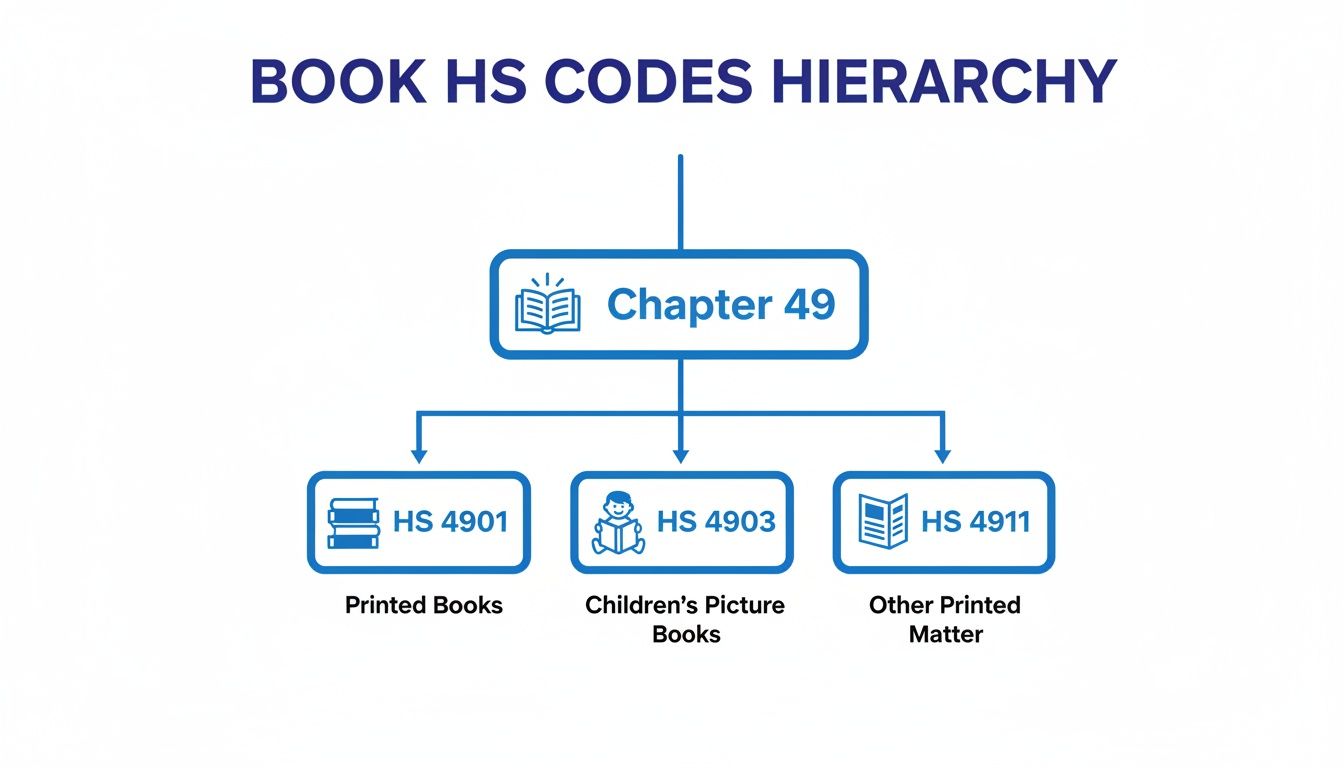
This visual helps you see how an item is classified, starting from the general (Chapter 49) and drilling down to the specific (like HS 4901 for textbooks or HS 4903 for children's books).
Step 3: Verify with Official Search Tools
Once you think you've landed on the right HS code, your next move is to double-check it against an official source. Never just trust a third-party website or reuse a code from an old shipment. Customs authorities have their own online databases for this very reason.
Always cross-reference your findings with the official customs portal for the destination country. This is the only way to confirm the national-level subheading (the 8 to 12-digit code) and check for any specific regulations or tariff updates.
For goods arriving in Singapore, for example, the Singapore Customs' HS/CA Product Code Search Engine is the ultimate source of truth. Using these official tools isn't just a good idea—it's essential for compliance.
Step 4: Check Precedent Cases for Complex Goods
So, what do you do with unusual items? Say, a book that comes packaged with a toy, or a multimedia learning kit? For these more complex goods, looking up binding rulings or precedent cases can be a lifesaver. Customs agencies frequently publish their decisions on how they've classified tricky products in the past.
Digging into these precedents helps you understand the official line of thinking when a product’s "essential character" isn't so clear-cut. This final check ensures your logic is sound and matches how customs authorities have handled similar shipments before, massively reducing the risk of a costly dispute or reclassification down the line.
Common Classification Mistakes and How to Avoid Them
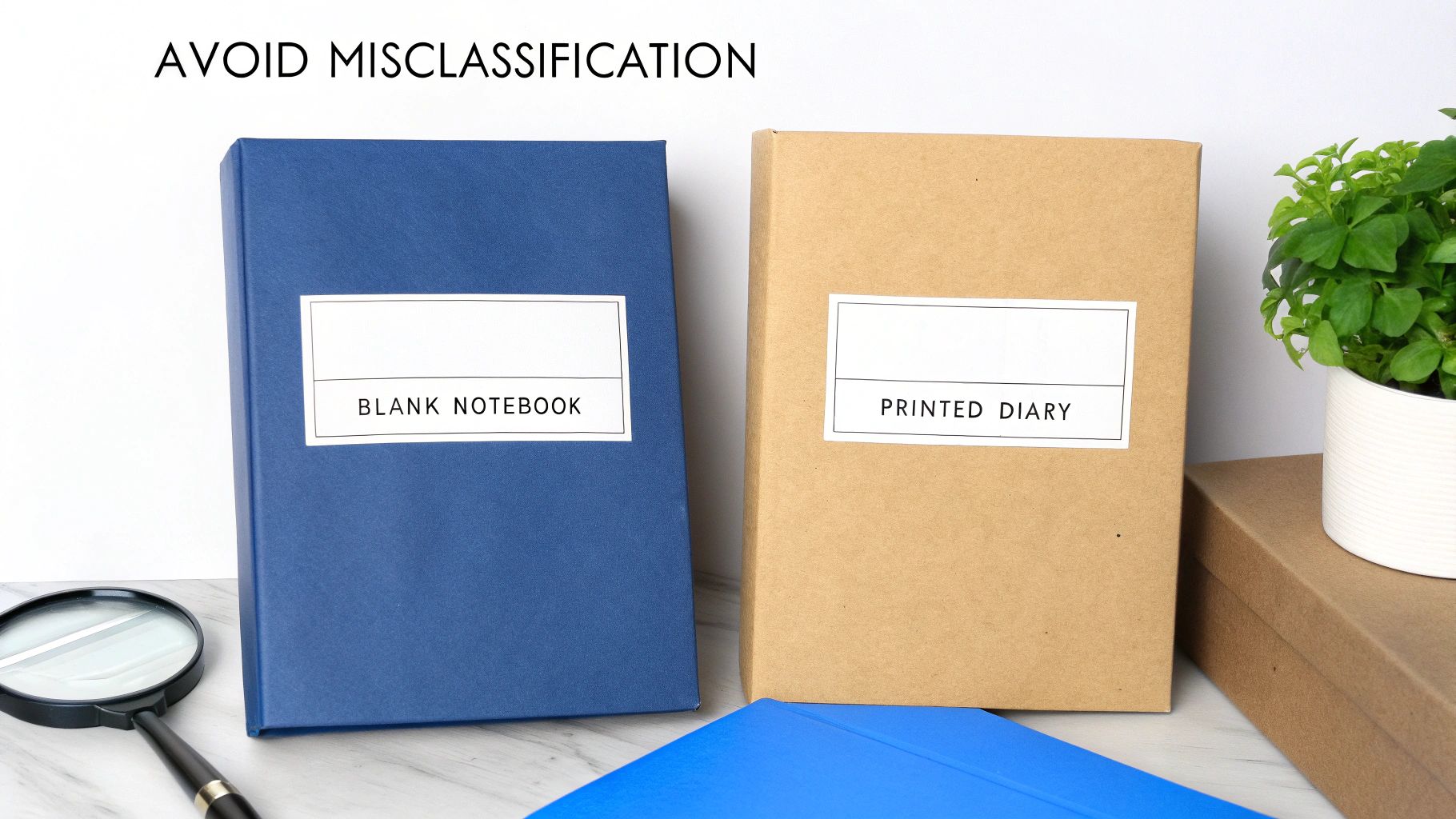
The line between the right Harmonized System code and a costly mistake can be razor-thin. It’s the kind of simple error that seems small at first—like confusing a printed diary with a blank notebook—but can quickly escalate into thousands of dollars in fines, shipment delays, and painful customs audits.
Mastering the nuances of the harmonized code for books isn't just about ticking a compliance box; it’s about protecting your timeline and your bottom line.
Navigating these rules demands real attention to detail. You'd be surprised how often incorrect HS classifications pop up. In fact, a Declarators analysis found they were behind 7.2% of all import disputes in Singapore during 2023. These aren't just minor clerical errors; they led to a staggering SG$8.9 million in overpaid GST and duties.
Understanding the common pitfalls is the first step to avoiding them. Let's break down the most frequent classification blunders and give you clear, actionable steps to keep your shipments moving smoothly. For a closer look at Singapore's specific code structure, the official HS/CA Product Code Search Engine is your best resource.
Mistake 1: Confusing Printed Matter with Paper Products
This is the classic, number-one error we see all the time. A logistics manager sees a bound paper product and instinctively defaults to Chapter 49. It’s an easy assumption to make, but it can be a costly one.
The defining question you need to ask is: where does the item's primary value come from?
- The Pitfall: Classifying a blank journal or a pack of ruled notebooks under HS Chapter 49.
- What to do instead: Stick to the core principle. Chapter 49 is reserved for goods where the printed content is the main event—think novels, textbooks, or manuals. Items that are blank or only minimally printed, like notebooks, diaries with mostly empty pages, and stationery, belong in HS Chapter 48 (Paper and Paperboard). The simplest gut check is to ask: is it for reading, or is it for writing on?
Mistake 2: Mishandling Educational Kits and Sets
Shipments heading to the education sector are often more complex than just a box of books. A language learning kit, for example, might bundle textbooks with workbooks, flashcards, or even a supplementary CD-ROM. Trying to classify the whole lot under a single book code is a common shortcut that practically invites customs scrutiny.
- The Pitfall: Using HS 4901 for a complete set that contains a book alongside other educational materials.
- What to do instead: This is where you need to apply the General Interpretative Rules (GIRs) for "goods put up in sets for retail sale." The key is to identify which item gives the set its essential character. If the book is clearly the principal component, the entire kit can often take on the book’s HS code. But if the components have more or less equal importance, you may have to classify them separately.
Pro Tip: When in doubt, document your reasoning for choosing the "essential character." This simple step demonstrates due diligence to customs authorities if your shipment is ever flagged for review, showing you’ve taken a proactive and thoughtful approach to compliance.
Mistake 3: Classifying Digital and Physical Books the Same Way
In the modern publishing world, the line between physical and digital media feels pretty blurry. For customs, though, it’s a hard border. E-books and audiobooks aren't physical goods, which means they fall completely outside the Harmonized System.
- The Pitfall: Attempting to assign an HS code from Chapter 49 to a shipment of e-book access codes or a hard drive loaded with digital audiobooks.
- What to do instead: You have to recognise that digital products are treated as services or intellectual property. Their import and export are governed by rules on digital trade, not the HS tariff schedule. If an e-book is delivered on a physical medium (like a USB drive), the HS code applies to the physical item itself (e.g., heading 8523 for the drive), not the digital book it contains.
How to Turn HS Code Data Into Qualified Sales Leads
What if every customs declaration was a breadcrumb leading straight to your next big client? It’s time to stop thinking of the harmonized code for books as just a compliance headache. When you see it as a business growth tool, the entire game changes.
This data, which most people see as purely operational, is actually a goldmine of qualified sales leads just waiting to be tapped.
For freight forwarders and logistics carriers, customs data is the ultimate treasure map. Every single time a company imports goods, they create a detailed record. This isn't just a vague product description; it’s a direct window into a prospect's entire shipping operation, revealing who is shipping, what they’re shipping, how much, and how often.
From Raw Data to Actionable Insights
The real magic happens when you turn all that raw data into genuine business intelligence. By filtering customs declarations for a specific HS code, like 4901 for printed books, you can instantly pull a list of companies that are actively importing those exact products.
This isn't some generic business directory you bought online. It’s a highly curated list of active shippers with a proven, current need for your logistics services.
The HS code for books, especially HS 4901 within Singapore's AHTN framework, is incredibly revealing. Data from SingStat, for example, shows a 28% jump in imports under HS Chapter 49 between 2020 and 2024, hitting a total value of SG$1.2 billion. For any logistics professional, this is solid gold. It points you directly to growing importers in the education and publishing sectors who desperately need reliable partners. You can explore more about these trade classifications on SingStat's official site.
This screenshot from Coreties gives you a glimpse of how modern platforms organise customs data to highlight high-value shipping prospects.
What was once a mess of complex trade records becomes a clean, sortable list, making it easy for sales teams to pinpoint top importers by shipping volume and frequency.
Crafting a Hyper-Personalised Outreach
Armed with this level of detail, you can finally ditch the generic cold calls. Instead, you can craft a hyper-personalised pitch that lands with real impact. Imagine calling a potential client and starting the conversation with, "I noticed you regularly import educational textbooks from Vietnam into Singapore. We specialise in that exact trade lane and have a solution that could streamline your process."
That kind of opener immediately establishes your relevance and shows you've done your homework. You're no longer just selling a generic service; you're offering a specific solution to a problem you already know they have. You can learn more about how to filter customs data using an HS code filter to build these kinds of targeted lists.
Let's look at how a raw HS code can become a qualified sales lead. This simple, three-step workflow shows the process from data to conversation.
From HS Code to Qualified Lead in 3 Steps
| Step | Action | Business Outcome |
|---|---|---|
| 1. Target | Filter customs data for HS Code 4901 to find companies importing books. | Get a focused list of active, relevant prospects. |
| 2. Analyse | Review their shipping volumes, frequency, and trade routes. | Understand their specific logistics needs and pain points. |
| 3. Engage | Craft an outreach message that directly references their shipping activity. | Start a warm conversation that shows expertise and relevance. |
As you can see, this data-driven approach completely transforms your sales process into something far more intelligent and effective.
Instead of guessing who might need your services, you're engaging with companies based on their actual, verified shipping behaviour. It’s the difference between casting a wide net and fishing with a spear.
This method isn’t just about finding leads; it’s about creating a sustainable engine for growth by turning compliance data into your most powerful sales asset. And for those looking to get even more advanced, exploring strategies like AI-powered lead generation can add another powerful layer to converting this data into real business.
Your Blueprint for Customs Mastery and Business Growth
Getting the harmonised code for books right delivers a powerful one-two punch. First, you shield your operations from expensive delays and compliance headaches. Second, you unlock a hidden pipeline of high-value sales opportunities. Think of this guide as your complete playbook—giving you the practical skills to classify any book shipment and the strategic know-how to turn that data into your next big client.
When you put these principles into practice, you're doing more than just ticking a compliance box. You're showing clients that you're a true partner, someone who understands the nuances of their supply chain. This is how you move past one-off transactions and start building relationships that last.
The real work starts now. Dive into customs data, pinpoint the shippers who clearly need your expertise, and reach out with solutions that genuinely solve their problems.
Of course, customs expertise is just one piece of the puzzle. Lasting business growth also depends on solid strategic planning for sales to create a clear, data-informed path forward.
When you blend precise logistics knowledge with a sharp sales framework, you build an unstoppable engine for growth. This is your blueprint for turning a regulatory necessity into a real competitive edge, fuelling your company's success for years to come.
Frequently Asked Questions
When you're dealing with the HS code for books, a few common questions always seem to pop up. Let's tackle some of the most frequent ones we hear from logistics pros and shippers.
What Is The Main Difference Between HS Codes In Chapter 48 And Chapter 49?
The simplest way to think about it is this: it all comes down to the printing.
Chapter 48 is all about the paper itself. It covers paper and paperboard items that are either completely blank or have just a little bit of printing that doesn't add much value, like headed stationery or empty notebooks. The product's main value is the paper.
On the other hand, Chapter 49 is where the printed content is the star of the show. This is the home for books, newspapers, and brochures. Here, the value isn't in the paper but in the story, the information, or the pictures printed on it.
How Are E-books Classified Under The Harmonized System?
This one's a bit of a curveball. E-books aren't classified under the Harmonized System at all because they aren't physical goods. Since they are digital products, they're typically handled as services or software and don't get an HS code the way a printed book does.
The rules that govern their import and export fall under regulations for digital services and intellectual property, which is a completely different ballpark from the tariff schedule for physical items.
Think of it this way: HS codes are designed to track tangible things you can physically hold as they cross a border. An e-book is just a file, so it completely sidesteps that system.
Does A Book With An Included CD-ROM Change Its HS Code?
This is a classic "it depends" situation, and it hinges on the product's "essential character."
If the CD-ROM is just a bonus feature—like an audiobook version or a few extra practice exercises—the whole package is almost always classified under the book's HS code, which would likely be in heading 4901. The book is clearly the main event.
However, if the book and CD are marketed together as a multimedia kit where both parts feel equally important, customs might see it differently. They could classify it as a "set," which follows a different set of rules and could very well land it a different code. It's something that needs a careful look.
Discover, analyse, and connect with high-volume book shippers today. With Coreties, you can turn customs data into qualified leads and start meaningful conversations with prospects who need your expertise. Find your next client with Coreties.