A Guide to UPS SCS Singapore for Logistics Teams
When most people hear "UPS," they immediately think of the familiar brown trucks zipping around town delivering parcels. But for businesses in Singapore, the real story is UPS Supply Chain Solutions (SCS). This is a completely different beast, a division dedicated to the heavy lifting of global logistics, far beyond your average package delivery. Think […]
When most people hear "UPS," they immediately think of the familiar brown trucks zipping around town delivering parcels. But for businesses in Singapore, the real story is UPS Supply Chain Solutions (SCS). This is a completely different beast, a division dedicated to the heavy lifting of global logistics, far beyond your average package delivery. Think of them as a major third-party logistics (3PL) player, orchestrating everything from international freight to massive warehousing operations for multinational corporations.
Getting to Grips with UPS SCS in Singapore
If you're in logistics sales or working for a competing freight forwarder, the first thing you need to do is get the image of those brown trucks out of your head. UPS SCS Singapore is the engine behind the company's entire Southeast Asia strategy, not just a local delivery office. It masterfully uses Singapore's position as a global trade hub to deliver incredibly complex, end-to-end supply chain management.
Here’s a simple way to look at it: The regular UPS parcel service is like a taxi, designed to get one package from A to B efficiently. In contrast, UPS SCS is like the entire public transport system for a major city. It coordinates a vast, interconnected network of trucks, ocean liners, and cargo planes to move staggering amounts of goods for huge companies.
Why Singapore is So Critical to Their Strategy
UPS didn't just randomly set up shop here; their presence in Singapore is a calculated, strategic move. The country's top-tier port and airport, combined with its political stability and prime location, make it the perfect nerve centre for regional logistics. For companies based here, UPS SCS offers a single, powerful gateway to a global network, which is a tough pitch for smaller forwarders to beat.
Their operations really stand on three core pillars:
- Global Freight Forwarding: This is their bread and butter—managing intricate air and ocean freight shipments across the world's busiest trade routes.
- Contract Logistics: They go beyond just moving goods. This involves providing dedicated warehousing, meticulous inventory management, and distribution services designed for specific industry needs.
- Integrated Solutions: This is where they tie it all together, blending freight, customs brokerage, and ground transport into one smooth operation. The goal is to take the headache away from the shipper.
By positioning itself as a one-stop-shop in one of the world's most vital trade hubs, UPS SCS Singapore is a serious competitor. To effectively compete, you have to understand their model inside and out. This guide will unpack their services, the industries they target, and where they stand in the market, giving you the insights needed to find the gaps where a more nimble or specialised provider can win.
A Look Inside Their Core Logistics Services
First things first, to really understand UPS SCS Singapore—whether you see them as a competitor or a potential partner—you need to get past the image of the iconic brown trucks. Their world isn't about dropping off parcels at your door. We're talking about a completely different beast: a sophisticated, large-scale logistics machine built for multinational corporations navigating seriously complex global supply chains.
It’s less about selling individual services off a menu and more about providing interlocking building blocks. A client might come to them for a simple air freight shipment, but the real power play from UPS SCS is their ability to connect all these blocks—freight, customs, warehousing—into one seamless system that manages a product's entire journey from factory to final destination.
This diagram really clarifies how UPS separates its business. You have the familiar express parcel side, and then you have the industrial-grade supply chain solutions arm.
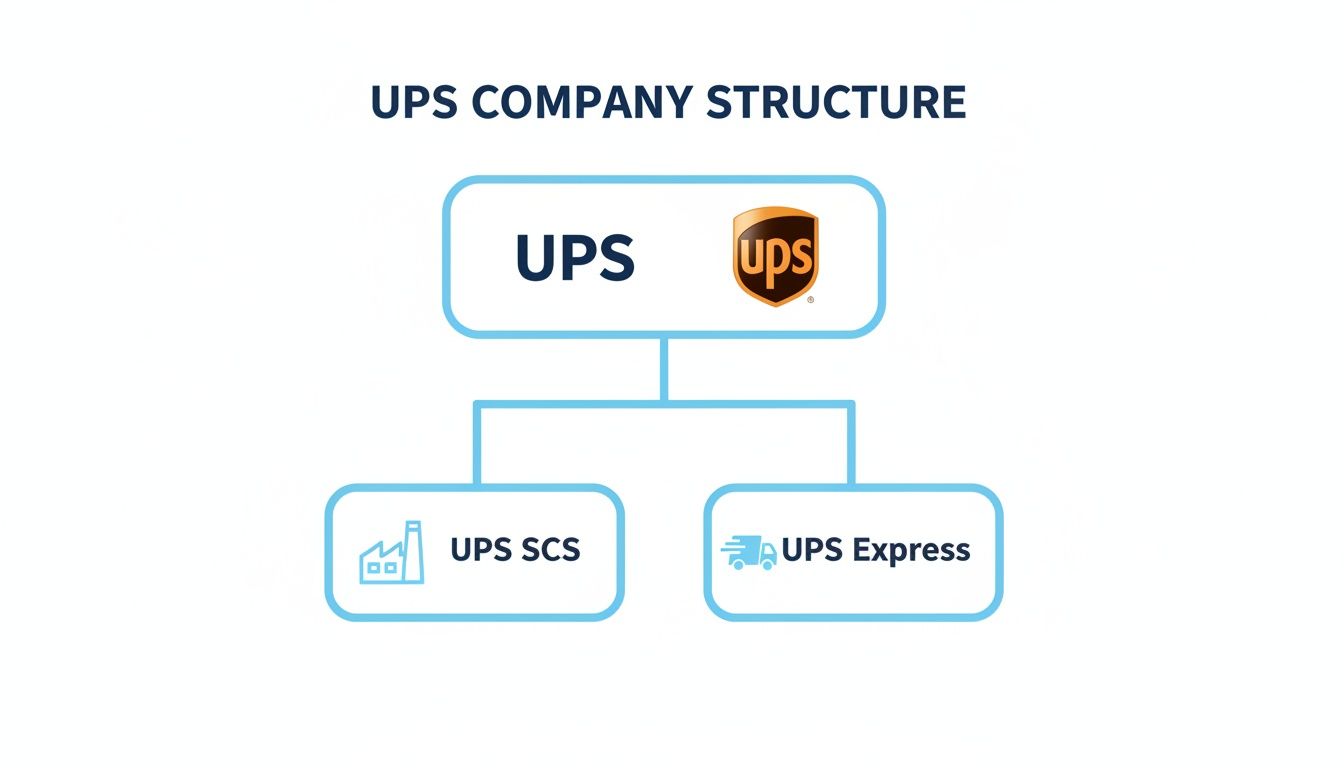
Seeing it laid out like this makes it obvious that UPS SCS is a distinct B2B entity. It's not chasing the same business as the parcel network, and that distinction is crucial for understanding who they target and how they operate in Singapore.
Freight Forwarding: The Air and Ocean Powerhouse
At its core, UPS SCS Singapore is a massive freight forwarder. They move a staggering volume of cargo through the air and across the seas, acting as the critical link between the companies shipping the goods and the asset owners—the airlines and shipping lines.
For air freight, they lean heavily on Singapore Changi Airport's world-class status as a premier cargo hub. This is non-negotiable for their key clients in the high-tech and healthcare sectors, where goods are often extremely time-sensitive. This isn't just about finding space on a flight; it's a full-service operation that includes ground handling, consolidating shipments, and making sure every piece of cargo clears strict aviation security protocols.
Their ocean freight game is just as strong, capitalising on the Port of Singapore's unmatched global connectivity. They've got the full playbook of services:
- Full Container Load (FCL): For clients with enough cargo to fill an entire 20- or 40-foot container.
- Less than Container Load (LCL): The solution for smaller shipments, where they cleverly consolidate freight from multiple customers into a single shared container.
- Specialised Services: Think temperature-controlled "reefer" containers for sensitive pharmaceuticals or handling the logistics for massive, oversized industrial equipment.
Customs Brokerage and Compliance
One of the biggest weapons in the UPS SCS arsenal is their in-house customs brokerage. In the world of cross-border trade—a minefield of red tape and potential delays—this integrated service is a game-changer.
By baking customs clearance directly into the freight forwarding process, UPS SCS delivers a truly seamless "port-to-door" experience. This is a massive weight off a shipper's shoulders. A single mistake on a customs form can bring an entire multi-million dollar shipment to a screeching halt, racking up painful delays and storage fees.
Their expertise here is especially vital for industries like medical devices and electronics, which are saddled with complex import rules, specific documentation, and tricky duty calculations. For any competitor, offering a service this tightly integrated is a very high bar to clear.
Contract Logistics and Warehousing
UPS SCS doesn't just move boxes from Point A to Point B. They also manage them. Their extensive contract logistics services mean they operate entire warehousing and distribution centres for their clients. These aren't just dusty sheds for storage; they are high-activity hubs for managing inventory, fulfilling orders, and providing a whole host of value-added services.
Imagine a global electronics brand. They could use a UPS SCS facility in Singapore to:
- Receive enormous bulk shipments from their factories across Asia.
- Store all that inventory securely in a climate-controlled warehouse right near Changi Airport.
- Have the UPS team perform quality checks or even add localised packaging and manuals.
- Distribute the finished products directly to retailers and distributors all over Southeast Asia.
This is what turns them from a mere transport provider into a deeply embedded supply chain partner. It's a much stickier, more valuable relationship.
The Hidden Connection to Uninterruptible Power Systems
When you think about logistics, ships, planes, and warehouses probably come to mind first. But there’s a prospecting angle for UPS SCS Singapore that’s often missed, hiding in plain sight: the hardware that keeps modern commerce running—specifically, Uninterruptible Power Supply (UPS) systems. And no, this isn't just a clever play on the company's name. It's a direct link to one of Singapore’s most vital and rapidly growing sectors.
Think about what truly powers Singapore’s economy. It’s a global hub for high-tech manufacturing, finance, and, crucially, data centres. The one thing all these industries absolutely cannot function without is clean, stable, uninterrupted electricity. Even a momentary power flicker in a data centre or an automated warehouse isn't a small problem—it's a potential catastrophe, leading to millions in lost data and operational downtime.
Why Power Systems Are a Logistics Goldmine
This absolute need for power reliability has created a huge market for UPS hardware and the tech that goes with it. These systems are the unsung heroes of the digital and automated economy, making sure servers, factory robots, and port machinery run 24/7. For a sharp logistics sales team, this dependency is a golden opportunity.
It breaks down pretty simply:
- Massive Demand: As Singapore's key industries expand, so does their need for new and replacement power systems.
- Sensitive Freight: UPS units aren't just any cargo. They are heavy, delicate, and often contain hazardous materials like large batteries, which means they need specialised handling.
- High-Value Shipments: These are expensive pieces of equipment. Shippers can't afford to take risks, making secure and reliable transport their number one priority.
By grasping just how critical these power systems are, a freight forwarder can approach potential clients not just as another company offering a rate, but as a partner who gets it. A partner who understands the importance of their product. That's a much stronger sales conversation.
Singapore's Uninterruptible Power Supply (UPS) market is booming, projected to grow at a robust CAGR of 6.2% from 2025 to 2031. This growth is driven by the nation's explosive data centre expansion, with over 60 facilities already hosting giants like Google and Alibaba who demand flawless power backups. Discover more insights on the Singapore UPS market.
A Practical Prospecting Strategy
This insight isn't just theory; it's an actionable sales strategy. Instead of sending out generic emails, your team can zero in on the manufacturers and distributors of UPS hardware. You can walk into a conversation already understanding their unique challenges, from navigating complex customs classifications to ensuring their sensitive electronics are handled with care. To get even more specific, check out our guide on the HS code for power supply units to build your expertise.
When you speak their language and show you understand how crucial their products are, you elevate the conversation beyond a simple price quote. You start building a real partnership based on specialist knowledge, tapping into a high-value niche in the tech shipping market that a player like UPS SCS Singapore is almost certainly focused on.
Mapping Their Key Industries and Trade Routes
To go head-to-head with a global logistics giant like UPS, you first need to understand their playbook. It's not just about knowing what they do, but why they do it. By looking at where UPS SCS Singapore focuses its energy and resources, you can spot both their fortresses and the cracks where smaller, more agile players can find an opening.
Their entire strategy is built around serving specific, high-value industries. These are sectors where rock-solid, integrated logistics aren't just a nice-to-have; they're an absolute necessity.
This sharp focus lets them develop deep, specialised knowledge and create solutions that a generalist forwarder just can't match. Think of it like this: if you have a complex heart problem, you don't go to your family doctor. You see a cardiologist. UPS SCS positions itself as that specialist for certain supply chain challenges.
Their High-Value Industry Verticals
UPS SCS Singapore isn't trying to be everything to everyone. That's not their game. Instead, they've doubled down on a handful of sectors that play to Singapore's economic strengths and their own powerful global network.
- High-Tech and Electronics: This is their bread and butter. Singapore is a massive hub for electronics, and UPS is right in the middle of it, providing secure warehousing, specialised anti-static handling, and mission-critical air freight for everything from tiny components to finished laptops.
- Healthcare and Pharmaceuticals: In this field, there's zero room for error. UPS provides sophisticated, temperature-controlled logistics (cold chain), navigates the maze of regulatory compliance, and even handles direct-to-hospital deliveries—services far beyond what most standard forwarders can offer.
- Retail and E-commerce: For big-name brands, UPS is the engine behind the scenes. They manage vast inventory for regional distribution hubs and run the complex fulfilment operations that power a booming e-commerce market.
- Industrial Manufacturing: This vertical involves the heavy lifting—moving machinery, critical spare parts, and raw materials for Singapore’s manufacturing base. It requires real expertise in handling oversized and project cargo.
By zeroing in on these demanding industries, UPS SCS creates incredibly "sticky" client relationships. A med-tech firm that depends on their cold chain expertise isn't going to jump ship to save a few bucks. This makes these clients tough to win over, but incredibly valuable if you can.
Major Trade Lanes and Strategic Routes
Knowing who they serve is one thing, but knowing where the cargo is going is just as important. The main trade lanes UPS SCS Singapore operates are the lifeblood of their network, connecting this little red dot to the world’s economic powerhouses.
Their key routes are all about connecting Singapore with three core regions:
- Intra-Asia: Massive cargo flows move back and forth between mainland China, Hong Kong, Japan, and South Korea. This traffic is the backbone of the regional electronics and manufacturing supply chains.
- Europe: You'll see consistent freight moving to and from major hubs like Frankfurt, Amsterdam, and London. This is typically high-value cargo like pharmaceuticals and advanced technology.
- North America: These are the critical air and ocean lanes to the United States and Canada, serving both import and export demands across all their key industry verticals.
For a local forwarder or NVOCC, this map is a goldmine. It tells you which lanes are dominated by the big players and, more importantly, which ones might be underserved. For any sales team trying to win business, understanding the landscape of active exporters in Singapore is the essential starting point. This intelligence lets you build a smarter pitch—maybe you can offer a faster transit time on a specific route, a more aggressive price point, or the kind of personalised customer service that a global machine sometimes struggles to deliver.
Sizing Up the Competition in Singapore
To go head-to-head with a global powerhouse like UPS, you need to understand exactly how they fit into the local market. While UPS SCS Singapore has a massive global network and brand recognition that few can match, they are far from the only game in town. Singapore’s logistics scene is incredibly crowded and dynamic, and knowing their strengths and weaknesses is the first step to carving out your own space.
Think of the logistics market like vehicles on a highway. UPS SCS is the massive, long-haul lorry. It’s powerful, dependable, and can haul a huge, varied load across continents using a standardised system. For a big multinational corporation that needs a consistent, predictable service to hundreds of destinations, it’s the perfect choice.
Global Integrators vs. Local Specialists
The most obvious competitors are the other global giants—think DHL Supply Chain and Kuehne + Nagel. They all battle on a similar field, offering integrated, end-to-end solutions backed by sprawling global infrastructure. For a shipper, the choice between them often boils down to which one has a stronger presence on a specific trade lane or whether a global contract is already in place.
But the real opportunity for most local players lies in the contrast. Singaporean freight forwarders and agile Non-Vessel Owning Common Carriers (NVOCCs) are the nimble sports cars and delivery motorbikes of the logistics world. They may not have the sheer scale of the global lorry, but they have other critical advantages.
A local forwarder, for example, might have deep, personal relationships at the port that can get a tricky customs issue sorted with a single phone call. That’s a level of hands-on service a global machine often struggles to replicate. To see how another major player positions themselves, you can check out our deep dive on Nippon Express Singapore.
The Achilles' heel for global integrators is often their rigid, one-size-fits-all approach. Their pricing and service models are built for scale and standardisation, making them less flexible for shippers with unique or fluctuating needs.
UPS SCS vs Local Forwarders: A Competitive Snapshot
This table breaks down the core differences in how UPS SCS and a typical local forwarder operate and who they best serve.
| Attribute | UPS SCS Singapore | Typical Local Freight Forwarder |
|---|---|---|
| Ideal Customer | Large MNCs with global, standardised shipping needs. | SMEs or companies with specialised, niche cargo requirements. |
| Key Strength | Global network, integrated technology, brand reliability. | Personalised service, operational agility, deep local knowledge. |
| Service Model | Standardised, process-driven, end-to-end solutions. | Customised, flexible solutions tailored to the client's needs. |
| Pricing | Often based on rigid, global rate structures. | More flexible, can offer spot rates and creative pricing. |
| Weakness | Can be inflexible, bureaucratic, and less personal. | Limited global reach without partners, smaller scale. |
Understanding this distinction is crucial. You aren't just selling against a competitor; you're selling a fundamentally different approach to logistics.
Finding and Exploiting Your Edge
This is precisely where your sales team can press its advantage. While UPS SCS sells the power of its global system, you can sell adaptability, specialised expertise, and direct access to decision-makers.
- Personalised Service: Your clients get a dedicated contact who knows their business inside and out, not a rotating cast in a call centre.
- Pricing Flexibility: Without the massive overheads of a global network, you can often put forward more competitive or creative pricing structures.
- Niche Expertise: Double down on a specific industry or a challenging cargo type that requires specialised handling—the kind of business the big players might find too troublesome.
Ultimately, competing against UPS SCS Singapore isn't about trying to match them feature for feature. It's about identifying the shippers who are a poor fit for the "long-haul lorry" model and showing them the value of a more customised, responsive, and personal logistics partner.
Actionable Strategies for Winning New Business
Knowing the competition is one thing, but actually using that insight to land new clients is where the real work begins. This is how your analysis becomes revenue. For any logistics sales team going head-to-head with UPS SCS Singapore, you need a smart, data-backed plan to find and connect with the right prospects.
The aim isn't to just cast a wide net. It's about surgically targeting shippers who are a perfect match for what you do best. You're looking for businesses operating in the same high-value sectors and trade lanes that UPS SCS owns, but who might be getting frustrated with a rigid, one-size-fits-all approach.
Pinpointing Prime Opportunities
Your first step? Dive into customs data platforms. These tools are absolute goldmines, letting you sift through Singapore's import and export records to find companies shipping high-tech electronics, medical devices, or industrial parts along those key routes into Europe and North America.
When you identify these shippers, you're armed with powerful intel before you even pick up the phone. You can see their shipping volumes, who they're trading with, and get a solid estimate of their logistics spend. This data lets you build a sharp, relevant message that speaks directly to their business.
Imagine ditching the generic sales pitch. Instead, you can open with something like, "I noticed you're regularly moving electronics from Singapore to Frankfurt. We offer specialised handling for sensitive cargo on that exact lane, which could give you a more secure and reliable alternative."
Crafting a Winning Pitch
Once you've built your target list, your outreach has to be on point. Trying to out-muscle UPS on global scale is a fight you won't win. Your real advantage lies in being the more agile, focused, and hands-on partner.
Here’s how to frame your pitch for maximum impact:
- Lead with Flexibility: This is a major pain point for clients stuck with large integrators. Talk about how you create tailored solutions, offer more adaptable pricing, and can pivot quickly when their needs change.
- Flaunt Your Niche Expertise: If you’re a specialist in a certain commodity, like temperature-controlled pharmaceuticals or oversized machinery, put that front and centre. It's your biggest differentiator.
- Sell Superior Service: Emphasise the value of a single, dedicated point of contact who genuinely understands their business. Contrast that with the often anonymous, call-centre experience they might be getting from a global giant.
By blending sharp data analysis with a pitch that highlights your unique value, your team can effectively challenge UPS SCS Singapore and win over high-value clients who are looking for a more responsive and specialised logistics partner.
Got Questions About UPS SCS in Singapore? We've Got Answers.
Here are a few common questions that pop up when logistics pros talk about UPS Supply Chain Solutions in Singapore. Let's clear the air and get straight to what sets them apart from the classic brown trucks.
What's the Real Difference Between UPS and UPS SCS?
Think of it this way: they’re part of the same family, but with completely different jobs. The regular UPS you know—the one with the iconic brown vans—is all about express parcel delivery. Their world revolves around getting individual packages from point A to point B, fast. It’s a machine built for speed and a massive volume of small shipments.
UPS SCS Singapore, however, plays in a totally different league. They are a full-blown third-party logistics (3PL) provider. Instead of small parcels, they manage entire supply chains for big multinational companies. This includes everything from chartering air and ocean freight and navigating complex customs clearance to running massive warehouses.
Which Industries Are Their Bread and Butter?
In Singapore, UPS SCS doesn't try to be everything to everyone. They've strategically zeroed in on high-value, high-stakes sectors where things absolutely cannot go wrong. Their sweet spot is in:
- High-Tech and Electronics: Think secure transport and specialised warehousing for delicate, high-value components.
- Healthcare and Pharmaceuticals: This is where their expertise in temperature-controlled (cold chain) logistics and navigating strict regulations really shines.
- Retail and E-commerce: They act as the engine behind regional distribution hubs and e-commerce fulfilment centres.
- Industrial Manufacturing: They handle the big stuff, like oversized cargo and just-in-time machinery parts.
By focusing so intently on these demanding industries, UPS SCS has built up a deep well of expertise. They become less of a vendor and more of an embedded partner in their clients' operations, which is a massive competitive advantage.
How Do Their Prices Stack Up Against Local Forwarders?
This is where you see the global giant versus the local expert play out. As a rule, UPS SCS Singapore works with a more structured, global pricing framework. Their rates tend to be most competitive for large multinational corporations that ship high volumes consistently and can benefit from a standardised, global contract.
A local freight forwarder, on the other hand, is usually far more flexible and dynamic with their pricing. They’re the ones who can give you a sharp spot rate for a one-off shipment or build a completely custom pricing model for a small or medium-sized business with unique needs. While UPS SCS sells system-wide reliability, the local players often win on agility and cost.
Ready to stop guessing and start targeting the right shippers? Coreties transforms global trade data into your next hot lead list. Our platform helps you find qualified prospects, get verified contact details, and craft data-driven outreach that wins business. See how much faster you can build your pipeline at https://coreties.com.