Plastic Zone Tarzana: A B2B Investigator’s Guide for 2026
You've found a supplier name, a city reference, and just enough conflicting business data to make a routine sourcing task turn into a risk review. The RFQ draft is open. Your operations team wants lead times confirmed. Sales wants alternatives ready. But when you look up Plastic Zone Tarzana, the record doesn't resolve into one […]
You've found a supplier name, a city reference, and just enough conflicting business data to make a routine sourcing task turn into a risk review. The RFQ draft is open. Your operations team wants lead times confirmed. Sales wants alternatives ready. But when you look up Plastic Zone Tarzana, the record doesn't resolve into one clear supplier profile.
That's the key issue. Plastic Zone Tarzana isn't just a company lookup problem. It's a supplier verification problem. For procurement and logistics teams, that distinction matters because bad entity data doesn't stay in a spreadsheet. It spills into freight planning, compliance checks, and vendor onboarding.
Tarzana itself is a real place, a Los Angeles neighborhood in the San Fernando Valley with a documented population of 38,184 as of November 2025, according to Tarzana's public profile. But a real location doesn't guarantee a clear supplier identity. With Plastic Zone Tarzana, the public record points in different directions, and that's exactly where disciplined procurement work begins.
The Tarzana Supplier Puzzle
A buyer searching for an acrylic fabricator usually expects a familiar pattern. You confirm the legal name, match the operating address, review capabilities, and move into qualification. With Plastic Zone Tarzana, that sequence breaks down early.
One trail suggests a legacy operation associated with custom plastic fabrication. Another suggests a different classification altogether. That sounds minor until you remember how procurement teams work. Category fit drives outreach. Outreach drives RFQs. RFQs drive scheduling, routing, and customer commitments.

When a simple supplier search becomes an investigation
A plastics buyer may search “Plastic Zone Tarzana” expecting to verify whether the company can supply acrylic sheets, handle custom cuts, or support fabrication work tied to a downstream manufacturing schedule. Instead, the data forces a different set of questions.
- Is this the same business entity listed across multiple directories, or a stale branch reference that remained online after operations changed?
- Is the Tarzana site active in any meaningful operating sense, or is it part of an older business footprint still circulating in public listings?
- Does the classification reflect actual capability, or is the directory taxonomy inaccurate enough to mislead a purchasing team?
Those aren't academic concerns. If your team sends a specification package to the wrong type of supplier, you lose time twice. First during initial outreach, then again when your team has to replace the vendor and rebuild internal confidence in the shortlist.
Practical rule: If a supplier's identity is unclear at the search stage, treat capability claims as unverified until primary records and direct responses line up.
Why this case matters beyond one Tarzana listing
Plastic Zone Tarzana is useful because it exposes a common procurement blind spot. Teams often assume that repeated directory references equal validation. They don't. Repetition can merely mean one bad record has been copied into several places.
That's why this case deserves a closer look. Not because every ambiguous vendor is risky by default, but because ambiguity changes the burden of proof. The supplier may be legitimate, capable, and responsive. Procurement still has to prove that before volume, timelines, or customer expectations are attached to the relationship.
The Official Story vs The Public Record
The most important fact in this case is the conflict itself. According to a ZoomInfo company profile reference, some sources cite Tarzana as a legacy site established in 1985 specializing in custom fabrication, while Manta.com reportedly lists the entity as established in 2005 and categorized under “Mold Makers.” That creates a 15-year gap and a direct clash in industry classification.
That's not a minor profile discrepancy. It creates two different supplier narratives.
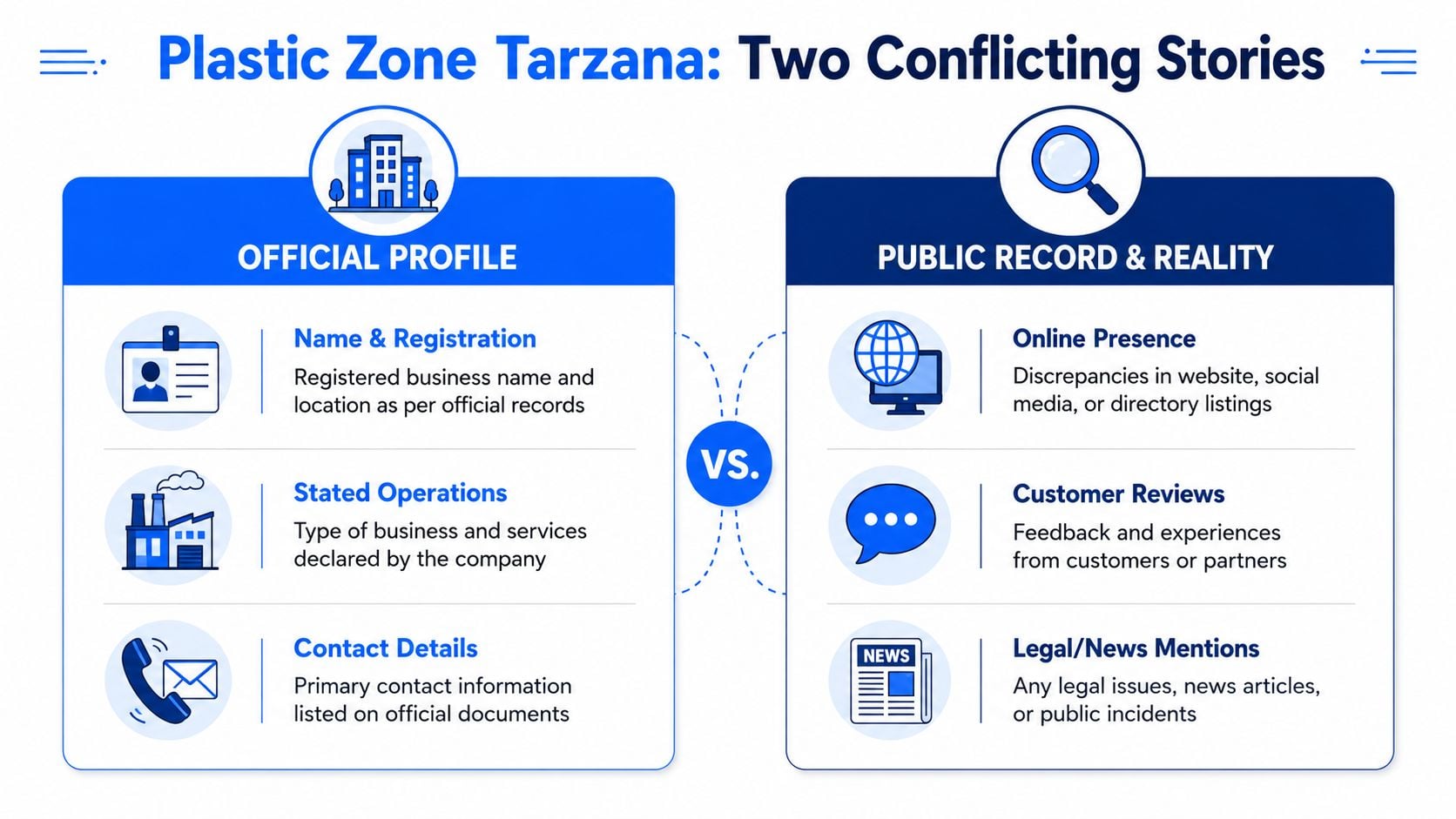
Two incompatible business identities
One version presents Plastic Zone Tarzana as a legacy plastic fabrication operation. In procurement terms, that implies familiarity with fabricated plastic components, custom work, and possibly materials handling tied to acrylic and related production needs.
The competing version labels the business under mold making. That points buyers toward a very different capability set, different quoting assumptions, and potentially a different production model. A mold maker and a plastic fabricator can overlap in the broader manufacturing world, but they are not interchangeable categories for sourcing.
Here's the conflict in a side-by-side format.
| Attribute | Legacy Profile (Fabricator) | Directory Profile (Mold Maker) |
|---|---|---|
| Business history | Established in 1985 | Established in 2005 |
| Apparent focus | Custom fabrication | Mold makers classification |
| Procurement implication | Material and fabrication sourcing candidate | Tooling or mold-related sourcing candidate |
Why classification conflict matters more than it seems
Procurement teams rely on categorization to narrow options fast. If the label is wrong, your process gets distorted before anyone makes contact.
Consider what each classification tells your team:
- Plastic fabricator suggests the supplier may process sheets, components, or custom fabricated parts.
- Mold maker suggests tooling expertise, mold production, or an adjacent manufacturing role.
- Legacy site language hints at historical continuity, but doesn't confirm current operations.
A buyer reading those records may assume the difference is clerical. That assumption is dangerous. The category affects what drawings you send, which stakeholders join the review, and whether logistics starts planning around inbound material, custom parts, or tooling.
The risk isn't only that one record is wrong. The risk is that no public source clearly resolves which record reflects present reality.
What procurement should do with conflicting records
At this stage, don't force certainty where the record doesn't support it. Label the supplier as unresolved inside your sourcing workflow until you verify legal identity, current operating status, and actual service scope.
This is also where document comparison matters. If your team is reviewing vendor forms, certificates, onboarding paperwork, or contradictory profile screenshots, tools such as LegesGPT's AI document review platform can help organize discrepancies before legal or compliance teams spend time on manual review.
For logistics teams, the same discipline applies to trade documentation and reporting workflows. If you're building a stronger intake process around vendor and shipment data, this port import export reporting service guide is a useful operational reference because it frames how reporting gaps can distort downstream decisions.
Why Supplier Ambiguity Cripples Your Supply Chain
Most supplier ambiguity doesn't announce itself as a crisis. It enters through a vendor list, a copied directory entry, or an old branch reference that nobody challenged. Then your team builds a plan on top of it.

The verified record for this topic includes a stark warning. It states that 30% of procurement delays stem from vendor misclassification, but the provided citation for that figure is not available in the source set given here. Because that claim isn't fully supported by a verifiable linked source in this brief, it shouldn't be used as a planning fact. Even without that number, the logic still holds. Misclassified vendors waste buying cycles and create preventable delay.
Where the damage actually shows up
The first failure point is the RFQ. If your team thinks it's contacting a fabricator but the company operates in a different category, your inquiry won't match the supplier's workflow. The reply may be delayed, redirected, or ignored because the request doesn't fit the business.
The second failure point is internal alignment. Engineering, procurement, and logistics may each interpret the supplier differently. That produces mismatched assumptions on packaging, production readiness, and shipment timing.
Then freight planning gets pulled into a problem it didn't create. If sourcing expected fabricated acrylic output and the supplier relationship turns out to involve a different capability, your transportation assumptions are suddenly detached from reality.
Why ambiguity spreads operational risk
A confusing supplier profile can trigger several downstream problems at once:
- Wasted qualification effort because your team reviews insurance, tax, or onboarding paperwork for an entity that may not fit the category.
- Weak backup planning because the vendor remains on the shortlist longer than it should.
- Poor customer communication because sales or operations speaks with confidence before supplier status is confirmed.
Teams that audit these failure points systematically often use checklists similar to a UK supply chain audit guide, especially when the issue is less about pricing and more about traceability, role clarity, and documentary consistency.
A related discipline is regulatory exposure review. If supplier records don't align, your risk isn't limited to service disruption. It can spill into onboarding controls and documentation standards, which is why a structured regulatory risk management process belongs in vendor qualification, not only in compliance remediation.
A short briefing on supply chain verification helps frame the issue from an operations angle:
The procurement takeaway
A supplier with unclear identity shouldn't be treated as a normal sourcing candidate. It should be treated as an exception case. Exception cases need tighter documentation, narrower assumptions, and a faster escalation path when answers don't come back clean.
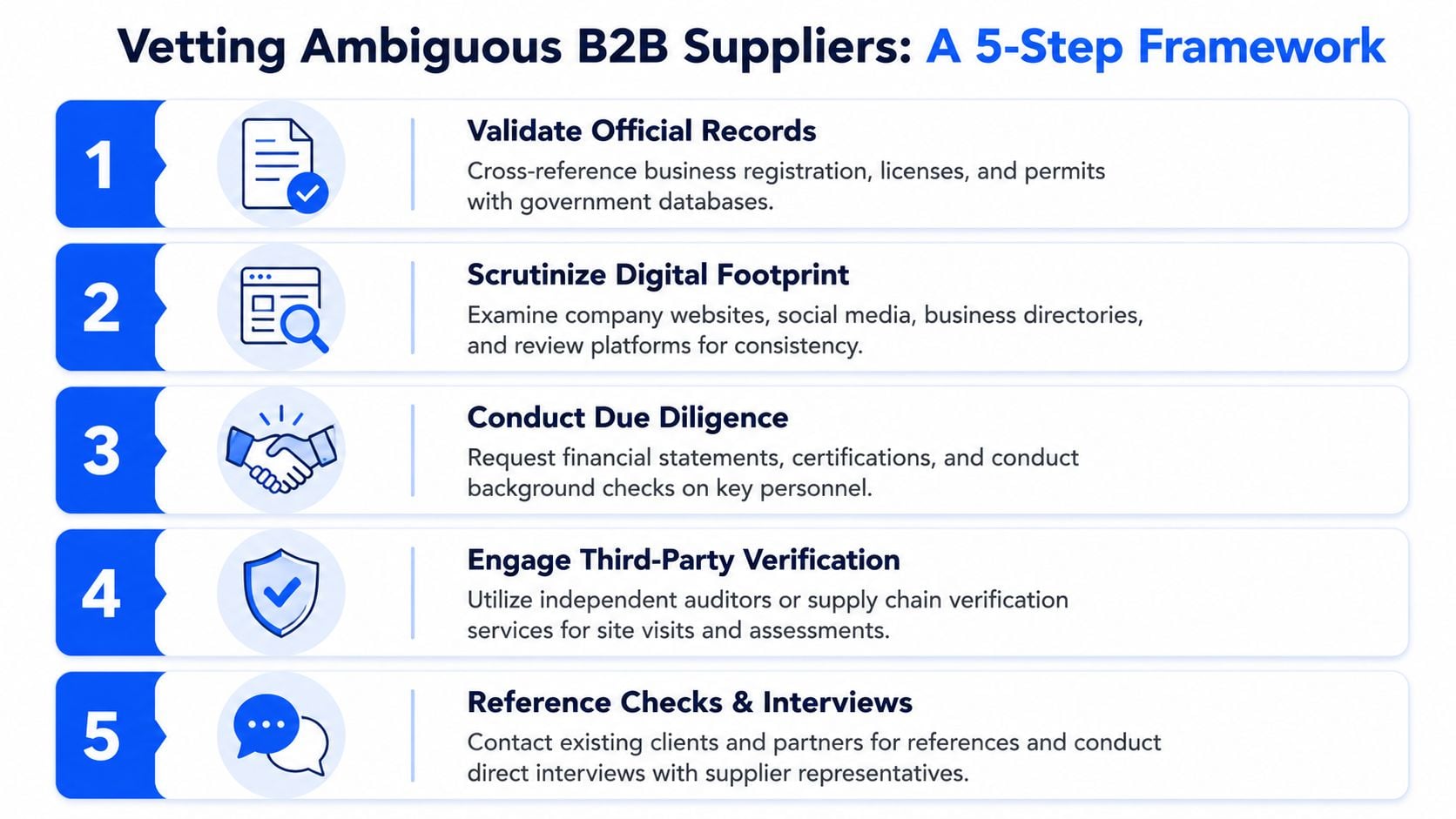
A Framework for Vetting Ambiguous B2B Suppliers
When public records conflict, speed matters less than sequence. Teams that move carefully at the start usually lose less time overall because they avoid rebuilding the supplier file later.
Start with source hierarchy
Not all records deserve equal weight. A government filing, signed certificate, or direct company response should outrank a scraped directory listing every time.
Build your review order like this:
- Primary records first. Legal registration, permits, tax documentation, and current certificates.
- Direct supplier statements second. Capability decks, signed emails, line cards, and onboarding forms.
- Secondary records last. Directories, list aggregators, and copied profile pages.
That hierarchy stops your team from treating broad web visibility as proof.
Field note: A supplier with five matching directory listings may still have only one original error behind all five.
Compare identity, capability, and operating status separately
Many teams bundle these into one question. That's a mistake. A supplier can be legally real, commercially reachable, and still misrepresented in capability.
Use three separate checks:
- Identity check. Confirm the legal entity name, address, and who is authorized to represent the business.
- Capability check. Ask what the site currently produces or services, not what older listings say it once did.
- Operating status check. Verify whether the location is active, administrative, legacy, or part of a larger entity structure.
This separation makes outreach sharper. It also reduces the chance that a polite but vague sales reply gets mistaken for full qualification.
Run a digital footprint review
Public contradictions usually leave traces. Look for inconsistency across websites, archived pages, professional profiles, and business listings. You're not looking for perfection. You're looking for coherence.
A practical review includes:
- Website consistency. Does the company describe one business model consistently across pages?
- Professional presence. Do employee profiles align with the claimed services?
- Directory drift. Do category labels vary depending on the platform?
If your team wants a broader due diligence checklist beyond basic procurement review, Sentry Private Investigators' due diligence offers a useful framework for thinking about verification layers and contradiction handling.
Use controlled outreach
Don't begin with a broad request like “Tell us about your services.” Ask narrow questions that force clear answers.
A strong first email asks for:
- current operating location,
- primary product or service category,
- whether the Tarzana reference is an active site,
- the right contact for technical qualification.
That kind of outreach reveals a lot from the response itself. Fast, precise answers usually indicate operational clarity. Vague responses often signal either weak internal controls or a mismatch between public identity and current operations.
Build a decision gate before onboarding
Your team needs a simple threshold for moving a supplier from ambiguous to qualified. Without that, unclear vendors linger in the pipeline.
Use a gate such as:
| Review area | Minimum evidence to proceed |
|---|---|
| Legal identity | Matching business records and contact confirmation |
| Capability | Direct statement of current services with supporting documents |
| Location status | Confirmation that the referenced site is active or clearly defined |
| Risk ownership | Internal sign-off from procurement or compliance |
For teams that source by trade lane or commodity history, one option is a platform like Coreties' supply chain databases resource, which describes how company-level shipping and importer data can support qualification research when directory data alone is thin.
The Unique History of Tarzana California
Tarzana's name carries more history than many buyers realize. The neighborhood's identity is tied to 1912, when Edgar Rice Burroughs' Tarzan of the Apes appeared in All-Story Magazine, as noted by the Tarzana Neighborhood Council history page.
That literary connection later became geographic. Local history records note that Burroughs purchased the former estate of General Harrison Gray Otis and called it the Tarzana Ranch. Over time, the surrounding area took on that name.
Why the location context matters
For procurement teams, local history won't qualify a supplier. But it does sharpen one useful distinction. Tarzana is a place with a defined identity, not just a keyword attached to a business listing. That matters when you're testing whether a location reference in a supplier profile reflects a real operating footprint or borrowed geographic familiarity.
A neighborhood with a distinctive historical identity can produce many stale or derivative references over time. Buyers should resist the assumption that a recognizable place name adds credibility to a business record. It only confirms that the place exists.
A real neighborhood can still contain an unclear supplier record. Location legitimacy and supplier legitimacy are separate questions.
Frequently Asked Questions for Procurement Teams
Is Plastic Zone Tarzana a fabricator or a mold maker
Current public records do not support a firm classification. The available evidence points in two directions, with one profile indicating fabrication activity and another suggesting mold-making. Procurement should treat capability as unconfirmed until the supplier ties its current services to a specific legal entity, operating address, and recent customer or production evidence.
Should procurement contact the company anyway
Yes, with controls.
Use first contact to verify identity, not to start quoting. Ask for the legal business name, active operating location, current service scope, and the right contact for technical review. If the reply is partial, inconsistent, or routed through a generic sales response that avoids specifics, stop the process until those gaps are resolved.
What is the biggest practical risk in cases like this
False fit is the main risk. A team may place the supplier into a sourcing lane before basic facts are settled, then build timelines, RFQ assumptions, and customer commitments around an unproven match.
The cost shows up later in avoidable ways. Engineering may review the wrong capability set. Procurement may request pricing from an entity that cannot perform the work. Logistics may hold space in a production schedule for a supplier that was never operationally qualified.
How should a buyer classify this supplier internally right now
Use a status that signals uncertainty clearly. Good options include unverified, entity conflict, capability unresolved, or location unconfirmed.
That labeling matters because internal systems often create implied approval. Once a supplier is entered loosely, sales, engineering, and operations may treat it as usable even when the file still contains unresolved conflicts.
Does the Tarzana location itself tell us anything useful
Yes, but only at the geographic level. Tarzana is a real Los Angeles neighborhood with its own civic identity, as described in the Tarzana community overview. That helps confirm the place name is not fabricated.
It does not confirm that a specific supplier at that location is active, reachable, or capable of doing the work your team needs.
What should buyers ask in the first outreach email
Keep the message narrow and verifiable. Request the current legal business name, whether the Tarzana site is active, the primary service category, the manufacturing or tooling processes offered today, and the contact responsible for technical qualification.
Do not send drawings, annual volumes, or target pricing in the first exchange. Release those details only after the supplier clears the identity and capability check.
When should the supplier be removed from consideration
Remove or deprioritize the supplier when contradictions remain after direct outreach, or when provided documents do not match the claimed entity, address, or service line.
A reasonable response delay is not the issue. Persistent mismatch is. If a supplier cannot establish who it is and what it does, it should not stay in an active sourcing pipeline.
If your team needs a cleaner way to research shippers, verify trade activity, and build more reliable outreach lists before supplier ambiguity turns into pipeline waste, Coreties provides logistics-focused lead discovery and customs-data workflows that can support earlier, better-informed qualification.