A Complete Guide to PCB Board HS Code Classification
The main HS code for a printed circuit board is 8534, which covers bare, unpopulated printed circuits. But that simple number is just the beginning. The correct code changes dramatically the moment you add components, turning that bare board into a Printed Circuit Board Assembly (PCBA). Getting this distinction right is the single most important […]
The main HS code for a printed circuit board is 8534, which covers bare, unpopulated printed circuits. But that simple number is just the beginning. The correct code changes dramatically the moment you add components, turning that bare board into a Printed Circuit Board Assembly (PCBA). Getting this distinction right is the single most important step to avoiding expensive shipping delays and customs fines.
Cracking the Code: Understanding PCB HS Codes
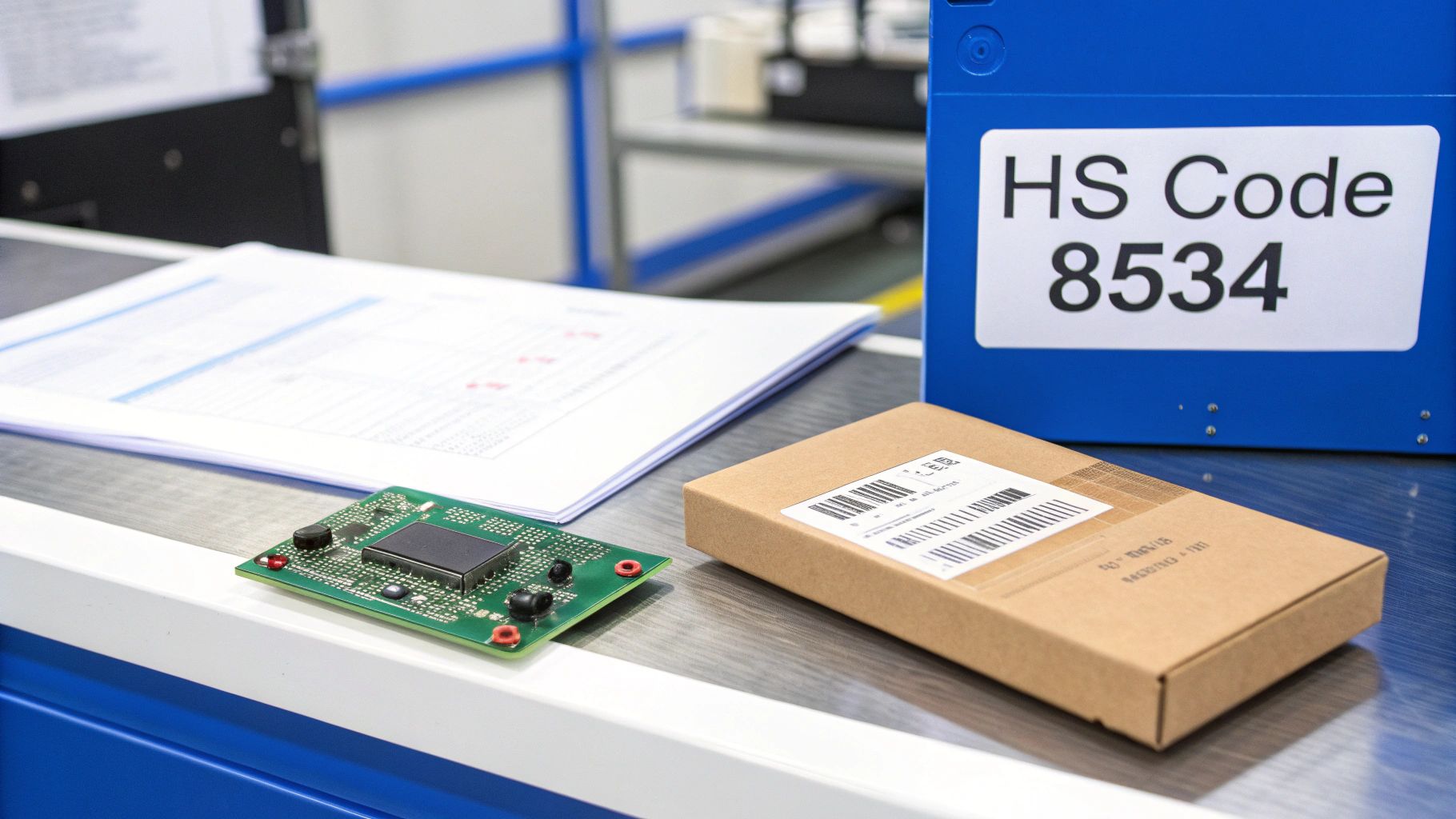
Trying to ship electronic components internationally can often feel like speaking a different language. The Harmonized System (HS) code is that language—a universal classification system that customs authorities all over the world use to identify products, calculate duties, and gather trade data. Think of it as a global passport for your goods; it makes sure every country knows exactly what's inside the box.
For anyone working in electronics logistics, knowing your PCB HS codes isn't just about ticking a box. It's a core skill. The wrong code can flag your shipment for inspection, slap you with surprise tariffs, and even damage your relationship with your customers. Nail it, and your shipments will glide through customs, saving you a world of time and money.
Why This Code Matters So Much
The HS code is built like a pyramid, breaking products down from broad categories into very specific items. It starts with a general Chapter, gets more specific with a Heading, and then drills down even further with a Subheading. The first six digits are the same everywhere, creating a universal standard for global trade.
It’s this shared system that lets a customs officer in Singapore understand a shipment from Germany without needing to read a complex technical manual. It makes the whole process predictable.
The most crucial factor in determining the correct HS code is the board's state: is it bare or populated? This single distinction changes everything, from the primary heading used to the potential duties owed.
Bare vs. Populated Boards: A Critical First Step
The heart of PCB classification comes down to one question: is it a bare board or an assembly?
A bare Printed Circuit Board (PCB) is just the foundation. It's the flat board etched with conductive pathways, but with no electronic components soldered onto it yet. These fall cleanly under HS Heading 8534.
But the second you solder on components like microchips, resistors, or capacitors, it becomes a Printed Circuit Board Assembly (PCBA). This completely changes its "essential character" in the eyes of customs. It's no longer just a circuit; it's now a functioning electronic module.
As a result, its classification shifts to entirely different headings. It might fall under HS 8542 for integrated circuits, or even be classified under the chapter for the final product it's designed to be part of. We’ll walk through how to make this call with confidence, paving the way for smooth, accurate customs declarations.
Decoding HS Code 8534: The Language of Printed Circuits
Think of a product’s HS code not as a random set of numbers, but as a universal language that tells customs officials its story. For bare, unpopulated printed circuit boards, that story begins with Chapter 8534. This is the specific identifier that tells everyone, from a customs agent in Singapore to one in Germany, that you’re shipping a bare printed circuit.
The whole system works on a simple idea: getting more specific with each set of numbers. Every two digits you add drills down further into the product's details, like filtering search results. The first six digits are the most important, as they are standardised across the globe, creating a common ground for international trade.
This global standard is what makes trade work smoothly. It means an agent doesn't need to be a circuit board engineer to understand what they're looking at. The code does the talking, classifying a complex component into a clear category for assessing duties and taxes.
The First 6 Digits: A Universal Standard
Let's break down the most common code for bare PCBs, 8534.00, to see how this hierarchy works in practice.
- Chapter 85: This is the top-level category. It covers all "Electrical machinery and equipment and parts thereof," placing your PCB squarely in the electronics family.
- Heading 8534: This narrows it down significantly to just "Printed circuits." Now, customs knows it’s a board designed for mounting components, not a finished product.
- Subheading 8534.00: This final pair of digits, at the international level, often simply confirms the item is a printed circuit, with no other bells and whistles.
This screenshot from the World Customs Organisation's Trade Tools shows how the system funnels down from a broad section to a very specific product heading.
As you can see, it’s a logical path from a massive category of goods down to the precise item you’re shipping.
Getting Specific: Subheadings for Different PCB Types
While 8534.00 is a great starting point, the real world of PCBs is far more diverse. At the 8- or 10-digit national level, customs codes get much more granular to account for this. This is where the physical characteristics of the board come into play, and knowing them helps you get the classification right every time.
Two of the most common differentiators are:
- Layer Count: Is it a simple single-sided board, a double-sided one, or a complex multilayer PCB? Often, boards with more than four layers get a different national code (like one ending in .10) compared to those with four or fewer (which might end in .90).
- Flexibility: Is the board rigid, made from a material like FR-4, or is it a flexible circuit (FPC) designed to bend and fit into compact devices? This is a critical distinction in modern electronics and has its own classification path.
The trade volumes tell the story of how important these distinctions are. For example, Singapore's imports under HS Code 85340090, which often covers simpler multilayer PCBs, hit USD 98.50 million. This came from 3,330 shipments and 397 suppliers, showing just how much activity falls under one specific national code. You can explore more insights on Singapore's PCB import data and its supply chain.
By getting a handle on this logic, you stop guessing. You can confidently ask your clients for the specific details—layer count, material, flexibility—that you need to nail the customs declaration. This precision is what prevents costly delays and rejections at the border.
Classifying Populated PCBs and Assemblies Correctly
One of the most frequent—and costly—mistakes in electronics logistics is misclassifying a populated printed circuit board. As soon as you add components, a bare board's identity completely changes in the eyes of customs, and so must its pcb board hs code. Getting this wrong can trigger major delays, hefty fines, and incorrect duty payments.
Think of a bare PCB under HS Code 8534 as an empty street grid. It has potential, with roads and plots laid out, but it doesn't do anything specific just yet. The moment you start adding buildings (microchips), traffic lights (capacitors), and power lines (resistors), it’s no longer just a grid. It has become a functional city, a living system with a distinct purpose.
This transformation is what customs officials call a change in "essential character." The board is no longer just a "printed circuit"; it's now a functional electronic module. This critical shift means it can no longer be classified under the generic heading 8534.
The Shift Away from HS Code 8534
Once a PCB is populated, it becomes a Printed Circuit Board Assembly (PCBA). Its classification now hinges on its primary function or the main component that gives it its purpose. This is where precision becomes everything, as the new HS code could land in a completely different chapter.
Here are some of the most common destinations for a PCBA's HS code:
- HS Code 8542: This heading covers "Electronic integrated circuits." If your assembly's principal function comes from a powerful microchip, microcontroller, or memory module, it will almost certainly be classified here.
- HS Code 8517: This is for "Telephone sets… and other apparatus for the transmission or reception of voice, images or other data." A PCBA designed for a router or a mobile communication device would fall squarely under this heading.
- Chapter 90: This chapter is for "Optical, photographic, cinematographic, measuring, checking, precision, medical or surgical instruments and apparatus." A PCBA built specifically as the brain of a medical scanner would be classified as a part of that device.
The logic is simple: the final function dictates the classification. The board is no longer defined by what it is (a circuit) but by what it does.
This decision tree infographic helps visualise the classification journey, starting from the broad Chapter 85 and drilling down based on whether the board has components.
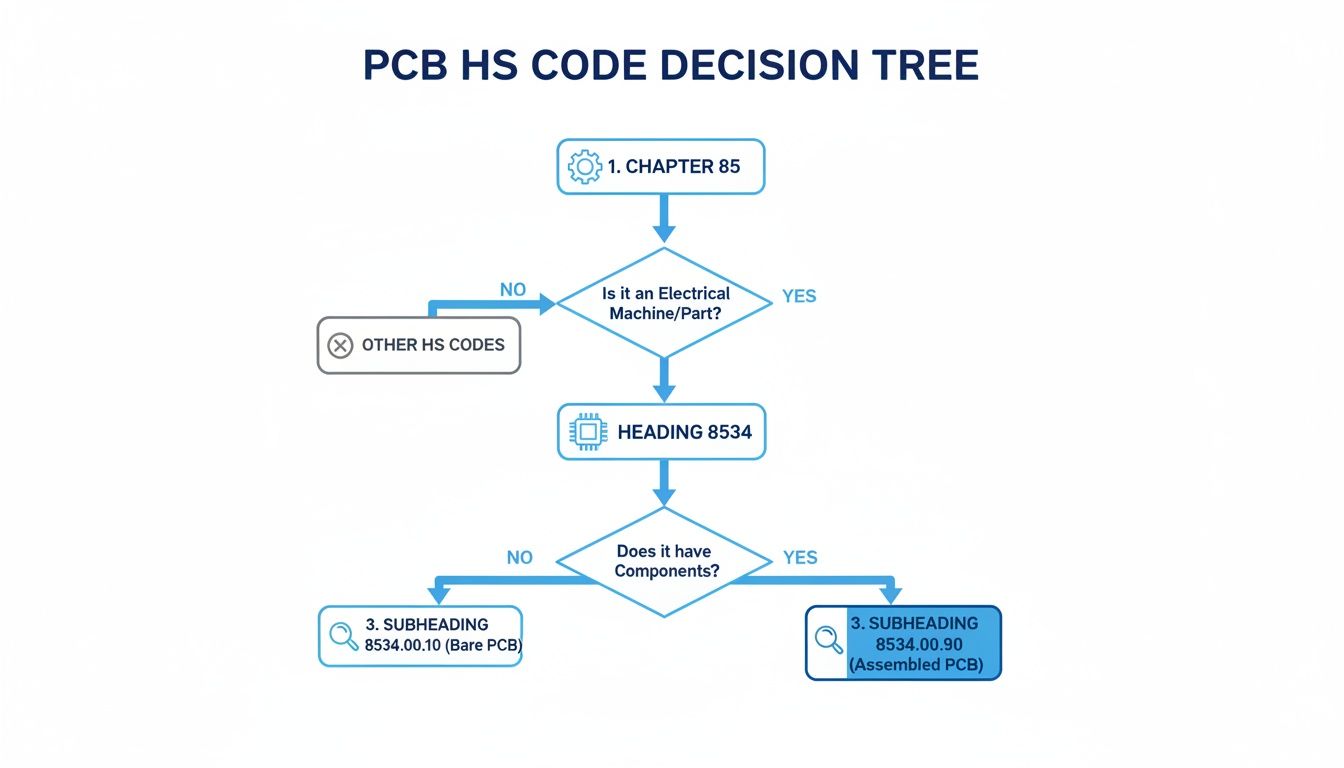
The key takeaway here is that the presence of populated components is the main fork in the road. It sends you down a completely different classification path than a bare board.
Practical Checklist for Populated Boards
To sidestep the common pitfalls, run through these questions before assigning a pcb board hs code to your assembly. This simple checklist helps you think like a customs official and cover all the bases they use to determine the correct classification.
-
What is the principal function of the assembly?
- Does it process data like a computer motherboard? (Could be 8473)
- Does it manage power like a voltage regulator? (Could be 8504)
- Is it an integrated circuit that acts as the "brain" of a device? (Likely 8542)
-
Is the assembly a "part" of a larger machine?
- If the PCBA is exclusively designed for one specific product—like a car's engine control unit—it should be classified as a part of that product under its chapter.
- This requires clear documentation proving its dedicated use.
-
What component gives the board its essential character?
- Pinpoint the most significant or highest-value component on the board. A PCBA with a powerful central processing unit (CPU) is fundamentally different from one whose main job is to light up a few simple LEDs.
The golden rule for PCBAs is to classify the assembly based on its primary function, not its physical form. A board populated with a GPS module is a GPS device, not just a circuit board.
By adopting this function-first mindset, you align your declarations with customs logic. This proactive approach not only ensures compliance but also minimises the risk of your shipments getting stuck, protecting both your timeline and your bottom line.
Navigating Country-Specific Tariff Codes
The first six digits of a PCB HS code are like a universal language for customs officials, a shared standard that works the same way from Singapore to Spain. But that’s where the global harmony stops. After the sixth digit, each country or trading bloc tacks on its own suffix—usually two to four more numbers—creating a national tariff code. This is where global trade gets local, and it’s these last digits that actually determine duties and taxes.
Think of it like a global phone number. The first part (the country and area code) gets you to the right city, but you need the final, unique digits to reach a specific house. For a freight forwarder, mastering these local variations is the secret to giving clients accurate landed-cost estimates and preventing nasty surprises at the border. An identical 4-layer PCB can face completely different duty rates depending on whether it's landing in the US, the EU, or right here in Singapore.
This divergence means that relying solely on the 6-digit HS code is a recipe for disaster. You have to dig deeper and use the destination country's specific tariff system to find the full 8 to 10-digit code.
Comparing Major Trading Blocs
Different economic regions have their own systems for extending the HS code. Getting a handle on how these national codes are structured is absolutely vital for anyone managing an international electronics supply chain.
- United States (HTSUS): The US uses the Harmonized Tariff Schedule of the United States, which extends the code to 10 digits. These last four digits provide incredible specificity, differentiating products to apply various trade agreement benefits or, in some cases, punitive tariffs.
- European Union (TARIC): The EU uses the Integrated Tariff of the European Communities (TARIC), another 10-digit system. The first eight digits (known as the CN code) are used for export declarations and stats, while the full 10 digits are mandatory for import declarations to apply duties, quotas, and other regulations.
- Asian Markets: Many major players in Asia, like China, Japan, and South Korea, typically use 8 to 10-digit codes. Each nation tailors its system to reflect its own industrial policies and trade agreements.
The key takeaway is simple: a single product needs multiple, distinct tariff codes depending on where it’s going. This is a crucial detail that can make or break shipping costs and customs clearance times.
For freight forwarders, the difference between a 6-digit and a 10-digit code is the difference between a rough guess and a professional, accurate quote. It demonstrates expertise and protects your client from unforeseen expenses.
This becomes especially important in markets with their own complex regulations. For instance, navigating the specific tariff requirements for Indonesia involves understanding local nuances that go well beyond the global standard. You can explore a detailed breakdown in our guide on the Indonesia HS code system.
A Practical Example of Code Variation
To see how this plays out in the real world, let's look at how a standard, 4-layer rigid PCB gets classified across different regions. It’s the perfect way to see how the same product is treated differently from a customs perspective.
This table shows just how much the final code can change for the very same item.
Example of HS Code Variation for a 4-Layer Rigid PCB
| Region/Country | Example Tariff Code | Structure Explanation |
|---|---|---|
| Global Standard | 8534.00 | The 6-digit international heading for all printed circuits. |
| United States | 8534.00.0040 | The HTSUS code specifies "Plastics impregnated, multilayered" with 4 layers or less. |
| European Union | 8534.00.19 | The 8-digit CN code for multilayered printed circuits. |
| Singapore | 8534.00.90 | This local code covers many multilayered circuits, reflecting its trade focus. |
As you can see, what starts as a simple 8534.00 branches out into highly specific national codes that determine the final landed cost. It's a small detail with a big financial impact.
Drilling down into Singapore's trade dynamics under HS Code 8534.00.90 reveals a thriving import scene valued at USD 98.50 million. This comes from 3,330 shipments to 357 importers from 397 suppliers—a testament to the island's status as a logistics nerve centre in SG. For forwarders looking to find high-potential electronics clients, these figures are pure gold. You can discover more insights about Singapore's import landscape on OEC.world.
Best Practices for Customs Documentation
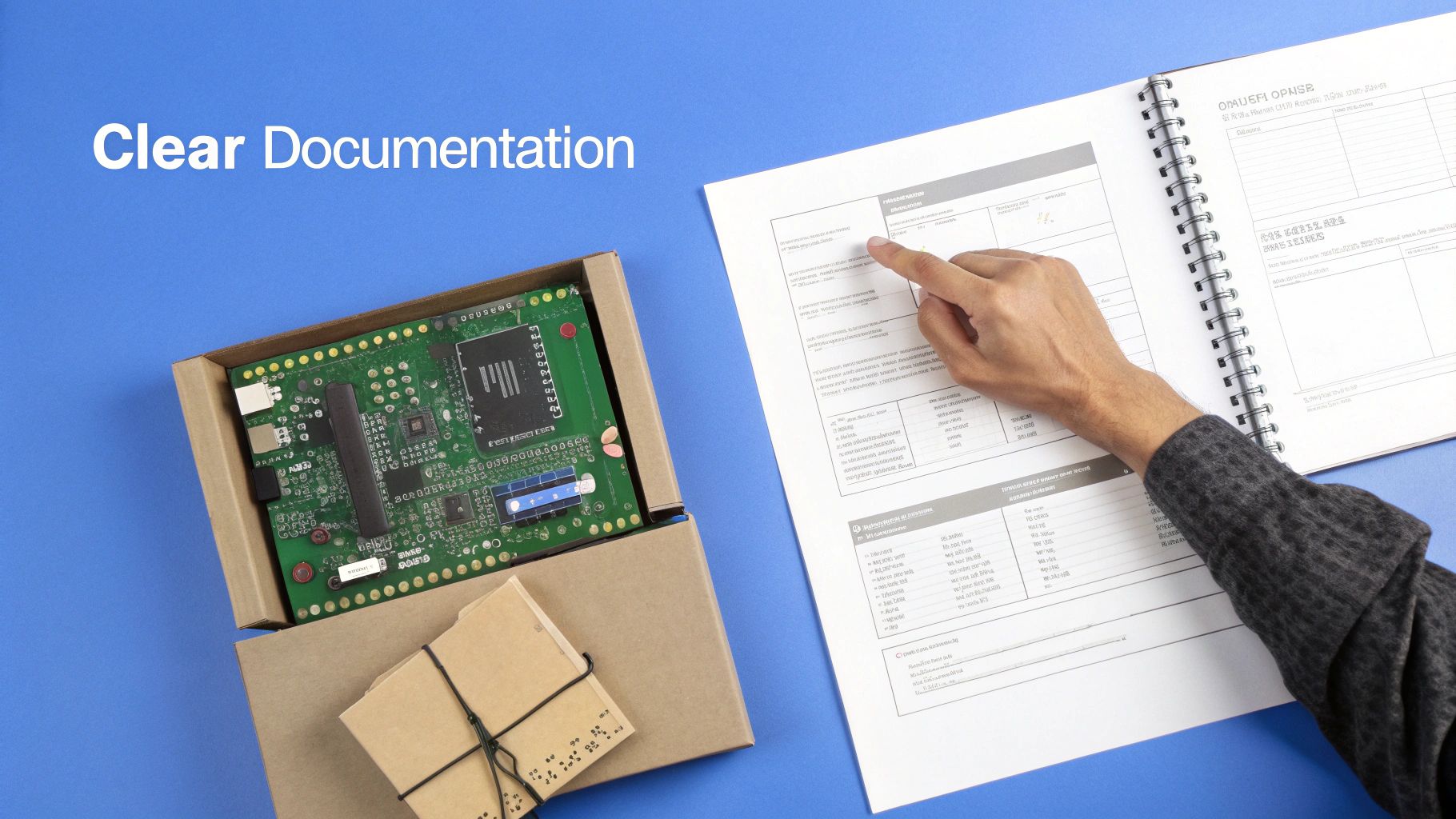
Nailing the right pcb board hs code is a huge step, but it's only half the battle. That code needs to be backed up by airtight customs documentation. Think of your HS code as the headline and your documents as the full story. If they don't tell the same tale, customs officials will hit the pause button, and that means delays and inspections. Getting your paperwork in order from the get-go is the secret to a smooth, predictable supply chain.
The commercial invoice is ground zero for this process. It needs a clear, straightforward, and non-technical description of your goods. This is where so many shipments go wrong.
Crafting a Clear Product Description
Vague descriptions are a massive red flag for customs. Using lazy terms like "electronic parts" or "circuit components" is asking for trouble. An inspector’s job is to make sure your declared HS code actually matches what’s in the box, and a generic description gives them zero confidence. It pretty much forces them to open up your shipment, costing you precious time and money.
Instead, your description needs to be specific enough that someone who isn't an electrical engineer can understand it. Most importantly, it must line up perfectly with the HS code you’ve chosen.
- Weak Description: "Electronic Parts for Machine"
- Strong Description: "Bare, 4-Layer Rigid Printed Circuit Boards (Unpopulated)"
See the difference? The strong example instantly justifies a classification under HS code 8534. It tells the officer the board's state (bare), its layer count (4-layer), and its physical type (rigid). There's no room for guessing.
The whole point of your product description is to make the customs officer's job easy. Give them enough detail to justify your HS code at a glance, and your odds of a lengthy inspection drop dramatically.
Knowing When to Include Supporting Documents
For a simple shipment of bare boards, a perfectly crafted commercial invoice will usually do the trick. But as the complexity of your shipment grows, so does the need for extra paperwork. This is particularly true for populated boards (PCBAs) or any item classified as a component of a larger machine.
For these more complex shipments, you should consider including:
- Technical Datasheets: For a PCBA, a datasheet clearly explains the board’s function. This helps justify a more specific classification, like under heading 8542 for integrated circuits.
- Bill of Materials (BOM): A BOM is a complete list of every single component on a PCBA. It’s powerful proof that helps determine the "essential character" of the assembly, a critical factor for correct classification.
- Engineering Drawings: If your circuit is clearly a part of a larger piece of equipment (like a medical device), engineering drawings prove it was designed for that specific purpose.
These documents are your evidence. They show customs you’ve done your homework and build trust over time. This level of detail is especially critical for anyone acting as the Importer of Record, since they carry the legal responsibility for the shipment's accuracy. To understand more, check out our guide on the role of an Importer of Record. A little extra effort on your paperwork upfront can save you from major logistical nightmares down the road.
Using Customs Data to Verify Codes and Win Clients
Getting the right pcb board hs code is one thing, but what if you could use that knowledge to actively grow your business? This is where things get interesting. Knowing your HS codes isn't just about avoiding customs headaches; it's a powerful tool for finding and winning new clients. It's time to stop thinking of compliance as a chore and start seeing it as a competitive edge.
Imagine having a direct line of sight into the supply chains of your ideal customers. You could see exactly which companies are importing printed circuit boards, where they're getting them from, and in what volumes. This isn't a far-fetched idea—it's precisely what modern customs data platforms make possible.
Turning Data into Actionable Leads
The whole process starts with the HS code itself. You can flip the script: instead of just verifying a code for a current shipment, you use it as a search filter to hunt for new business. By searching for shipments classified under key PCB codes, like 8534.00.90, you instantly get a list of active importers. These are your prime prospects.
This isn't just a list of names, either. You can dig deeper to analyse their shipping volumes, trade partners, and frequency. This kind of intel helps you zero in on high-value targets who are already moving the exact kind of freight you handle best.
By mastering HS code classification, you’re not just ensuring smooth customs clearance; you’re building a targeted list of the most valuable shipper leads in the electronics sector. It’s a direct path to smarter, more effective sales prospecting.
For freight forwarders, this data is pure gold. Take Singapore's PCB sector. It's a perfect example of Southeast Asia's manufacturing boom. The country has a mature ecosystem that holds its own against regional powerhouses like Thailand and Malaysia. In a recent period, Singapore imported USD 98.50 million worth of goods under HS 85340090 across 3,330 shipments. This activity involved 357 importers sourcing from 397 international suppliers, showing just how much opportunity there is for savvy logistics providers. You can read more about Southeast Asia's growing PCB industry on Businesswire.com.
From Prospecting to Winning Business
Once you’ve pinpointed a promising lead, your expert knowledge of the pcb board hs code is your best opening line. Forget the generic sales pitch. You can approach a potential client with specific, valuable insights about their own operations.
For instance, you could open with: "I noticed you're regularly importing multilayer PCBs from Taiwan under code 8534.00.90. We specialise in this classification and have a great track record of clearing these shipments without a hitch, which could save you from potential delays." This immediately shows your value and establishes you as an expert, not just another sales rep.
The best part is that modern logistics sales platforms now integrate customs data directly into their prospecting tools. They let you apply an HS code filter to find ideal shippers and then help you connect with the key decision-makers. Check out our guide on how to use an HS code filter for lead generation to see this strategy in action. It’s a seamless way to turn your regulatory know-how into your most effective sales tool.
Common Questions About PCB Board HS Codes
When you're dealing with the nitty-gritty of shipping electronics, the same questions about PCB board HS codes tend to pop up again and again. Getting these right isn't just about theory; it's about practical, on-the-ground expertise that saves you from expensive mistakes and keeps your cargo from getting stuck at the border.
Let's walk through some of the most common issues that freight forwarders and shippers run into. Think of these as quick, actionable answers you can use right away.
What Is the Biggest Mistake Shippers Make?
Hands down, the most common and costly error is classifying a populated Printed Circuit Board Assembly (PCBA) as a bare board under HS 8534. This one slip-up is responsible for a huge number of customs holds and fines.
The moment you solder components like chips, resistors, or capacitors onto that board, its entire nature changes. In the eyes of customs, its "essential character" is no longer just a circuit. It’s now a functional electronic module.
This shift means you have to change its classification. The new HS code needs to reflect its new function, which might be HS 8542 for integrated circuits or another code entirely, depending on what the final product does. Sticking with the old code leads to paying the wrong duties and facing serious delays.
How Do I Classify a Flexible Printed Circuit?
Flexible Printed Circuits (FPCs) start under the same main heading as their rigid cousins: HS 8534. They share the same initial six digits, but the final classification will hinge on the specific tariff schedule of the country it's headed to.
At the national level, customs systems have more detailed subheadings to tell different board types apart.
The best practice here is to be crystal clear. On your commercial invoice, describe the item specifically as a "flexible printed circuit". This simple detail helps guide customs officials to the correct 8- or 10-digit code and ensures you’re paying the right duties.
My PCB Is a Part for a Medical Device
This is a classic "it depends" situation, and it really shows how important context is in HS classification. The right code comes down to how the item is shipped and described.
- Shipped Alone: If you're shipping the PCBA by itself, you classify it based on its own electronic function. That will likely land it under a heading like 8542.
- Identifiable as a Part: But, if the board is clearly a part designed only for a specific medical device (found in Chapter 90), then you should classify it as a "part" of that device.
As a general rule, customs classifies parts designed exclusively for a particular machine along with that machine. To go this route, you'll need solid proof, like technical drawings, to show its specific use. For these kinds of shipments, talking to a customs broker is always a smart move.
At Coreties, we turn complex customs data into your most powerful sales tool. Our platform helps you filter shipper leads by HS code, trade volume, and location, so you can find and connect with high-value clients in the electronics sector faster than ever. Discover qualified leads and streamline your outreach with Coreties today.