Laptop HS Code Guide: Classify Laptops for Smooth Customs
When you're shipping laptops, one number is more important than almost any other: HS code 8471.30. This is the six-digit code that customs agencies around the world use to identify portable computers, making it the universal starting point for any laptop shipment. What Is the HS Code for Laptops Think of the Harmonized System (HS) […]

When you're shipping laptops, one number is more important than almost any other: HS code 8471.30. This is the six-digit code that customs agencies around the world use to identify portable computers, making it the universal starting point for any laptop shipment.
What Is the HS Code for Laptops
Think of the Harmonized System (HS) as an international language for trade. It’s like a postal code for products, telling customs exactly what’s inside a box without them having to open it. Just like a wrong address can send a package to the wrong city, the wrong HS code can send your shipment into a black hole of customs delays and fines.
Getting the laptop HS code wrong can set off a domino effect of expensive problems. Your shipment could get flagged for a physical inspection, racking up storage and demurrage fees while it sits at the port. Worse, customs might slap you with a penalty for a misdeclaration, which hurts your bottom line and damages your reputation with both the authorities and your client. In the world of logistics, where timing is everything, these kinds of mistakes can quickly turn a profitable shipment into a costly headache.
Why This Code Matters in Singapore
For anyone in logistics working in or out of Southeast Asia, knowing your way around laptop HS codes is a real competitive edge. Singapore isn't just a major port; it's a global nerve centre for electronics, acting as a critical hub for both importing and re-exporting high-tech goods.
The numbers speak for themselves. In 2022, information and communication technology (ICT) goods—a category that includes laptops under HS code 8471—made up a massive 31.12% of Singapore’s total goods imports.
This incredible volume means Singapore Customs is extremely thorough when it comes to classification. As a freight forwarder, proving you have this expertise means you can offer a smoother, faster, and more reliable service.
This knowledge isn't just about avoiding problems, either. Understanding key trade data like this helps you spot high-volume shippers and market trends, turning customs compliance into a powerful tool for growing your business. You can dive deeper into these figures with the World Bank data on Singapore's ICT imports.
Decoding the Numbers in HS Code 8471.30
Think of a laptop's HS code less like a random number and more like a postal address for your goods. Each pair of digits narrows down the location, telling customs officials exactly what’s inside the box. Getting this "address" right is fundamental for smooth clearance.
The journey starts at the broadest level with the first two digits, the Chapter. For any laptop, this is Chapter 84: Nuclear reactors, boilers, machinery and mechanical appliances; parts thereof. It’s a huge category, but it immediately tells customs we’re dealing with a machine, not a t-shirt or a piece of fruit.
Next, we zoom in with the following two digits, the Heading. The code 71 specifies Automatic data-processing machines and units thereof. This is a critical step that separates laptops and computers from all the other machinery in Chapter 84, like industrial pumps or engines. Just stopping at the four-digit code 8471 is a surprisingly common mistake, but it leaves the declaration far too vague for customs.
Pinpointing the Product with Subheading 30
The final two digits are where we get to the point. The Subheading 30 nails the classification down to a Portable automatic data-processing machine, weighing not more than 10 kg, consisting of at least a central processing unit, a keyboard and a display. This is the minimum level of detail that customs authorities, particularly in diligent hubs like Singapore, demand.
This visual shows exactly how the classification system funnels from a massive global category right down to a specific product.
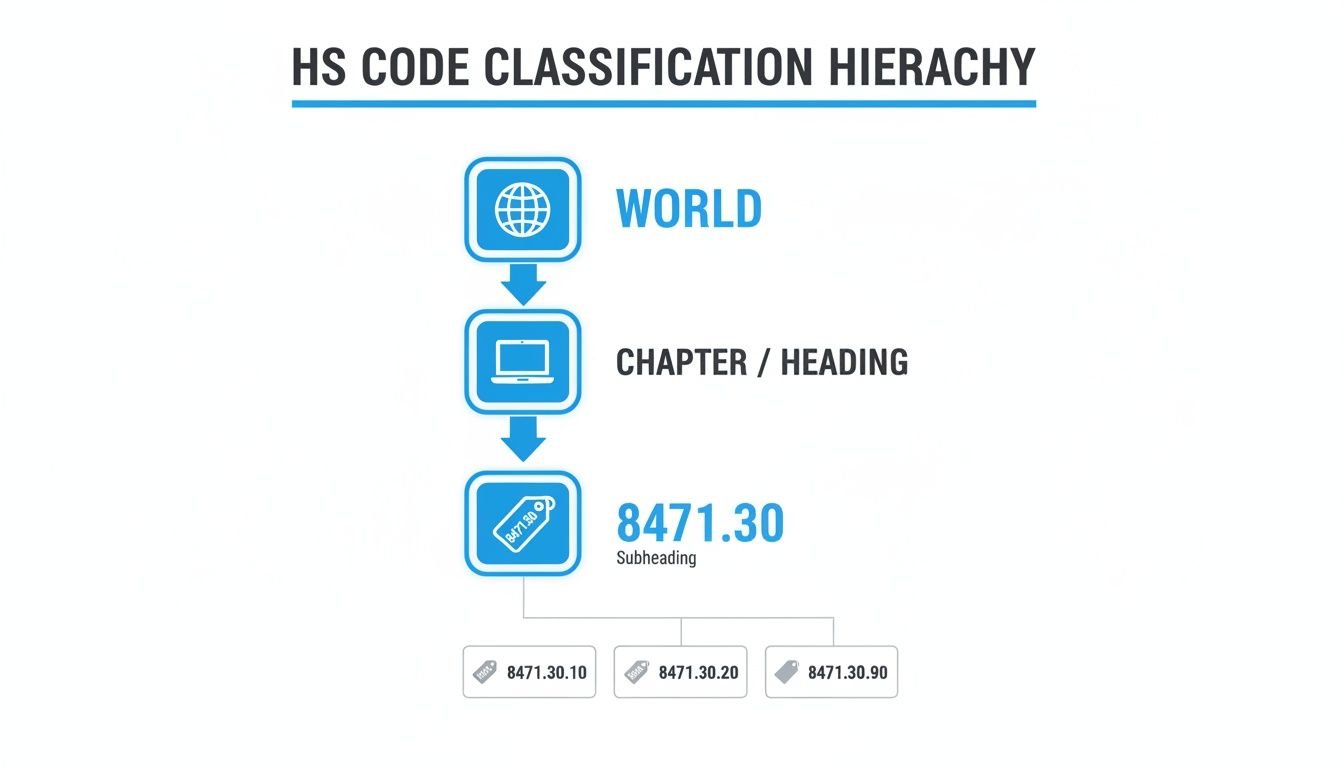
As you can see, the code logically progresses from the general (Machinery) to the highly specific (Portable Computer), with each number adding vital information.
To really see how it all fits together, let’s lay it out in a table.
Breaking Down the Laptop HS Code 8471.30
This table shows the clear, hierarchical structure of the Harmonized System code for portable computers. Each segment builds upon the last, providing an increasingly precise product definition.
| Code Segment | Designation | Description |
|---|---|---|
| 84 | Chapter | Machinery and mechanical appliances |
| 71 | Heading | Automatic data-processing machines |
| 30 | Subheading | Portable, weighing not more than 10 kg |
Grasping this simple structure is your best defence against shipment rejections. It ensures your duty and tax calculations are spot-on from the very beginning, preventing costly delays and rework down the line.
Classifying Laptop Accessories, Batteries, and Parts
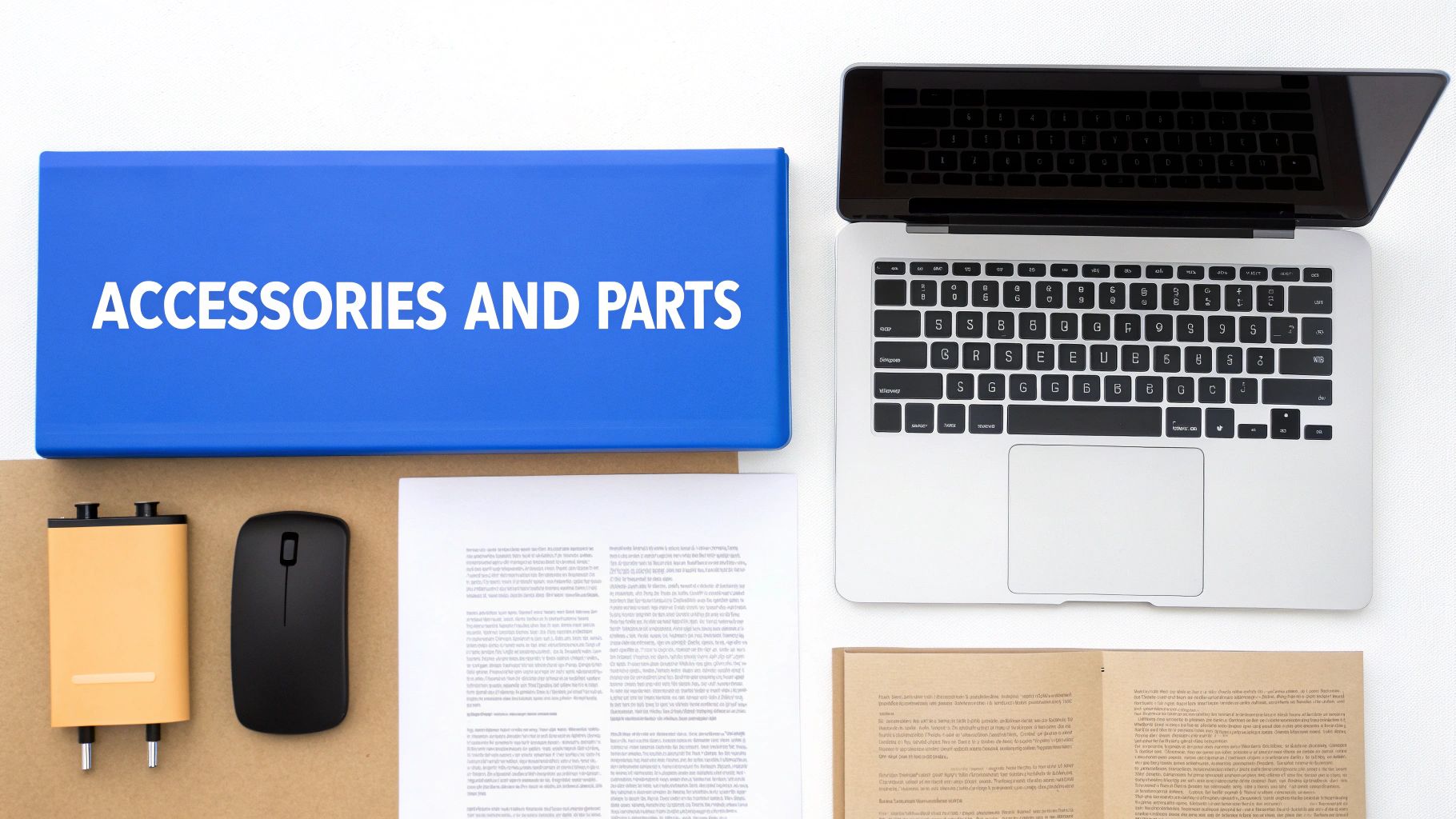
A laptop rarely travels alone. It’s almost always boxed up with a power adapter, maybe a mouse, and sometimes a spare battery. This creates one of the most common puzzles in customs classification: are you shipping one product, or several? Getting this wrong is a surefire way to cause delays and rack up penalties.
The secret lies in figuring out if the items qualify as a "set" in the eyes of customs. If all the accessories are packaged and sold together with the laptop in a single retail box, you can usually classify the whole lot under the laptop's primary HS code, 8471.30. But if you’re shipping them separately—as spare parts or standalone items—each one needs its own specific HS code.
Common Accessory HS Codes
When accessories and parts have to be declared on their own, you need to know their individual codes. Each component has a specific HS code based on what it does.
Here are some of the most frequent codes you'll run into:
- Lithium-Ion Batteries: You’ll almost always find these under HS code 8507.60. Given their hazardous nature, batteries get a lot of attention from customs officials.
- Power Adapters (AC/DC Converters): These belong under HS code 8504.40.
- External Mice or Keyboards: As input devices, these are typically classified under 8471.60.
- Carrying Cases: This one is tricky. A textile bag might fall under Chapter 42, but if it's specifically shaped and fitted for the laptop, it might be classified along with the computer.
A good rule of thumb is this: if an accessory has its own job to do and could easily be sold and used on its own, it probably needs its own HS code. Don't take the risky shortcut of lumping everything under one code.
Beyond just the codes, making sure these items are physically secure is vital. Using strong tamper-evident packaging helps protect these valuable goods from theft or damage while they're on the move. And since you're dealing with electronics, you might find yourself shipping internal components, too. If that's the case, our guide on the PCB board HS code can be a huge help.
Declaring every item correctly from the start stops customs from reclassifying your goods and hitting you with unexpected duties, making sure your shipment gets where it's going without a hitch.
Common HS Code Mistakes to Avoid
When it comes to customs, precision is everything. A tiny error in a laptop's HS code can snowball into a massive headache, but it's rarely a simple typo that causes the biggest problems. The most expensive mistakes usually come from a subtle misunderstanding of the product itself.
These aren't just clerical slip-ups. They're misinterpretations that can trigger incorrect duty payments, shipment seizures, and seriously strain your relationships with clients. Knowing where the common traps lie is the first step to building a classification process that's not just accurate, but bulletproof.
Misclassifying Hybrid and Speciality Laptops
One of the most common pitfalls is getting hybrid devices wrong. Take a 2-in-1 laptop with a detachable keyboard. It's easy to see why someone might classify it as a tablet under HS code 8471.41, which could have entirely different duty rates. The deciding factor is its main purpose. If it's designed and sold primarily as a portable computer, 8471.30 is almost always the right call.
A good rule of thumb from customs is to classify a product based on its principal function. If that 2-in-1 device relies on its keyboard for its main jobs, it’s a laptop.
A few other tricky scenarios pop up all the time:
- Refurbished vs. New Units: You can't just declare a refurbished laptop as "new." While the HS code itself might be the same, the customs valuation will be different, which directly affects the duties and taxes owed.
- Pre-loaded Enterprise Software: A laptop shipping with expensive, specialised software needs a second look. The value of that software can drastically change the item's total declared value. In some countries, it might even influence the classification itself.
Getting these details wrong doesn't just mean delays. It chips away at your reputation for being a careful, compliant forwarder—and in logistics, that reputation is everything.
Using HS Code Data to Find New Clients
A laptop's HS code is far more than just a number for getting through customs. For a sharp freight forwarder or carrier, it's the key to unlocking a goldmine of business intelligence. This simple code can transform a routine compliance task into a powerful engine for growth.
Think about it. By using global trade data platforms, you can filter shipments by HS code 8471.30. This instantly shows you who is importing laptops, where they're coming from, and in what quantities. Your sales process shifts from hopeful guesswork to a precise, data-backed strategy.
Instead of shooting in the dark with cold calls, your team can pinpoint a company importing thousands of laptops from China into Singapore every month. Armed with this knowledge, you can craft a pitch that’s immediately relevant, referencing the exact trade lanes they’re already active on.
Pinpoint High-Value Opportunities
Using HS code data means you can focus your energy where it counts. You’re no longer relying on stale contact lists or broad market research; you’re targeting companies based on their actual, current shipping activity.
This data-first approach gives you a serious edge:
- Identify Active Shippers: Find businesses that are moving large volumes of laptops right now.
- Understand Their Trade Lanes: See the specific origin and destination countries they work with.
- Estimate Potential Value: Get a solid idea of an account's size from their import history.
The laptop trade under HS code 8471 is a massive part of Singapore’s economy, which means there's a huge amount of customs data available. In a benchmark year, computer imports reached a staggering $19.1 billion. The biggest flows came from Chinese Taipei ($6.46 billion), China ($3.86 billion), and Malaysia ($2.25 billion), giving you a clear map of where the biggest opportunities lie.
When you analyse this data, you stop being just another service provider. You become a strategic partner who can start a conversation by showing you already understand a prospect's supply chain.
This level of insight makes your outreach incredibly compelling. You're not just selling a service; you're offering a solution that fits right into their existing operations. You can learn more about how to apply these principles by exploring our guide on using an HS Code filter for lead generation. It’s all about turning a simple customs code into your most effective tool for finding new business.
A Step-by-Step Guide to Verifying Laptop HS Codes
When it comes to customs classification, guesswork is a recipe for disaster. Confidence comes from a solid, repeatable process. Think of a verification checklist as your best defence against the expensive delays and penalties that a wrong HS code can trigger.
Let's walk through a straightforward framework to get it right every time.
First things first, you need to gather detailed product specifications. "Laptop" is far too vague for customs. You need the nitty-gritty details that officials use to classify the goods.
This means getting specific about:
- Screen Size: Are we talking about a standard 13-inch notebook or a hefty 17-inch mobile workstation?
- Weight: This is crucial. The subheading 8471.30 specifically covers machines weighing no more than 10 kg.
- Included Accessories: Make a list of everything in the box. Power adapters, detachable keyboards, a mouse—document it all.
- Primary Function: Is it a classic laptop, or a more complex hybrid 2-in-1 device?
Consulting Official Sources
Once you have your product’s profile, it’s time to check it against official tariff databases. Never, ever rely solely on a shipper's declaration or a random code you found online. Always go straight to the source.
For any shipment touching Singapore, your go-to resource should be the official Singapore Customs HS Code lookup tool. It’s the only way to get the most current and accurate information for the region. For a broader, international perspective, the World Customs Organization (WCO) Trade Tools is an invaluable resource.
Verifying a laptop HS code isn’t just about looking up a number; it’s about building a case. You're documenting your product's specific features and meticulously aligning them with official tariff descriptions. This creates a clear, defensible classification that can stand up to scrutiny.
Now, what about those tricky cases? If you're dealing with something highly specialised like a ruggedised industrial laptop or a medical-grade portable computer, the risk of getting it wrong goes way up.
In these complex situations, the safest move is to seek a Binding Tariff Information (BTI) ruling from the relevant customs authority. A BTI gives you a legally binding classification for your specific product, providing total certainty and heading off any potential disputes before they start.
Answering Your Top Laptop Classification Questions
Even with a solid process, some scenarios just aren't straightforward. Let's tackle a few of the most common head-scratchers that trip up freight forwarders and shippers when classifying laptops.
What if the Laptop Has a High-End Graphics Card?
A beast of a GPU doesn't change the fundamental nature of the product. The laptop's main job is still to be a portable computer, so it almost always stays under the HS code 8471.30.
The real impact of a powerful graphics card is on the laptop's value. You must declare this higher value accurately on the customs forms to ensure you’re paying the correct duties and taxes.
Do Refurbished Laptops Use a Different HS Code?
Nope, a refurbished laptop still falls under HS code 8471.30. The HS code itself doesn't change, but the customs valuation absolutely does.
It's crucial to declare that the unit is refurbished and report its lower market value. Listing a refurbished machine at the price of a brand-new one is a classic compliance mistake that will have you overpaying on duties.
Here's a simple way to think about it: the HS code tells customs what the product is, while the customs value tells them what it's worth. Both have to be spot-on.
Getting this right is especially important in major electronics hubs like Singapore. With the boom in remote work, the demand for portable computers has exploded, and so has customs scrutiny. To give you an idea of the scale, total imports for Singapore's computer and electronics sector hit a staggering $120.822 billion USD by December 2020. That's a massive volume of laptops for customs authorities to keep an eye on. You can find more on Singapore's trade statistics from CEIC.
How Are Laptops Shipped for Repair Classified?
When a laptop is brought into a country just for a tune-up and not for sale, you can often use special customs procedures. Regimes like Inward Processing Relief (IPR) might let you suspend duties and taxes for the temporary import.
The key is meticulous paperwork. You have to prove the laptop isn't being sold and will be shipped back out (re-exported) once the repair work is done.
Ready to stop guessing and start targeting the right shippers? Coreties transforms customs data into your most powerful sales tool. Find high-volume importers, identify their trade lanes, and connect with decision-makers in just a few clicks. Discover qualified leads and grow your business today.