Industry Benchmarking in Logistics: A Practical Guide
A freight forwarder calls a prospect and leads with the usual line. We have strong carrier relationships. We can offer competitive rates. We'd love a chance to quote your business. The shipper ends the call in under a minute. That conversation fails because it gives the buyer nothing specific to react to. In logistics, generic […]

A freight forwarder calls a prospect and leads with the usual line. We have strong carrier relationships. We can offer competitive rates. We'd love a chance to quote your business.
The shipper ends the call in under a minute.
That conversation fails because it gives the buyer nothing specific to react to. In logistics, generic claims sound interchangeable. Every forwarder says they have capacity. Every carrier says they have service. Every sales rep says they can save money. Without evidence tied to the shipper's lanes, suppliers, timing, or routing pain points, the pitch lands as noise.
The calls that work sound different. They start with something concrete. You're importing this commodity through this gateway. Your current pattern suggests dependence on one carrier group or one origin cluster. Your lane mix creates avoidable exposure when schedules slip. We can see where routing flexibility or service design may matter more than a lower base rate. That changes the discussion from “give us a try” to “we understand your network.”
That's where industry benchmarking becomes useful. Not as a slide for a quarterly strategy meeting. Not as a vague promise to be data-driven. It becomes a working tool for prospecting, routing, pricing conversations, account retention, and territory planning.
For logistics teams, the practical question isn't whether benchmarking sounds smart. It's whether it helps a rep write a better email today, helps an operations manager defend a routing decision this week, or helps leadership decide which trade lanes deserve attention this quarter. Used well, it does all three.
The End of Generic Sales Pitches
Most logistics sales teams have lived through the same pattern. A rep gets a list of target shippers, opens a spreadsheet, and starts sending outreach based on broad claims. Better service. Better rates. Better coverage. The response rate is weak because the message could have gone to anyone.
A shipper doesn't buy because a forwarder says the right adjectives. They buy when the seller shows a clear understanding of the shipper's operating reality. If a prospect imports regularly on a lane with recurring schedule friction, they care about routing resilience. If their inbound flow is concentrated with a small group of suppliers, they care about continuity and exceptions. If they're splitting freight across modes, they care about handoff reliability and response speed when something goes wrong.
Why broad claims fail in freight
Generic outreach breaks for three reasons.
- It ignores lane context. A shipper moving ocean freight from one origin pattern has very different concerns than a shipper relying on mixed air and ocean replenishment.
- It doesn't show commercial relevance. Buyers want to know why switching or adding a provider improves a real business outcome.
- It treats all prospects the same. In logistics, the account list may look broad, but the selling motion should be narrow.
Practical rule: If your first message could be copied into an email for fifty unrelated shippers, it probably won't open a serious conversation.
The stronger alternative is to benchmark before outreach. Look at the prospect's shipping activity, the likely carrier mix, the commodity pattern, and the trade lanes that matter most. Then compare that picture against what you know about your own service strengths and the market's common service patterns. The result is a sharper point of view.
What a useful pitch sounds like
A useful sales conversation doesn't start with “we'd like an opportunity.” It starts with an observation.
You might note that the shipper appears concentrated in a port pair where schedule variability has consequences for distribution planning. You might see that they depend on a narrow carrier set and could benefit from more optionality. You might find that your network aligns better with the shipper's origin geography than the providers they seem to use now.
That's not theory. It's a better use of available logistics data.
What Is Logistics Industry Benchmarking Really
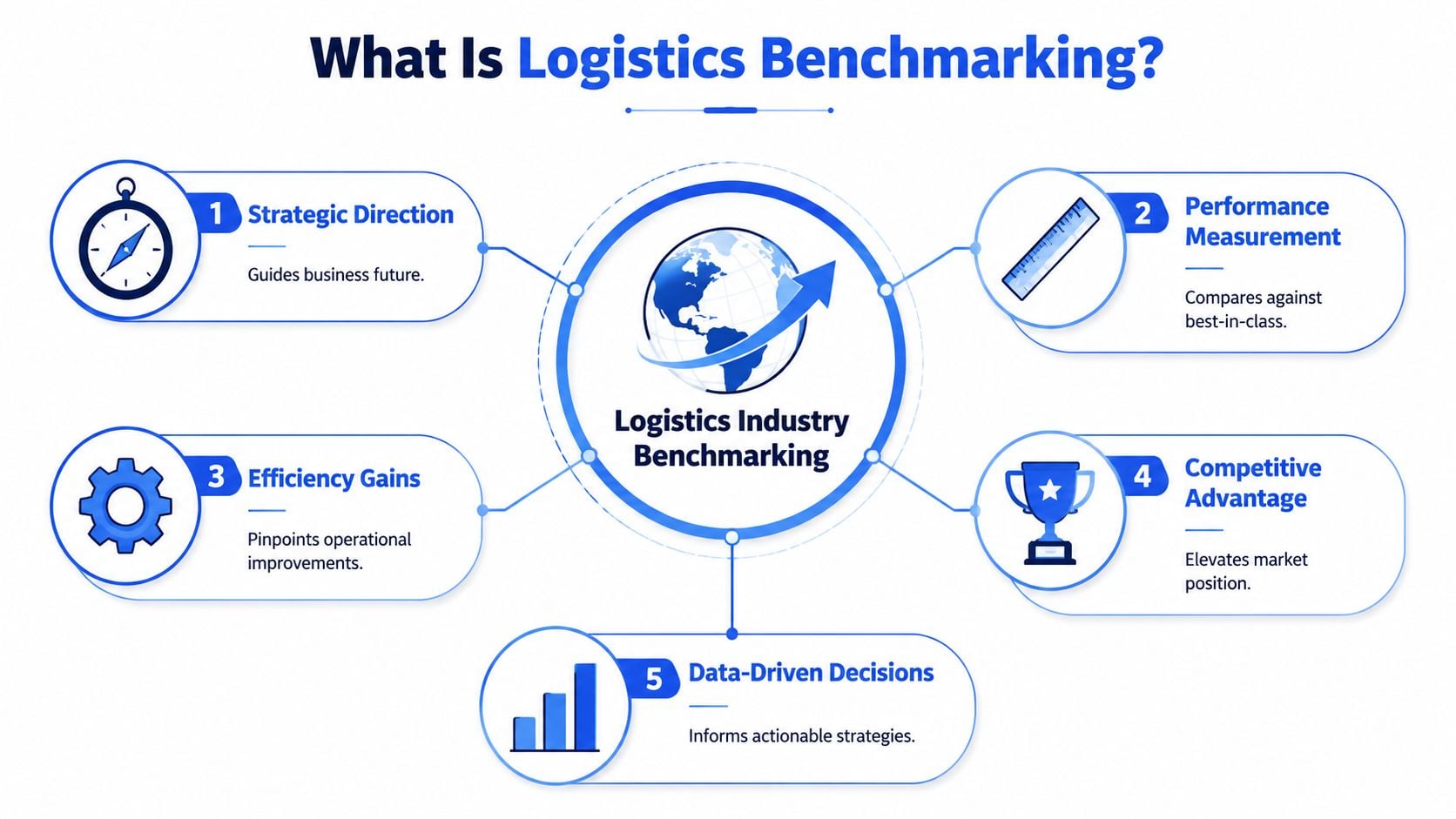
In logistics, industry benchmarking is the disciplined act of comparing your performance, network position, or account assumptions against a reliable point of reference. That reference might be your own historical performance, a competitor pattern, a lane-level market norm, or the practices of firms that operate especially well on a given trade.
A sports analogy works here. Good teams don't watch game film to admire their own highlights. They study opponents, tendencies, spacing, and execution. They want to know where they're losing ground and where they can exploit an opening. Logistics teams should think the same way. Benchmark your transit patterns, carrier mix, quote responsiveness, lane density, and exception handling against a standard that means something.
It's more rigorous than most teams treat it
A formal benchmark is not just a rough comparison. The U.S. Bureau of Labor Statistics describes benchmarking as using a standard or point of reference to compare performance, and notes that its Current Employment Statistics program benchmarks the March employment level to the first-quarter employment level from the Quarterly Census of Employment and Wages every year in an annual calibration process designed to align sample-based estimates with a broader universe estimate, as explained in the BLS overview of benchmarking.
That example matters because it strips away the buzzword. Benchmarking is a correction discipline. It's a way to test whether your current read of the market, your sales narrative, or your operating assumptions match a broader reality.
What that looks like in freight
For a freight forwarder, benchmarking often means asking questions like these:
- Lane position. Are we strong on the lanes we claim to target, or are we spreading sales effort too thin?
- Service reliability. Are our actual operating results holding up against what the market expects on those routes?
- Commercial fit. Are we pursuing shippers whose shipping patterns match our strengths?
- Pricing posture. Are we discounting where service quality should carry the conversation?
For a pricing or revenue team, the logic is similar to how teams use Market Edge's pricing platform to anchor pricing decisions against external signals rather than instinct alone. In logistics, the same mindset applies to lanes, routing options, and account targeting.
Benchmarking only becomes useful when it changes a decision. Which account to pursue. Which lane to defend. Which routing option to put in front of the customer.
The daily version of benchmarking
A lot of people hear the term and think of annual planning decks. In reality, the daily version is simpler. A rep uses customs activity to compare a target shipper with similar importers. An operations manager compares scheduled versus actual lane performance. A branch leader reviews whether the team's strongest commodity flows match the accounts they're spending time on.
That's logistics benchmarking in its most practical form. It turns broad market noise into a smaller set of decisions that can win business.
The Most Valuable KPIs for Freight Forwarders
The most useful freight KPIs are the ones that help a team answer a commercial or operating question fast. Which accounts fit our network. Which lanes are vulnerable. Which customers are drifting. Which service failures are hurting renewals. Good benchmarking starts with metrics that support action.
A foundational rule matters here. Effective benchmarking requires consistent definitions, timeframes, and quantitative KPIs such as costs, margins, satisfaction scores, or response times, and benchmarks can come from internal historical data, competitor analysis, public reports, and survey data. That means a benchmark only has value when the numbers are comparable over the same period, as described in this benchmarking data guide.
Customs and shipment intelligence KPIs
For logistics sales teams, customs-derived signals are often the first layer because they reveal actual movement patterns, not survey opinions.
| KPI | Data Source | What It Reveals |
|---|---|---|
| Shipper-carrier relationship pattern | Customs filings | Which providers appear to handle the shipper's freight and how concentrated those relationships look |
| Shipment volume by lane | Customs filings | Where the shipper's trade activity is concentrated and which lanes deserve tailored outreach |
| Origin and supplier concentration | Customs filings | Whether the account depends on a narrow supplier base or a wider sourcing mix |
| Commodity movement trend | Customs filings | Which product categories matter most and whether your specialization is relevant |
| Port and gateway pattern | Customs filings | Which entry points shape inland planning, congestion exposure, and drayage complexity |
These KPIs are especially valuable in prospecting because they help a rep stop guessing. Instead of saying “we serve Asia to North America,” the rep can focus on the actual origin clusters and gateway habits visible in the prospect's traffic pattern.
Service and schedule KPIs
Operations teams need another category. They need metrics tied to execution.
- Scheduled versus actual transit time. This shows whether the marketed service profile matches lived experience on the lane.
- On-time performance by route. Useful for account reviews and routing redesign.
- Port dwell pattern. Helpful when a lane looks stable on paper but customers experience recurring delays.
- Exception response speed. A quiet but important differentiator in account retention.
If you're refining the service side of your benchmark stack, resources on tracking customer service metrics for 2025 can help teams think more clearly about response handling, resolution flow, and service consistency. Those ideas matter in logistics because service quality often determines whether a shipper tolerates a rate premium.
Internal commercial KPIs
Internal metrics matter just as much because external data alone won't tell you whether your team is converting opportunity into business.
Consider these:
- Quote-to-booking ratio. A weak ratio can mean poor qualification, weak follow-up, or a mismatch between target accounts and network strength.
- Customer churn pattern. If customers leave on specific lanes or modes, the root cause may be structural rather than account-specific.
- Gross margin by lane or account type. Useful when the sales team is winning business that operations can't serve profitably.
- Sales response time. Often overlooked, but it shapes whether you're even in the deal.
The KPI itself isn't the insight. The comparison is the insight. A response time means little until you compare it against your own standard, your team's historical pattern, or the expectation of the shipper you're trying to win.
What not to benchmark
Teams waste time when they benchmark numbers that aren't normalized. If one branch counts a quote one way and another branch counts it differently, the comparison won't help. If lane performance is measured across mismatched periods, you'll draw the wrong conclusion. In freight, bad definitions can look precise while hiding operational reality.
The fix is simple. Pick fewer KPIs, define them tightly, and track them consistently.
A Repeatable Benchmarking Methodology for Logistics
Most benchmarking efforts break down because teams collect too much data before they decide what problem they're solving. A repeatable process keeps the work useful. In logistics, the strongest methodology is usually the one a sales manager, pricing analyst, and operations lead can all use without turning it into a research project.
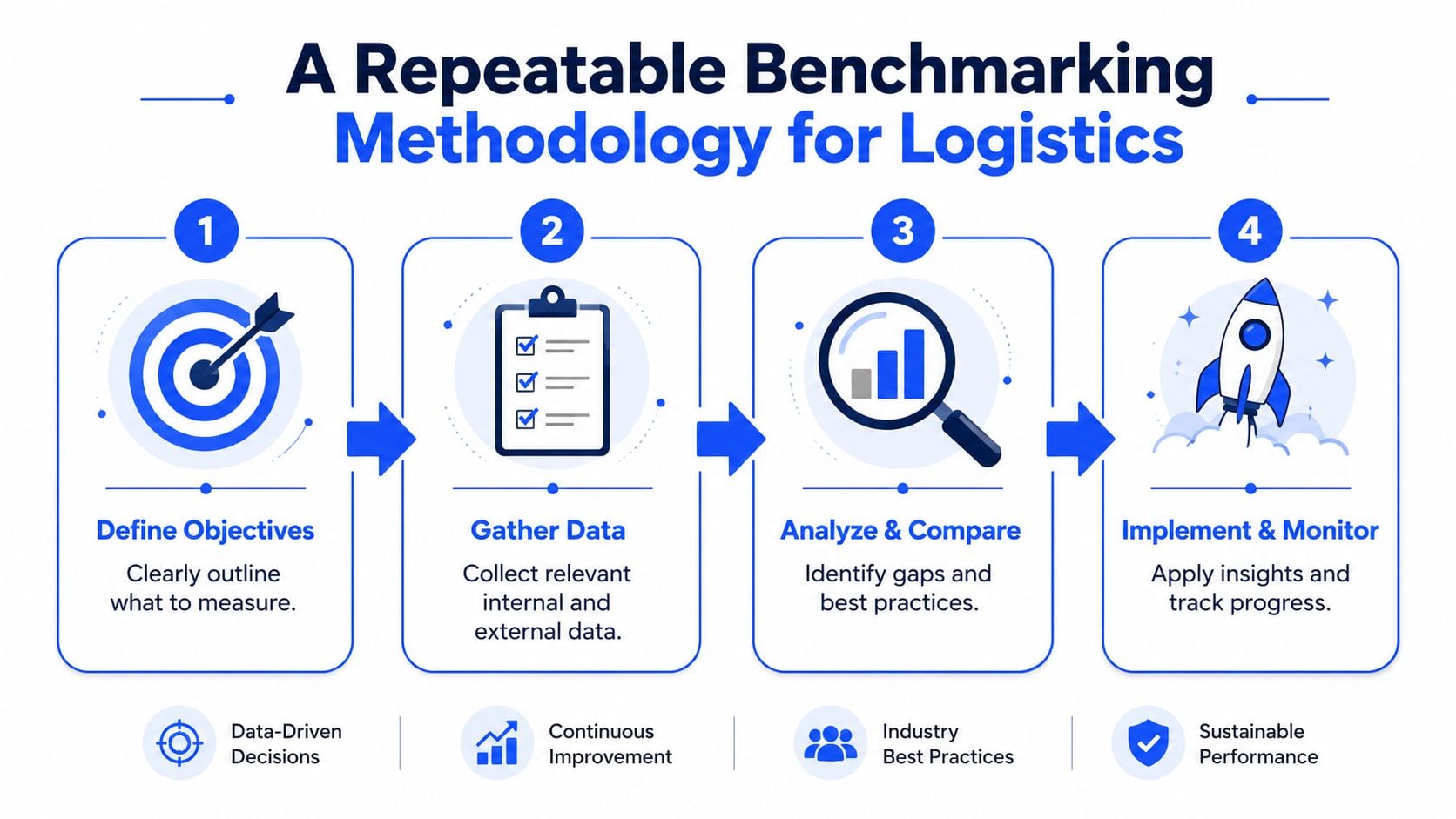
Step 1 define the business objective
Start with a real decision. Don't start with the data source.
A good objective might be winning a specific importer account, improving service credibility on a trade lane, defending a vulnerable customer, or deciding whether to commit more sales effort to a geography. The objective determines what benchmark matters. If the goal is prospecting, shipment and lane intelligence take priority. If the goal is account retention, service and response metrics become more important.
Write the objective in operational terms. “Increase visibility in retail imports” is too broad. “Build a targeted list of retail importers whose lane mix fits our network and whose current routing pattern appears exposed” is workable.
Step 2 gather comparable data
Teams tend to either overbuild or oversimplify. Pull from a small number of sources that fit the objective:
- Internal systems such as TMS, CRM, and quote history for service and conversion data
- Public and commercial shipment intelligence for shipper patterns, commodities, and trade lanes
- Carrier schedules and route information for service design and routing alternatives
- Account notes and exception records for context that raw movement data can't explain
If your team needs more structured shipment visibility, services such as a port import export reporting service can help standardize how lane and account activity are reviewed before outreach or network decisions are made.
Step 3 analyze and normalize before comparing
This is the step that separates useful benchmarking from misleading dashboards. JANA notes that benchmarking compares business processes and performance metrics against industry bests, but it also stresses agreement on which metrics matter and a defined methodology for collection, aggregation, and distribution. Without normalization and common data definitions, cross-company comparisons can produce misleading conclusions instead of actionable gaps, as explained in JANA's discussion of technical information metrics and benchmarking methodology.
In logistics terms, normalization means asking basic but essential questions.
- Are we comparing the same trade lane over the same period?
- Are transit times defined the same way across the data set?
- Are we mixing bookings, shipments, and quotes as if they were interchangeable?
- Are account categories broad enough to distort the result?
A rep who compares a shipper's peak-season pattern to a quiet off-season period may think there's an opportunity where there isn't one. An operations leader who compares all Asia-origin freight as one bucket may miss a severe problem isolated to a specific gateway pair.
Standardize first. Compare second. Any other order creates false confidence.
Step 4 turn the gap into action
The final step is practical. If the benchmark shows a gap, assign a move.
- If a prospect appears overconcentrated with a provider set that doesn't match your strongest lane, craft outreach around network fit.
- If your actual service underperforms on a lane you sell aggressively, fix the routing before increasing pipeline pressure.
- If a branch wins a lot of quotes but books poorly, review qualification criteria and pricing discipline.
- If a key customer's traffic pattern shifts, adjust account strategy before renewal pressure surfaces.
The benchmark is not the output. The output is the decision memo, routing change, prospect list, pricing stance, or account review plan that comes from it.
Practical Use Cases for Sales and Routing
The easiest way to understand benchmarking is to watch it change a real conversation. In logistics, the value shows up when a rep stops sending broad outreach and when an operations manager stops defending a route because it's familiar.

Use case one prospecting a shipper with a lane-specific point of view
A sales development rep gets a target account in the consumer goods space. The old approach would be simple. Find the logistics manager, send a note about rate competitiveness, and ask for a quote opportunity.
Instead, the rep reviews customs activity first. The shipper appears to import repeatedly on a narrow set of origin points. The movement pattern suggests dependence on one carrier mix and a small number of gateways. The rep also compares that pattern with the forwarder's own strengths and sees a better fit on an alternative routing design the prospect doesn't appear to be using much.
Now the outreach changes. It doesn't claim universal superiority. It says, in effect, your inbound profile suggests heavy reliance on a limited lane structure, and there may be room to reduce exposure through a routing design that better matches your supplier geography. That's a much better reason to take a meeting.
The rep can push this further by combining shipping intelligence with account research and predictive analytics for sales to prioritize the shippers most likely to respond to a lane-specific message rather than a broad introductory one.
A shipper rarely replies because a forwarder asks for a chance. They reply when the forwarder shows they've already done part of the shipper's homework.
What the rep is really benchmarking
The rep is not benchmarking the prospect against an abstract “industry average.” The benchmark is more targeted.
- Current shipper pattern versus your network fit
- Observed routing concentration versus available alternatives
- Prospect's likely provider setup versus your commercial opening
That creates a usable sales narrative. The rep is no longer selling logistics in general. The rep is selling a more relevant option for that shipper's actual flow.
A short demonstration helps teams visualize the shift from generic market data to practical selling.
Use case two defending and improving a trade lane
Now switch to operations. A carrier or forwarding operations manager is reviewing a key account on a competitive trade lane. The account isn't lost, but it feels unstable. Service complaints are increasing, and the customer has started asking more detailed questions during review calls.
The manager benchmarks internal execution against the lane's market expectations and against what the company has been promising commercially. Scheduled transit looks acceptable, but actual handoffs and dwell points show friction. The lane isn't failing everywhere. It's failing at specific nodes where routing choices create avoidable delay and poor exception visibility.
That matters because the response changes from defensive to constructive. Instead of saying “conditions are challenging for everyone,” the manager can say, “We identified where this lane is weakening for your shipments, and we're proposing a routing adjustment with clearer handoff control and better exception management.” The customer hears ownership rather than excuses.
Why these use cases work
Both examples use the same principle. Benchmarking works when it narrows action.
The sales rep uses it to sharpen outreach around a shipper's real traffic pattern. The operations manager uses it to isolate a service gap instead of treating the lane as one undifferentiated problem. In both cases, the benchmark gives the team a specific basis for a decision.
That's the difference between data as decoration and data for impact.
Operationalizing Insights with the Right Tools
Manual benchmarking works at small scale. A rep can study a handful of accounts. An operations manager can review one lane in detail. But once a team wants repeatability across branches, modes, territories, and account segments, manual work starts to break down.
The bottlenecks are predictable.
Where manual benchmarking stalls
- Data aggregation slows down. Shipment intelligence, CRM records, schedules, and internal performance data sit in different places.
- Definitions drift. One team's lane view doesn't match another team's reporting logic.
- Action gets delayed. Even when the insight is clear, turning it into outreach lists or account plans takes too long.
Here, automation proves its worth. A practical overview like this guide to business intelligence automation is useful because it shows why teams need systems that connect collection, interpretation, and action rather than stopping at dashboard creation.
What a scalable workflow looks like
A scalable benchmarking workflow should let a team do four things without excessive manual stitching:
- Aggregate external and internal logistics signals
- Filter by shipper, lane, commodity, geography, and mode
- Surface account-level opportunities or service risks quickly
- Push insights into outreach or review workflows
For logistics-specific teams, Coreties fits that model by turning customs data into prospecting and account research workflows, helping users identify relevant companies, contacts, and lane patterns, while also supporting routing conversations through linked market and schedule context. If implementation discipline is the concern, a structured implementation timeline for logistics teams helps keep the rollout tied to clear sales and operations use cases instead of tool sprawl.
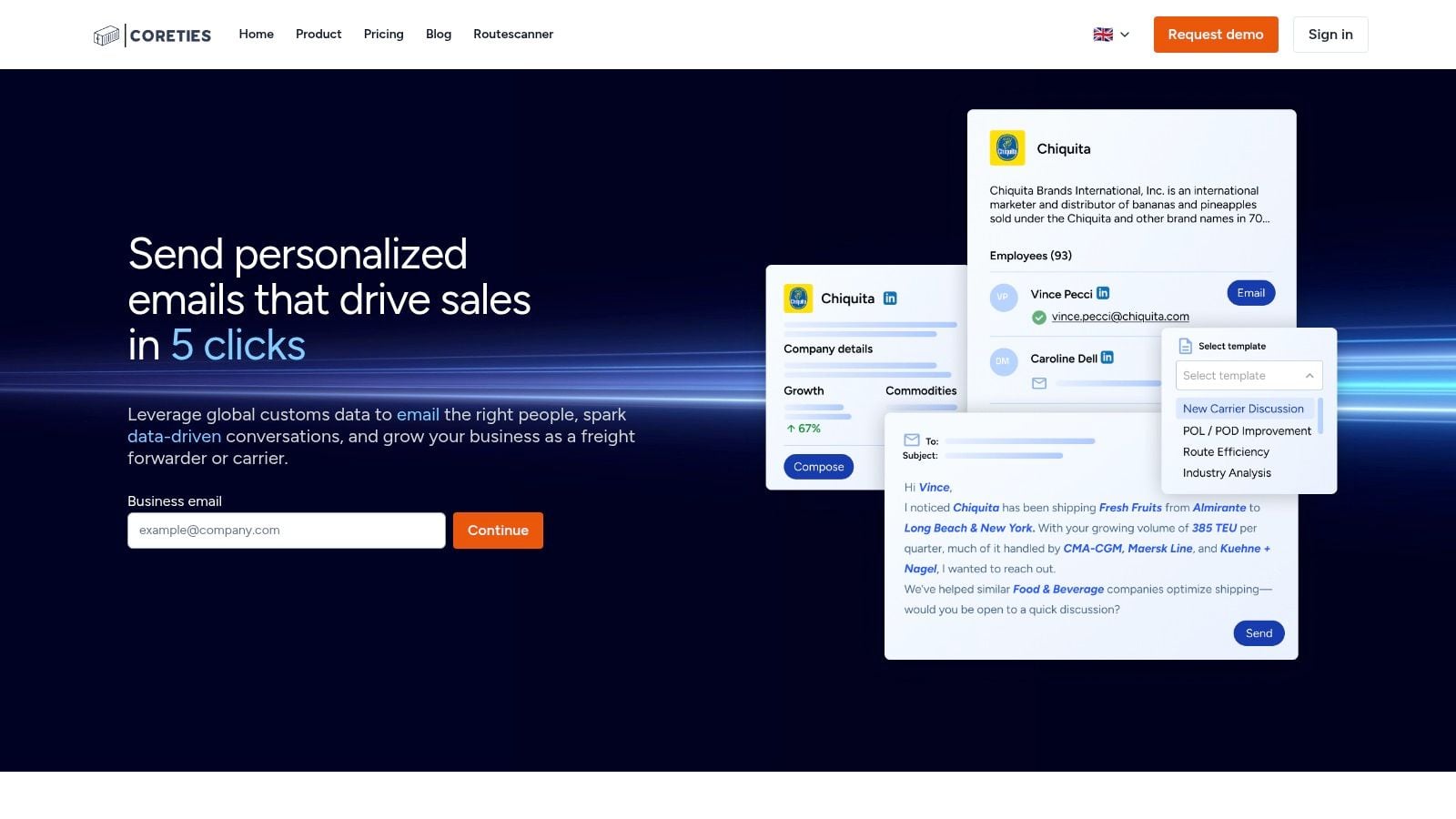
The point isn't to automate for its own sake. The point is to reduce the gap between noticing an opportunity and acting on it. In logistics, that gap matters. By the time a team manually assembles the shipper view, lane analysis, and outreach plan, the prospect may already be deep into a tender cycle or the account may already be speaking with competitors.
Industry benchmarking stops being a buzzword once it enters the daily rhythm of sales calls, account reviews, and routing decisions. Teams that use it well don't just know more. They approach the market with a clearer argument, a tighter target list, and a stronger operational case.
If your team wants to turn shipping data into practical prospecting, routing, and account intelligence, take a look at Coreties. It's built for logistics teams that need to move from raw customs activity to targeted outreach and sharper commercial decisions without relying on generic sales pitches.