Unlock the hs code filter to refine searches and boost qualified leads
If you're in logistics sales, you know the grind of sifting through endless company lists, making cold calls, and hoping for a lucky break. It's a numbers game, but it's often inefficient. What if you could skip the guesswork and go straight to shippers who definitely need your specific services? That’s where an HS code […]

If you're in logistics sales, you know the grind of sifting through endless company lists, making cold calls, and hoping for a lucky break. It's a numbers game, but it's often inefficient. What if you could skip the guesswork and go straight to shippers who definitely need your specific services?
That’s where an HS code filter comes in. Think of it as your secret weapon. This search function, found in good trade intelligence platforms, lets you pinpoint companies based on the exact goods they're importing or exporting. It turns a compliance headache—those standardized commodity codes—into a goldmine of pre-qualified leads.
Why an HS Code Filter Is Your Secret Weapon for Logistics Sales

In this business, timing and relevance are everything. The old way of prospecting just doesn't cut it anymore. An HS code filter flips the script entirely. It takes raw customs data and turns it into a strategic roadmap, showing you exactly who your ideal customers are. You stop guessing and start building hyper-targeted lists based on the real products companies are moving right now.
Moving from Broad Searches to Precision Targeting
Let's get practical. Say your specialty is temperature-controlled logistics for pharmaceuticals. A generic search for "healthcare companies" is a waste of time—it's far too broad.
But what if you filter for shippers who actively move goods under HS Chapter 30 (Pharmaceutical products)? Suddenly, you have a list of pre-qualified prospects. You know, without a doubt, that they handle sensitive cargo. You can confidently assume they need specialised handling, cold chain integrity, and someone who understands compliance.
This level of precision is a game-changer. It lets you:
- Pinpoint Lucrative Niches: Uncover shippers dealing in high-value or highly regulated goods, like electronics (HS Chapter 85) or specialised chemicals (HS Chapter 29).
- Align with Your Expertise: Stop chasing every lead and focus only on companies whose freight profile is a perfect match for your core services, whether that's oversized machinery, perishable foods, or hazardous materials.
- Get Ahead of Market Trends: By analysing shipment volumes for specific HS codes, you can spot emerging trends and identify companies whose logistics needs are growing.
The real power here is the context. You're not just finding a company name. You're getting a snapshot of their supply chain before you even pick up the phone.
A Practical Advantage in a Global Hub
This strategy is especially powerful in major trading hubs like Singapore. Here, HS code filtering is the backbone of how savvy sales teams identify profitable trade lanes. Singapore uses 8-digit HS codes under the ASEAN Harmonised Tariff Nomenclature (AHTN), adding a layer of national-level detail to the global 6-digit standard.
Those extra two digits are crucial. They distinguish subtle product variations that can have massive duty implications, which is vital for qualifying leads in verticals like electronics or medical devices. If you want to dive deeper, it's worth checking out the specifics of Singapore's HS classification system.
By making this shift, you stop throwing everything at the wall to see what sticks. Instead, you focus your time and energy on high-potential shippers who are already moving the exact type of cargo you were born to handle. It's smarter, not harder.
Choosing the Right HS Code Granularity for Your Search

Using an HS code filter effectively is a lot like using a microscope. You can pull back for a wide, general overview or zoom right in for a super-detailed look. It's not just about plugging in a number; it's about strategically choosing the right level of detail.
Each layer of the Harmonized System—Chapter, Heading, and Subheading—serves a different purpose. Go too broad, and you'll be swimming in irrelevant leads. Go too narrow, and you might miss a golden opportunity sitting just next door. The trick is to match the code’s precision to what you’re trying to achieve.
The Wide-Angle View With 2-Digit Chapters
The broadest search you can run is at the 2-digit HS Chapter level. Think of this as your 30,000-foot view of an entire industry.
For instance, searching for Chapter 39 (Plastics and articles thereof) will pull up a massive list of companies. You'll see everyone from raw material suppliers shipping polymer pellets to manufacturers of finished plastic toys.
This high-level approach is fantastic for:
- Market Analysis: Getting a quick read on the major players and trade volumes in a sector.
- Finding the Big Fish: Identifying large corporations that ship a diverse range of products within that category.
- Initial Territory Planning: Understanding the dominant industries in a specific region or trade lane.
For day-to-day lead generation, though, a Chapter-level search is usually just the first step. It shows you who’s in the game, but not what specific game they’re playing.
Gaining Focus With 4-Digit Headings
Ready to zoom in a bit? The 4-digit Heading level gives you a much clearer picture. This is where you start separating distinct product types within that broad chapter.
Let's stick with our plastics example. Inside Chapter 39, you could refine your search to Heading 39.26 (Other articles of plastics). This simple move instantly cuts out the bulk polymer suppliers and sharpens your focus on companies dealing in finished plastic goods—a far more relevant list for a forwarder not equipped to handle bulk raw materials.
A 4-digit search often hits the sweet spot. It’s specific enough to cut through the noise but broad enough to give you a healthy list of prospects without getting bogged down in tiny details.
Pinpoint Precision With 6-Digit Subheadings
When you need to be surgical with your prospecting, the 6-digit Subheading is the tool for the job. This is the most detailed level recognised worldwide, letting you zero in on highly specific products. If you specialise in a particular niche, this is where your HS code filter truly shines.
Imagine you're a freight forwarder who has expertise in handling delicate, high-value electronics. A search for Chapter 85 (Electrical machinery and equipment) is way too general. But targeting Subheading 8507.60 (Lithium-ion accumulators)? Now you’re talking.
This search instantly flags companies importing or exporting high-value, regulated batteries—a perfect match for your specialised services.
It’s also worth remembering that many countries, including Singapore, add their own layers of detail with 8 or 10-digit codes for national customs purposes. Getting familiar with these local variations is crucial. For more on this, our guide on the Singapore Customs HS Code is a great resource.
Mastering these different levels turns a simple search into a powerful business development strategy.
How to Build Smart Queries That Uncover Hidden Opportunities

Once you’ve got a handle on HS code granularity, the real fun starts. This is where you graduate from basic lookups and start building smart queries that turn your search tool into a proper lead-generation engine.
The goal is to construct searches that answer specific business questions, revealing pockets of opportunity you’d otherwise never find. Think of it like giving the database more intelligent instructions—you're not just asking for one file, you're telling it to bring you all the files in a certain category that also meet your specific criteria.
Expanding Your Reach With Wildcards
Your best friend for capturing an entire product category without typing out dozens of codes is the wildcard—usually an asterisk (*). It’s a simple placeholder that tells your hs code filter to find anything beginning with the numbers you’ve entered.
For example, a query for HS: 85* is incredibly powerful. This one search will pull up every shipper dealing in goods from Chapter 85 (Electrical machinery and equipment). In a single click, you get a bird's-eye view of the entire electronics sector, from microchips to industrial generators.
Combining Forces With Boolean Operators
This is where you can start to pinpoint really niche shipper profiles. Boolean operators—mainly AND, OR, and NOT—let you layer multiple criteria into a single, highly specific search.
- OR is for when you want to broaden your net. A search like
(HS: 2905*) OR (HS: 3824*)will find companies shipping either alcohols and their derivatives or prepared binders and chemical products. It’s perfect for targeting a wider segment of the chemical industry. - AND is for narrowing your focus. You'll typically use this with other filters like geography, but it's also great for finding shippers who deal in complementary products.
This kind of tactical search is vital in a diverse trading hub like Singapore. As one of the world’s most diversified trading centres, using HS-code filtering directly influences where freight forwarders can find the densest clusters of potential customers. Singapore is a high-variety trader, a status measured by the huge number of products imported at the HS 6-digit level.
This data integration means a sales rep can now ask, "Which HS codes saw the biggest import growth into Singapore recently?" Insights like these help you identify not just individual companies but entire booming verticals—essential knowledge for any modern EXIM enterprise focused on strategic growth.
Complex Query Breakdown: Finding Footwear Exporters
Let's build a query to answer a real business question: 'Show me all companies in Vietnam exporting footwear to the United States.'
The Query:
(HS: 64*) AND (Origin: Vietnam) AND (Destination: USA)
HS: 64*targets all products in Chapter 64 (Footwear).AND (Origin: Vietnam)layers on the first geographic filter.AND (Destination: USA)adds the final layer, creating a precise, actionable list.
Layering Filters to Create Hyper-Targeted Lead Lists
Using an HS code filter by itself is a great start, but the real magic happens when you start layering it with other data points. It’s the difference between looking at a flat photograph and having a detailed, 3D model of your ideal customer. When you combine product data with specific logistics information, a broad list of potential shippers suddenly becomes a curated group of perfect-fit leads.
This approach goes way beyond just knowing what a company ships. It gives you the full story of their supply chain—where their goods come from, where they’re headed, and who they’re working with right now. That kind of insight is exactly what you need to build a sales pitch that isn’t just personalised, but genuinely relevant to their day-to-day operations.
Building a Precise Lead Profile
Let's walk through a practical example to see how this works. Say you’re looking for German coffee importers who frequently ship with a major carrier.
Here’s how you’d build your search:
- Start with the Product: First, you’d filter by the HS code for coffee,
0901*. This immediately isolates all companies trading coffee from the entire global database. - Add the Origin: Next, you layer on an origin filter for
Brazil. Now your list only contains companies bringing coffee in from one of the world's biggest producers. - Pinpoint the Destination: Then, apply a destination filter for
Germanyto focus squarely on your target market. - Identify the Carrier: Lastly, you filter by a specific carrier, for instance,
Maersk.
What you’re left with is an incredibly specific list: German companies that import coffee from Brazil and already use Maersk. You know their exact product, their key trade lane, and one of their current logistics providers.
This isn't just another lead; it's a strategic opening. Your first email can now be laser-focused, referencing their Brazil-to-Germany lane and showing you’ve done your homework on their supply chain.
Sample Filter Layering for Prospecting Scenarios
Combining filters allows you to build highly specific lead lists tailored to your team's sales goals. Whether you're focusing on a new trade lane, a specific commodity, or trying to win business from a competitor, the right filter combination is key.
Here’s a table showing a few different scenarios to give you an idea of how this plays out in the real world.
| Sales Goal | HS Code Filter | Layered Filter 1 | Layered Filter 2 | Resulting Lead Profile |
|---|---|---|---|---|
| Expand Perishables Air Freight | 0804* (Dates, figs, avocados) |
Origin: Mexico |
Mode: Air |
US food importers flying fresh produce from Mexico. |
| Target Competitor Accounts | 8517* (Smartphones) |
Destination: Vietnam |
Carrier: [Competitor Name] |
Tech companies shipping phones to Vietnam using your competitor's service. |
| Promote New Reefer Capacity | 0303* (Frozen fish) |
Origin: Norway |
Destination: Japan |
Japanese seafood distributors importing frozen fish on the Norway-Japan lane. |
| Win LCL E-commerce Business | 9503* (Toys) |
Origin: China |
Shipment Size: < 10 tonnes |
Small to medium-sized toy importers with frequent, smaller LCL shipments from China. |
As you can see, a few simple layers can take you from a massive, generic dataset to a small, actionable list of high-potential prospects who fit your exact service offering.
Using Regional Data to Sharpen Your Focus
This technique is especially powerful when you apply it to a major trade hub like Singapore. For sales and routing teams, layering HS-code filters on top of Singapore’s detailed merchandise trade data is a game-changer. The country's official statistics report annual import and export flows for every HS chapter. This historical data lets you build filtered lead lists around high-growth commodities—like electronics or pharmaceuticals—and then add destination markets and routing options to create hyper-targeted, lane-specific outreach campaigns. You can dig into these datasets yourself over at ASEANStats trade data.
By layering filters, you build a compelling story. You're no longer approaching a prospect with a generic, "We can ship your goods." Instead, you can lead with a confident, value-packed proposition: "We see you're moving significant volumes of coffee from Brazil to Germany and can offer a competitive solution for that specific lane." That kind of specific insight shows real expertise and immediately makes you stand out.
Turning Search Results into Actionable Daily Outreach
Finding that perfect-fit shipper with an HS code filter feels like a win, but it's really just the starting whistle. A list of names is just raw data. The real magic happens when you turn those results into actual conversations. This is where you pivot from researcher to relationship-builder, creating a daily outreach habit that actually moves the needle.
Before you even think about picking up the phone or typing an email, you need to validate your findings. Take a quick look at the company’s recent shipment data. Are their shipping patterns, volumes, and preferred trade lanes consistent? This sanity check confirms you're looking at their current reality, not just old, dusty data.
From Company Name to Decision-Maker
Once you've confirmed a company is a solid prospect, the next puzzle is finding the right person. This used to be a huge time-sink, but modern tools with integrated LinkedIn profiles and verified emails make it much easier. You can often filter contacts by department—like “Logistics” or “Supply Chain”—to zero in on the exact decision-maker responsible for freight.
This step is critical. It takes the guesswork out of the equation and makes sure your well-researched message doesn't just get lost in a general info@ inbox.
This entire filtering process can be visualised as a funnel, narrowing down from a broad market to a specific, high-value lead.
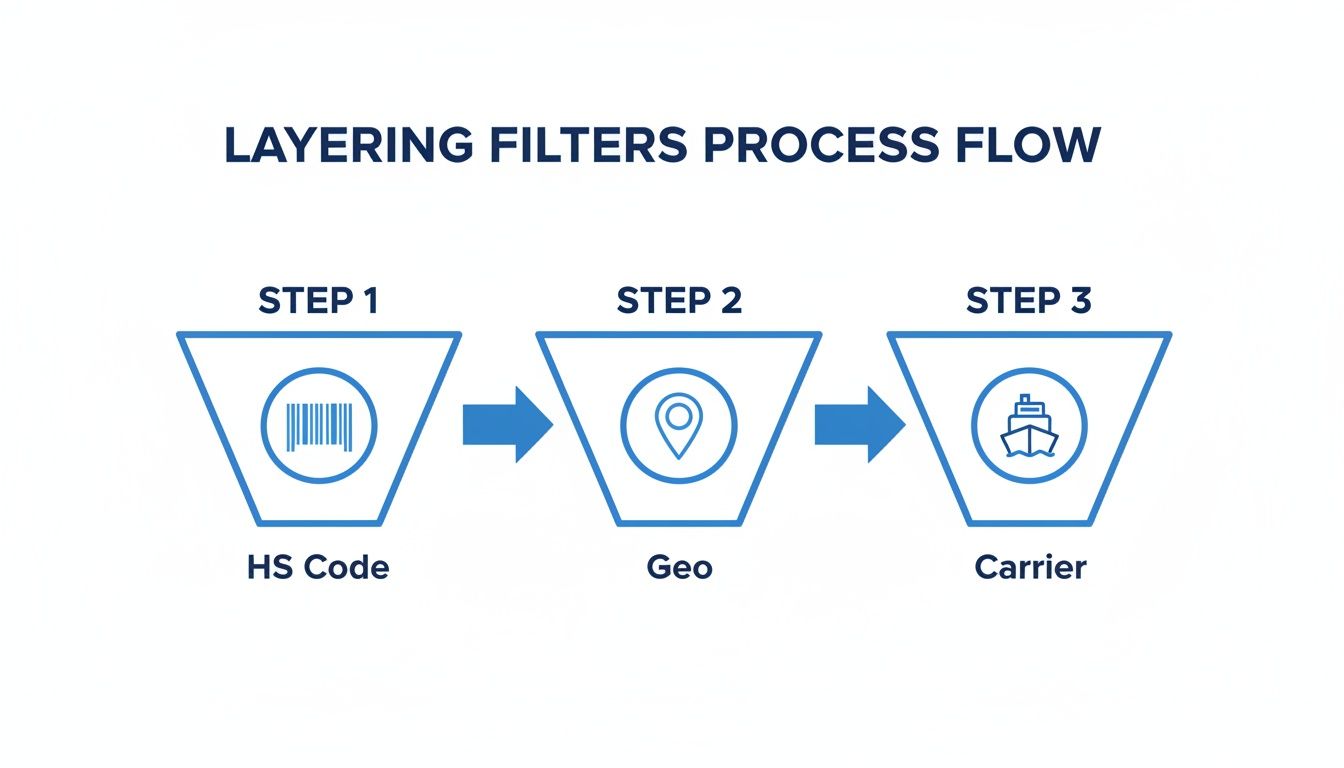
Starting with the product, then layering on geography and carrier details, is the foundation for creating a hyper-targeted list that powers your personalised outreach efforts.
Crafting Outreach That Actually Gets a Reply
Okay, time for the outreach. Let's be honest: generic sales emails are dead on arrival. The powerful advantage you have is the specific data you’ve uncovered. When you reference the exact commodity and trade lane, you instantly prove you've done your homework.
The goal is to show you understand their business, not just that you want their business. A quick mention of their specific shipments demonstrates you’ve found a real pain point you can help solve.
Here’s a simple, effective framework you can adapt:
- Subject: Question about your automotive parts (HS: 8708*) shipments from Germany
- Body: "Hi [Contact Name], I noticed your company regularly imports automotive components from Germany to Singapore. We specialise in this lane and have helped similar importers optimise their transit times. Would you be open to a brief chat next week to discuss how we might be able to support your supply chain?"
This approach is direct, respectful, and loaded with relevance. It’s worlds apart from the lazy "Can I introduce my company?" emails that flood everyone's inbox. You're leading with value and showing your expertise from the very first sentence.
Taking the time to understand who is ultimately responsible for the shipment, such as the importer of record, can sharpen your targeting even further. By consistently turning raw data into these kinds of sharp insights, you build a repeatable daily process that fills your pipeline with genuinely qualified leads.
Here’s the rewritten section, crafted to sound human-written and natural, following all your requirements.
Common Pitfalls to Avoid When Using an HS Code Filter
Using an HS code filter can be a game-changer for finding leads, but it's easy to get tripped up. I've seen a few common mistakes derail even the most well-intentioned prospecting efforts, leading to messy lead lists and a lot of wasted time. If you can steer clear of these traps, you'll build a much more reliable and efficient process.
The biggest mistake people make is not accounting for country-specific code variations. While the first six digits of an HS code are standardised globally, individual countries often tack on extra digits for more granular detail. For instance, Singapore uses an 8-digit system, but the United States uses a 10-digit Harmonized Tariff Schedule (HTS).
If you're just searching with a 6-digit code when targeting a country that uses a more detailed system, you're absolutely going to miss out on some of your best, most specific leads. Always take a moment to adapt your search to the destination country's code structure.
Misinterpreting Broad Chapter-Level Data
Another classic pitfall is running a search at the 2-digit Chapter level and thinking you've struck gold. Sure, filtering for Chapter 84 (Machinery) will pull up thousands of companies. The problem? It won’t tell you if you're looking at an exporter of massive industrial boilers or an importer of small household coffee makers.
This kind of broad search is fantastic for getting a high-level view of a market, but it’s completely useless for targeted outreach. You’ll just end up spamming companies that have zero interest in what you offer.
- The Problem: Your outreach will feel irrelevant, leading to terrible response rates.
- The Fix: Always go deeper. Drill down to at least the 4-digit Heading, but I'd strongly recommend getting to the 6-digit Subheading to make sure you're hitting the right targets.
Finally, don't ever take the code at face value. You have to cross-reference the HS code with the actual product descriptions in the shipment data. A simple typo by a shipper or a lazy, overly broad classification can stick a product under a completely misleading code. A quick scan of the description is all it takes to confirm you’re actually looking at the cargo you think you are, ensuring your entire prospecting campaign is built on a solid foundation of clean data.
Common Questions Answered
How Often Is HS Code Shipment Data Updated?
It's a common misconception that since the official Harmonized System codes are updated globally by the WCO only every five years, the data is stale. Nothing could be further from the truth.
The codes themselves are stable, but the actual shipment data—the bills of lading tied to those codes—is incredibly dynamic. Depending on the trade intelligence platform you're using, this data can be refreshed as often as daily or weekly. This is crucial because it ensures your HS code filter searches reflect what shippers are doing right now.
Can I Use This Filter for Both Importers and Exporters?
Yes, absolutely. Any robust trade data platform will let you segment your search by the direction of trade. You can easily specify whether you're hunting for companies importing goods under a specific HS code or those on the other side, exporting them.
This feature is fundamental for targeting the right players in the supply chain for whatever you're selling.
What if a Company Ships Under Multiple HS Codes?
This is the norm, not the exception, especially for larger or more diversified shippers. Don't let it throw you off.
The best strategy is to start by filtering for the HS codes that represent your ideal type of cargo. Once you've identified a promising lead, dive deeper. A good platform will let you analyse their complete shipping profile to see the full spectrum of commodities they're moving. This holistic view often reveals their broader operational needs and can uncover entirely new sales opportunities you hadn't even considered.
Ready to stop guessing and start targeting the right shippers? Coreties transforms global trade data into your next customer list. Find, verify, and contact decision-makers in minutes, not days. Discover your next lead at https://coreties.com.