Your Guide to Fabric HS Code for Singapore Freight Forwarders
So, what exactly is a fabric HS code? Think of it as a universal product passport for textiles. It's a specific number from the global Harmonised System that customs officers around the world use to identify exactly what kind of fabric is being shipped. This single code tells them everything they need to know—from raw […]

So, what exactly is a fabric HS code? Think of it as a universal product passport for textiles. It's a specific number from the global Harmonised System that customs officers around the world use to identify exactly what kind of fabric is being shipped.
This single code tells them everything they need to know—from raw silk to coated polyester—ensuring every textile is classified the same way, no matter where it's going. Getting this number right from the start is the key to seamless global trade.
Why Mastering Fabric HS Codes Matters for Your Business
Let's be honest, staring at a customs form packed with long, complicated codes can feel like a chore. But for freight forwarders in Singapore, those numbers are more than just a compliance headache. They're a hidden opportunity to get a serious edge over the competition.
The HS code is the common language of international trade. It lets you describe a shipment’s contents to a customs official on the other side of the world without them ever needing to open the box. When you and your team are fluent in this language, your business gains some very real advantages:
- Smoother Operations: The right code is like a green light at customs. Shipments fly through, clearance times shrink, and your clients' supply chains stay on schedule.
- Happier Clients: Quick, reliable customs processing isn't just a service—it's peace of mind. It builds incredible trust and positions you as an indispensable partner, which is exactly how you build lasting relationships.
- Fewer Costly Delays: A wrong code is one of the fastest ways to get hit with unexpected fines, extra fees, and expensive storage charges. Nailing the classification protects your profit margins and your customer’s budget.
Mastering fabric HS codes isn't just about dodging penalties. It's about turning a complex regulatory task into a powerful business development tool. It lets you solve problems before they happen and shows a level of expertise that truly makes your service stand out.
Ultimately, this guide won't just teach you how to classify any textile with confidence. It will show you how to turn that knowledge into a secret weapon for business growth. By seeing who is shipping what kind of fabric, you can pinpoint high-value prospects and tailor your outreach. This is about more than just moving boxes; it's about moving your business forward.
Decoding the Structure of Textile HS Codes
Ever felt like HS codes are just a random string of numbers? Think of the Harmonised System for textiles less like a code and more like a story. Each number tells a piece of a product's tale, guiding it through customs. It’s a bit like a library's filing system—you don't need to memorise every number, but understanding the logic behind the organisation is key.
The system is built on a hierarchy, starting broad and getting progressively more specific. With every pair of digits added, you're narrowing down the product's identity, much like adding a street name and then a house number to an address. For fabrics, this journey begins with the raw material and drills down to the final, finished product.
Globally, the Harmonised System is organised into Sections, Chapters, Headings, and Subheadings. You'll find most textiles and textile articles hanging out in Section XI, which covers Chapters 50 through 63. Think of this section as the "Textiles" wing of our global trade library.
From Chapter to Subheading
Let's unpack how a fabric HS code is built, layer by layer.
The first two digits point to the Chapter, which tells you the broad material category. For example, Chapter 52 is all about cotton, while Chapter 54 deals with man-made filaments. Simple enough.
The next two digits give you the Heading, which gets a bit more specific about the product’s form. A heading within Chapter 52 might tell you if you're dealing with raw cotton, yarn, or a woven fabric.
Finally, the last two digits form the Subheading, providing the fine-print details. This is where you'll find information about the fabric's weight, weave pattern (like twill or plain weave), or how it's finished (dyed, printed, or bleached). So, a code like 5208.32 instantly tells a customs officer they’re looking at a very specific type of dyed, plain-weave cotton fabric. If you want a complete overview of the system, our deep dive into the HS Code book is a great place to start.
Let’s look at that example, 5208.32, more closely to see how it all fits together.
Breaking Down a Fabric HS Code Example 5208.32
| Code Digits | Level | Description |
|---|---|---|
| 52 | Chapter | Identifies the material as Cotton. |
| 5208 | Heading | Specifies it's a woven fabric of cotton, containing at least 85% cotton by weight. |
| 5208.3 | 5-Digit Subheading | Narrows it down to dyed fabrics. |
| 5208.32 | 6-Digit Subheading | Provides the final detail: it's a plain weave fabric. |
As you can see, each set of digits adds a crucial layer of information, leaving no room for ambiguity at the border.
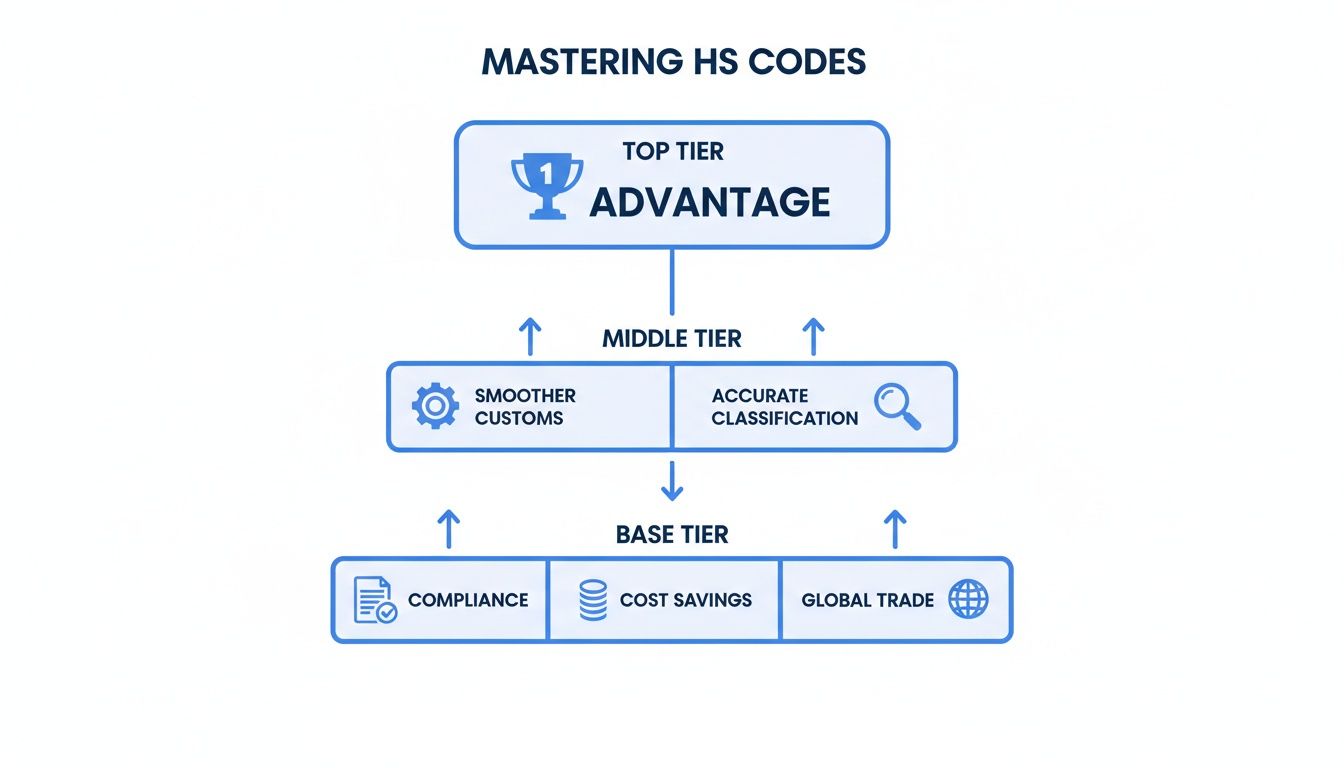
The real takeaway here is that getting this classification right isn't just about paperwork. It directly impacts how smoothly your shipments clear customs and can even unlock new ways to identify potential business leads.
This structured approach removes the guesswork from customs classification. By progressively identifying the material, construction, and finish, you follow a clear path to the correct code, ensuring compliance and preventing costly delays at the border.
Each number tells part of the story, and when you put them all together, they create a complete, universally understood profile for customs authorities around the world.
Navigating Common Fabric HS Code Categories
Okay, now that we've got the theory down, let's put it into practice. Think of this as your cheat sheet for the fabric HS code categories you'll see most often as a freight forwarder in Singapore. Getting familiar with these key chapters will make classifying shipments a whole lot faster and give you more confidence in your decisions.
The Harmonised System is actually quite logical. It organises textiles by following their journey from raw fibre all the way to a finished product. For anyone in freight, the most critical chapters live in Section XI, which is the comprehensive guide to pretty much every textile you can imagine.
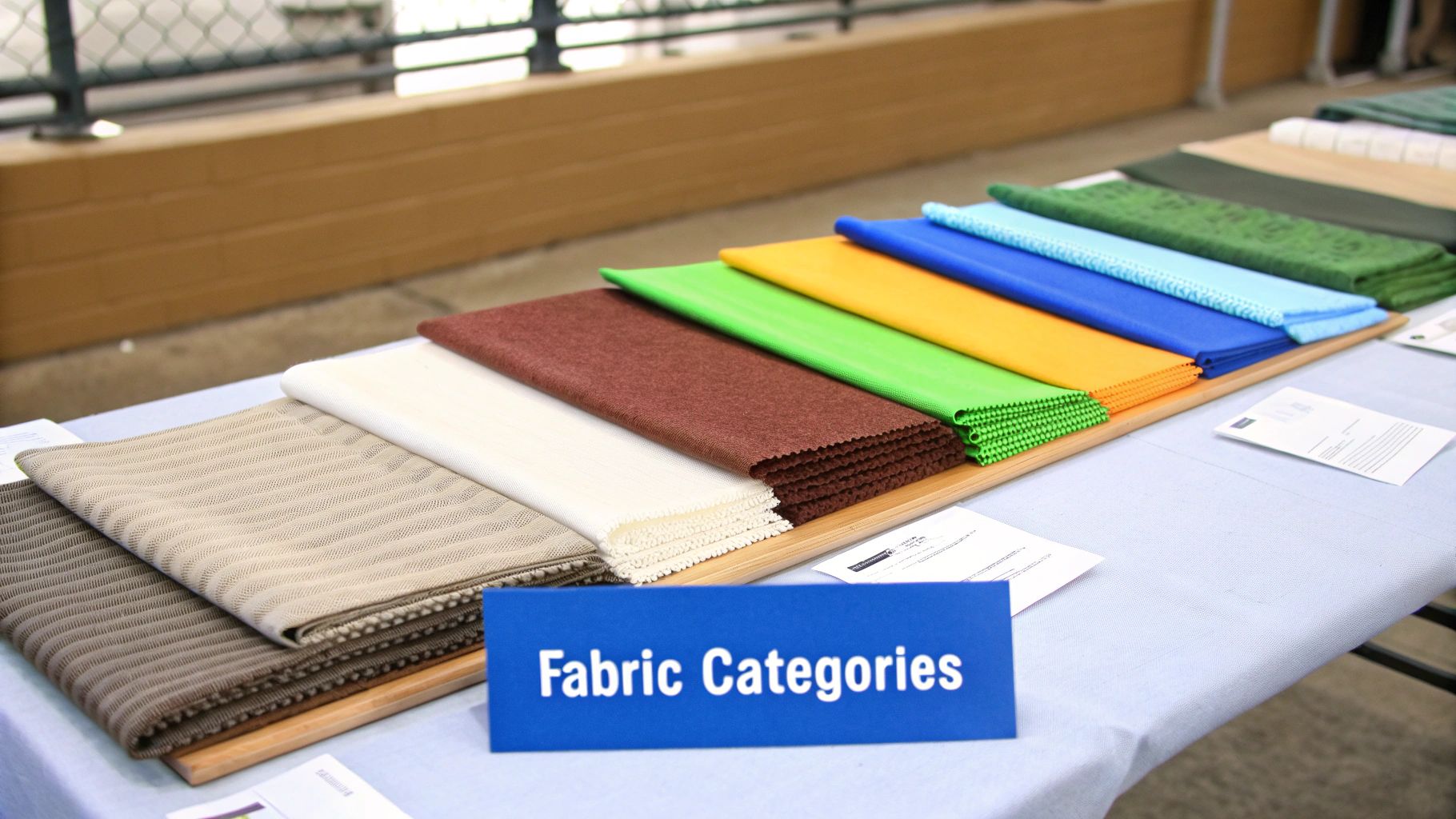
Natural Fibres: Chapters 50 to 53
The classification journey almost always starts with natural fibres. Each one gets its own chapter, and these are the essential building blocks for countless textile and apparel items.
- Chapter 50 – Silk: This covers the entire silk lifecycle, from the raw silkworm cocoons right up to woven silk fabrics. If you're handling a shipment of pure silk fabric destined for luxury scarves, its home is under heading 5007.
- Chapter 51 – Wool and Animal Hair: Here’s where you’ll find codes for wool, cashmere, and mohair, whether they’re raw, spun into yarn, or woven into fabric.
- Chapter 52 – Cotton: Cotton is one of the world's most traded commodities, so its chapter is incredibly detailed. A very common fabric HS code you'll encounter is 5208, which is for woven cotton fabrics that are at least 85% cotton by weight.
- Chapter 53 – Other Vegetable Fibres: This chapter is the catch-all for plant-based materials like linen (from flax), jute, and hemp.
Nailing these foundational chapters is the first real step to correctly identifying the source material of any textile product you're clearing.
Man-Made Fibres and Specialised Fabrics
Once we move past the natural stuff, the HS system has several chapters dedicated to synthetic and specialised textiles. This is where all the modern fabric innovations get classified.
Singapore's textile industry is a major player in its trade economy, and HS codes from Chapters 50-63 cover everything from raw silk to finished clothing. This makes accurate coding absolutely essential. In fact, the Textile Fibres price index recently jumped by 5.6% in just one month. For businesses using Coreties, this is valuable intel. You can geo-search for prospects using these specific HS codes and match them with Routescanner options to create compelling bids, boosting your outreach efficiency by up to 30x.
One of the most critical distinctions you’ll have to make is between 'woven' and 'knitted' materials. A woven fabric, like denim, has threads that interlace at right angles. A knitted fabric, like a t-shirt, is made from interlocking loops. Getting this small detail wrong can throw off your entire classification and cause real headaches at customs.
Here are the key chapters to keep on your radar:
- Chapter 54 – Man-Made Filaments: This includes materials like nylon and polyester when they exist as long, continuous threads (filaments). Picture a huge spool of polyester thread ready for a sewing factory.
- Chapter 55 – Man-Made Staple Fibres: When those same synthetic materials are chopped into short, staple lengths to be spun like cotton, they move over to this chapter.
- Chapter 60 – Knitted or Crocheted Fabrics: This chapter is exclusively for fabrics made through knitting. A big roll of jersey fabric that will be cut and sewn into t-shirts belongs right here. For a deeper look into how these fabrics become finished products, check out our guide on the HS code for garments.
This overview should give you a solid map for navigating the most common textile categories, helping you find the right fabric HS code with much more precision.
Your Step-By-Step Process for Accurate Classification
Figuring out the right fabric HS code can feel a bit like cracking a code, but once you have a solid method, it becomes a logical and repeatable process. This guide breaks down the classification into clear, practical steps, giving you the confidence to handle any textile shipment precisely.
Think of yourself as a textile detective. Your job is to uncover three key pieces of information: the material it's made from, how it was constructed, and any special treatments it has received. Armed with these facts, you can confidently navigate the Harmonised System and sidestep the costly delays that come from simple guesswork.
Step 1: Identify the Material Composition
First things first: what is the fabric actually made of? The entire Harmonised System is built on material type, so this is always your starting point. You need to identify the main fibre that gives the fabric its essential character.
For a single-material fabric, like 100% cotton, this part is easy. But what about blends, like a common 60/40 cotton-polyester mix? The rules here are just as straightforward: classification is based on whichever material has the highest percentage by weight.
- Example: A fabric that is 60% cotton and 40% polyester is treated as a cotton fabric and classified under Chapter 52.
- Example: If that blend were flipped to 60% polyester and 40% cotton, it would be classified as a man-made staple fibre fabric under Chapter 55.
Always insist on getting the exact percentages from the shipper's documentation. It's the only way to be sure.
Step 2: Determine the Construction Method
Once you know the what, you need to figure out the how. The way a fabric is constructed is the second critical piece of the puzzle, as the HS system draws a hard line between different manufacturing methods.
The two main construction types you’ll run into are woven and knitted.
- Woven Fabrics: These are made by interlacing two sets of yarns (the warp and weft) at right angles. Think of denim, twill, or a classic poplin shirt. Woven fabrics are generally found in Chapters 50-55.
- Knitted or Crocheted Fabrics: These are produced from a single yarn that's looped together, creating a more flexible material. T-shirt jersey and fleece are perfect examples. Knitted fabrics get their very own chapter: Chapter 60.
This distinction is crucial. Mistaking a knitted fabric for a woven one (or vice versa) is a common but completely avoidable error that almost guarantees a customs headache.
Step 3: Account for Special Finishes or Treatments
The final step is to look for any special finishes or treatments that have been applied to the fabric. These details often determine the final, more specific digits of the HS code at the subheading level.
Keep an eye out for these common finishes:
- Dyed: Is the fabric coloured in a single, solid shade?
- Printed: Does it have a multi-coloured pattern or design on its surface?
- Coated or Laminated: Has a substance like PVC or polyurethane been applied to make it water-resistant or give it other properties?
A great real-world example is a water-resistant jacket. If it's made from a polyester fabric coated with plastic, it would likely be classified under Heading 5903. This is a world away from an uncoated polyester fabric, showing just how much a simple finish can change everything.
By working through these three steps—composition, construction, and finish—you build a reliable system for pinpointing the correct HS code every single time. This diligence is what separates a shipment that sails through customs from one that gets stuck in costly limbo.
Turning HS Code Data into High-Value Shipper Leads
So far, we've mostly talked about fabric HS codes as a customs hurdle—something you have to get right to avoid delays and fines. But what if that same code could be your most potent sales weapon? For logistics providers willing to think a little differently, customs data is a goldmine of market intelligence.
This is where you can flip the script from a reactive chore to a proactive growth strategy. Instead of just classifying fabrics for customs, you can use those very codes to find companies that are shipping those exact products right now. It's about turning public data into a private pipeline of opportunities.
Platforms like Coreties are built around this idea. They let you take a specific fabric HS code—say, 5903.90 for coated fabrics—and instantly see a list of every Singaporean company importing or exporting those goods. Suddenly, you're not making cold calls anymore. You're making informed calls.
From Data Points to Client Conversations
This simple shift completely changes how you build a prospect list. Forget generic company directories. You're now working with a hyper-targeted list of active shippers. You know who is shipping, what they are shipping, and you can even get a sense of their volumes.
This kind of insight allows for incredibly personalised outreach. Imagine identifying all the top synthetic yarn exporters in Singapore. You could then approach them with a proposal that doesn't just talk about logistics in general, but specifically mentions your expertise with their product and offers better routing options for their main trade lanes.
Here’s a glimpse of how you might find and engage prospects using the search function in a tool like Coreties.
The screenshot shows just how fast this works—a quick search based on specific criteria turns into a list of qualified leads. A data-driven approach like this means you waste less time guessing and spend more time talking to potential clients who actually need what you offer.
Filtering shipment data with a specific fabric HS code turns a compliance number into a direct line to a potential client. It’s the difference between casting a wide net and using a spear.
Capitalising on Market Trends
This strategy also positions you to ride the wave of market trends. For example, Singapore's exports of textile fabrics coated with plastics (HS 5903.90) recently hit over $5.2 million in value. That number tells you there’s real strength in specialised textiles here.
As you can find out in our deeper look into the HS Code Filter, a statistic like that is pure gold for Coreties users. A savvy freight forwarder can filter customs data by that exact code to find these high-volume shippers, then set up automated, personalised outreach to their key decision-makers on LinkedIn. To dive deeper into these figures, you can explore more about Singapore's textile trade data on wits.worldbank.org.
This is how you get ahead of the competition—by using data to connect with the right people at exactly the right time.
Here's the rewritten section, designed to sound like it was written by an experienced logistics professional:
Side-Stepping Costly Mistakes and Compliance Headaches
Getting fabric HS codes right isn't just a box-ticking exercise. It's about actively dodging the expensive mess that happens when you get it wrong. One little slip-up on a fabric code can spark a domino effect of problems, hitting your bottom line and shaking your client’s confidence in you.
We're not just talking about extra paperwork, either. The fallout is real. Think shipments stuck in customs for days or weeks, racking up painful demurrage and detention fees. A misclassification can even trigger a full-blown customs audit, pulling your team into a time-consuming investigation when they should be moving freight.
The usual suspects: Where classifications go wrong
From what I’ve seen, the same mistakes pop up time and time again. Knowing where the landmines are is the best way to avoid stepping on one.
- Woven vs. Knitted Confusion: This is the big one we've talked about. Classifying a roll of jersey fabric (which is knitted, Chapter 60) under a woven category (like Chapter 52 for cotton) is an instant red flag for a customs inspector.
- Getting Blends Wrong: The rule for mixed-fibre fabrics is simple: the material with the highest percentage by weight dictates the code. If you're just guessing or don't have the exact breakdown from the supplier, you're setting yourself up for trouble.
- Forgetting Finishes and Treatments: Did you overlook that special coating, lamination, or dye? That detail can shunt the fabric into a completely different subheading, throwing off your duty calculations and leading straight to penalties.
These aren't just hypothetical problems. A misclassified shipment can mean unexpected duties and tariffs are slapped on, sometimes months after the goods have been delivered. Nothing sours a client relationship faster than a surprise bill showing up out of the blue.
Your best defence is just being thorough. Look at niche trade flows, like Indonesia importing fabric labels from Singapore—the data gets that specific. Even as the WCO keeps updating HS codes, a simple mistake on common textiles like cotton (Chapter 52) or knits (Chapter 60) is a massive, avoidable risk.
For any freight forwarder, double-checking classifications with reliable data isn’t just good practice; it’s essential self-preservation. You can dig into these kinds of SG-Indo trade insights on eximtradedata.com to see just how detailed this information can get.
Answering Your Top Fabric HS Code Questions
Even with a solid process, you're bound to run into some tricky situations with fabric HS codes. Let's tackle some of the most common questions we hear from logistics pros, giving you clear, practical answers to navigate these challenges with confidence.
What Happens If a Shipper Provides the Wrong Fabric HS Code?
This is a big one. If a shipper gives you the wrong HS code, customs authorities often hold the freight forwarder responsible. The fallout can be immediate and painful: shipment delays, surprise inspections, paying the wrong duties, and even fines that eat into your profits.
That’s why it's absolutely critical to verify the information you receive. You can use a trade data platform to see how similar products have been classified by other shippers in the past. This simple cross-check helps you spot potential errors before they snowball into costly problems at the border, protecting both your business and your client.
How Do I Classify a Garment Made from a Cotton and Polyester Blend?
When you’re dealing with mixed-material fabrics, the General Interpretative Rules (GIRs) are your guide. The key rule here says you classify the product based on the material that gives it its "essential character"—which, for fabrics, almost always means the material with the highest percentage by weight.
So, if you have a shirt that’s 60% cotton and 40% polyester, it gets classified under the cotton apparel headings in Chapter 52. Flip those numbers, and it would fall under a polyester category instead. Always get the exact weight percentages from the shipper’s documentation before deciding.
Think of it this way: the dominant fibre gets to tell the story. Whichever material makes up the majority of the fabric dictates its identity for customs purposes, leaving no room for ambiguity.
How Often Do Fabric HS Codes Change?
The Harmonised System isn't set in stone. The World Customs Organisation (WCO) reviews and updates the entire system every five years to keep up with new technologies and changing trade patterns. The next major global overhaul is scheduled for 2027.
But don't wait until then. Individual countries can—and do—make smaller tweaks to their own national tariffs much more frequently. For forwarders in Singapore, it’s vital to monitor updates from Singapore Customs and the authorities in your key destination markets. Staying current is the only way to prevent your shipments from being held up or rejected for using an outdated code.
Ready to turn customs data into your next big client? Coreties transforms complex shipment information into a powerful lead-generation engine, helping you find and connect with high-value shippers in just a few clicks. Discover your next opportunity at https://coreties.com.