Your Complete Guide to Clothes HS Code Classification
If you're shipping apparel internationally, you've probably come across the term clothes HS code. Think of it as a universal passport for every textile product that crosses a border. This standardised numerical system, officially the Harmonized System (HS), is how customs authorities worldwide classify and identify garments. It's this code that ensures a cotton t-shirt […]

If you're shipping apparel internationally, you've probably come across the term clothes HS code. Think of it as a universal passport for every textile product that crosses a border. This standardised numerical system, officially the Harmonized System (HS), is how customs authorities worldwide classify and identify garments.
It's this code that ensures a cotton t-shirt is recognised as a cotton t-shirt everywhere, which in turn determines the correct tariffs and duties. For clothing, the most critical distinction to get right from the start is whether your item belongs in Chapter 61 (knitted or crocheted apparel) or Chapter 62 (woven or non-knitted apparel).
What Is the Clothes HS Code System
Managed by the World Customs Organization (WCO), the Harmonized System is essentially the global language of trade. For anyone in logistics—especially freight forwarders and shippers—getting the clothes HS code right isn't just a box-ticking exercise; it's fundamental to your operations. A wrong code can trigger costly delays, customs audits, and even hefty financial penalties.
Proper classification is also a cornerstone of efficient e-commerce supply chain management, influencing everything from how quickly your goods clear customs to when they land on your customer's doorstep. But once you understand how the codes are structured, the whole system becomes much less intimidating.
Breaking Down the Code Structure
Every HS code for clothing is built on a logical, hierarchical structure that gets more specific with each pair of digits. The first six digits are the same globally, which guarantees that a t-shirt is classified consistently whether it's arriving in Singapore or being exported to Spain.
Here’s a simple breakdown of what those numbers mean:
- Chapter (First 2 digits): This is the highest-level category. For apparel, you'll almost always be looking at Chapter 61 for knitted goods or Chapter 62 for woven ones.
- Heading (Digits 3-4): This narrows it down to the type of garment. For example, within Chapter 61, the heading
05creates the code6105, which specifically means "Men's or boys' shirts, knitted or crocheted." - Subheading (Digits 5-6): This layer adds more detail, usually about the material. The code
6105.10, for instance, tells customs that the knitted men's shirts are specifically "of cotton."
Countries then add their own digits (from the 7th to the 10th) for national tariff lines and statistical tracking. Our guide on the https://www.coreties.com/blog/hs-code-singapore offers a closer look at these local variations. This level of precision is vital, as duty rates can change dramatically based on just one of these final numbers.
Quick Reference for Common Clothes HS Codes
If you're in logistics, you know that finding the right HS code for clothing fast is crucial for getting shipments through customs without a hitch. Think of this section as your go-to cheat sheet, organising common apparel by what it is and what it's made of. It's designed to help you quickly find what you need for everyday shipments, saving you from digging through dense classification rules every time.
The first and most important distinction in apparel classification is the fabric's construction. Everything boils down to two chapters: Chapter 61 for knitted or crocheted items and Chapter 62 for woven items. Is the fabric made of interlocking loops (knitted), or is it a grid of intersecting threads (woven)? That single decision is your starting point.
You can see this structure laid out in the Harmonized System itself, as shown on the WCO Trade Tools website.
This official breakdown into Sections, Chapters, and Headings is the blueprint for every single clothes HS code.
Common HS Codes for Garments
To speed things up, I’ve put together a table with the 6-digit HS codes for some of the most common clothing items we see moving across borders. Just keep in mind that these first six digits are the universal part; the importing country will add its own digits to get more specific.
Here’s a quick lookup table that gets straight to the point, highlighting the all-important split between knitted (Chapter 61) and woven (Chapter 62) goods.
Common Clothes HS Codes at a Glance
| Garment Type | Primary Material | HS Code (Chapter 61 – Knitted) | HS Code (Chapter 62 – Woven) |
|---|---|---|---|
| T-Shirts & Vests | Cotton | 6109.10 |
N/A (Typically knitted) |
| Trousers & Shorts | Cotton | 6103.42 (Men's) / 6104.62 (Women's) |
6203.42 (Men's) / 6204.62 (Women's) |
| Blouses & Shirts | Synthetic Fibres | 6106.20 (Women's) |
6205.30 (Men's) / 6206.40 (Women's) |
| Sweaters & Pullovers | Man-Made Fibres | 6110.30 |
N/A (Typically knitted) |
| Jackets & Blazers | Wool or Fine Animal Hair | 6103.31 (Men's) / 6104.31 (Women's) |
6203.31 (Men's) / 6204.31 (Women's) |
| Underpants & Briefs | Cotton | 6107.11 (Men's) / 6108.21 (Women's) |
6207.11 (Men's) / 6208.91 (Women's) |
This table covers many of the basics, giving you a solid starting point for classification.
How to Use This Table Effectively
When you use this table, the golden rule is to always confirm the primary material by weight. That single factor often determines the final subheading. For example, a men's woven blazer made mostly of wool falls under HS code 6203.31. But if that same jacket were made from cotton, its code would change to 6203.32.
A common pitfall I see is misclassifying unisex items. Customs authorities often have very specific rules based on the garment's cut, sizing, or even how it buttons (e.g., left-over-right for menswear) to determine whether it’s for men or women. This directly changes the HS code heading, so it pays to be precise.
This quick reference is a fantastic shortcut, but don't forget to cross-check your final code against the official tariff schedule of the destination country. This is especially true for garments with mixed materials or unusual features. Getting it right not only keeps you compliant but also helps you avoid costly delays and penalties that can easily throw your entire supply chain off schedule.
How Material Composition Impacts Your HS Code
Once you've figured out if a garment is knitted (Chapter 61) or woven (Chapter 62), your next task is to pinpoint its material composition. This is a huge factor in getting the HS code right, as customs officials rely on it to apply the correct tariffs and trade regulations.
It all starts with identifying the single fibre that has the greatest weight. A shirt made of 100% cotton is simple enough, but most modern clothing is made from blends to improve feel and performance. Getting the material right is one piece of the puzzle; another is managing the physical goods, where efficient textile storage systems play a vital role in any smooth supply chain operation.
This flowchart shows that first, crucial decision point every classifier has to make: knitted or woven?
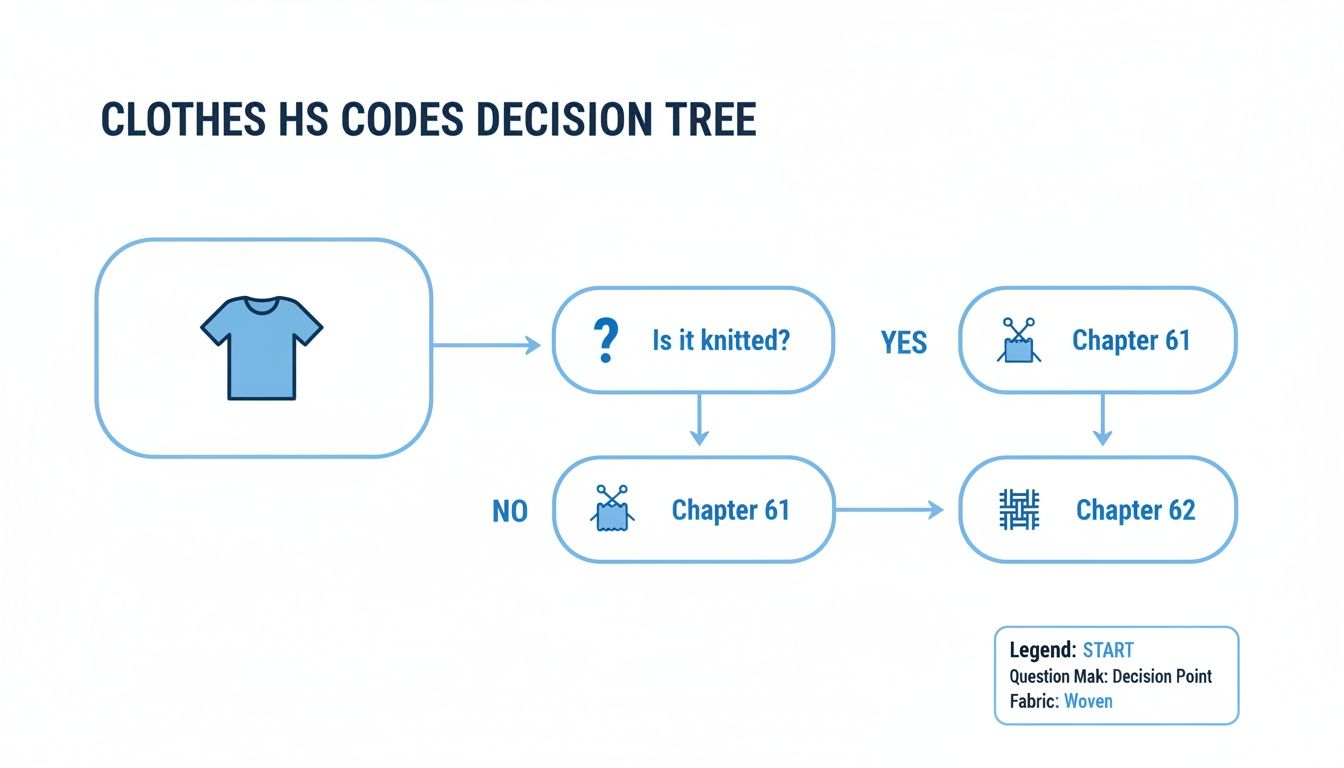
Making the right choice here gets you into the correct chapter. From there, the material composition guides you to the exact heading and subheading for your product.
The Predominant Weight Rule
When dealing with blended fabrics, customs classification hinges on the predominant weight rule. The idea is straightforward: the garment is classified under the heading for whichever single textile material outweighs any other.
Let's look at a sweater made from a blend:
- 45% Cotton
- 35% Polyester
- 20% Wool
In this case, no single material hits the 50% mark. However, cotton is the heaviest component, so you would classify this sweater under the HS code for cotton sweaters. In Singapore's dynamic textile and garment market, cotton is king, making up US$7.86 billion—roughly half the market—and is forecast to grow by 5.45% through 2032.
Key Takeaway: The Predominant Weight Rule isn't about a majority. It's about plurality. The single heaviest fibre dictates the classification, even if it's less than 50% of the total weight.
Classifying Common Materials
Different materials point to different subheadings within the HS code framework. Knowing these distinctions is absolutely essential for accurate classification.
Cotton (e.g., Subheading .20): Garments where cotton is the main material, like a men's woven shirt (6205.20), are some of the most frequently classified items.
Man-Made Fibres (e.g., Subheading .30, .40): This is a wide-ranging category that covers synthetic fibres like polyester and artificial ones like viscose. A women's woven polyester blouse, for instance, would be classified under HS code 6206.40.
Wool or Fine Animal Hair (e.g., Subheading .10, .31): This is where you'd classify items like a men's woven wool suit jacket (6203.31).
Getting the material right isn't just a box-ticking exercise for compliance; it has a direct effect on the duties you'll pay and your access to certain markets. If you want to go deeper into material classification, have a look at our guide on the fabric HS code.
Classifying Clothes by Gender and Age Group
Once you’ve nailed down the material and construction, the next step in pinpointing the right HS code for clothing is figuring out who it's made for. The Harmonized System draws a hard line between clothes for men and women, and for adults and children. This isn't just a minor detail; it determines the four-digit heading and is fundamental to getting your tariffs and stats right.
Take, for example, HS Heading 6203, which covers "Men's or boys' suits, ensembles, jackets…". Right next to it, you'll find Heading 6204 for "Women's or girls' suits, ensembles, jackets…". This parallel setup runs through both Chapter 61 (knitted) and Chapter 62 (woven), making it a core principle of apparel classification. Confusing these two is a surprisingly common mistake, and it can be a costly one.
Differentiating Men's and Women's Apparel
So, what happens with unisex-style items? Customs officials don't just guess. If there's no clear label, they rely on objective, physical characteristics to decide if a garment is for men or women.
Here’s what they typically look for:
- Cut and Styling: Garments with a shaped waistline or darts meant to fit a bust are almost always classified as womenswear.
- Sizing: The sizing system itself is a huge clue. A UK women's size 12 is a world away from a men's medium, and customs knows the difference.
- Closure: It's an old-school rule, but it still holds: men's garments traditionally button on the right and fasten left-over-right. Women's clothing is the opposite.
Getting this right has real commercial impact. In Singapore's apparel market, which is heavily reliant on imports under HS chapters 61 and 62, womenswear accounted for a massive 56.3% of the market share, worth US$2.0 billion in 2023. You can dig into data on Singapore's apparel market trends to see exactly why logistics teams are so meticulous about classifying this high-value segment correctly.
Classifying Infant and Children's Wear
Infants' clothing gets its own dedicated HS headings, like 6111 for knitted items and 6209 for woven ones. The rule of thumb here is size. A garment is generally considered infants' wear if it's designed for a baby with a body height not exceeding 86 cm.
Anything larger than that moves into the "boys'" or "girls'" categories, which are nested within the main men's and women's headings. Properly classifying by age and gender isn't just about ticking a compliance box—it's about making sure your shipments sail through customs without getting flagged for unnecessary inspections or delays.
Using Clothes HS Codes for Lead Generation
For freight forwarders and logistics sales teams, a clothes HS code is far more than a customs formality. It's a powerful key that unlocks a goldmine of global trade data, turning a simple compliance number into a direct route for finding high-value shippers.
Instead of casting a wide net for "apparel companies," you can use customs data platforms to get surgically precise. Filtering import and export records by a specific HS code lets you find exactly who is shipping the products you're best equipped to handle.
Pinpointing High-Value Prospects
Let's say your sales team has deep expertise in managing high-volume, fast-fashion imports. You can pinpoint this exact market by filtering trade data for the right codes.
- Filter by garment type: A quick search for HS code 6109.10 will instantly pull up a list of every company importing cotton T-shirts.
- Identify volume shippers: Dive into the bill of lading data tied to these codes. You can see which importers are moving the most containers or have the highest shipment values, separating the big players from the small fry.
- Analyse trade lanes: See which businesses are consistently shipping from manufacturing hubs like Vietnam or Bangladesh into key markets like Singapore. This reveals active, lucrative supply chains ready for your services.
This transforms your prospecting from educated guesswork into a data-backed strategy. You end up focusing your energy on companies with proven, current shipping needs. Platforms like Coreties are built specifically to turn these raw data points into clean, actionable lead lists.
As the screenshot shows, the right platform can translate messy customs data into a neat prospect list, complete with contact information and detailed shipping history.
Crafting Data-Driven Outreach
Once you've built a target list, the HS code data gives you everything you need for outreach that actually works. You can stop sending generic "we can move your freight" emails and start conversations that show you've done your homework.
Example Outreach Angle: "I noticed your company's recent shipments of women's woven trousers (HS code 6204.62) from China. We have extensive capacity on that lane and have helped similar apparel importers reduce their transit times by an average of two days."
This level of specific detail immediately establishes your credibility and proves you understand their business, making a response far more likely. It pays to focus on growing markets. For instance, Singapore's fashion apparel imports under HS Chapters 61 and 62 grew by an impressive 11.47% from 2023 to 2024, confirming why this trade lane should be a priority. You can dig deeper into these trends by exploring research on Singapore's apparel market.
The table below outlines a few practical strategies to get you started.
Actionable Lead Generation Strategies Using Clothes HS Codes
| Strategy | Required HS Code Filter | Business Outcome |
|---|---|---|
| Target High-Volume Importers | Filter by a specific code (e.g., 6109.10 for T-shirts) and sort by shipment volume or value. | Identify the largest, most consistent shippers in a niche, ensuring sales efforts are focused on high-potential accounts. |
| Find New Trade Lane Opportunities | Search for companies importing apparel (Chapters 61 & 62) from a specific country of origin (e.g., Bangladesh). | Uncover active supply chains and prospects who are already shipping on lanes where your company has a competitive advantage. |
| Identify Competitor's Clients | Filter for shipments handled by a rival freight forwarder, then analyse the HS codes of the goods they are moving. | Pinpoint dissatisfied clients or opportunities where you can offer better service or rates for specific product types. |
Ultimately, this strategic use of clothes HS codes connects your team's technical knowledge directly to revenue growth. It's an indispensable tool for any modern logistics sales professional. For a more detailed walkthrough of this technique, check out our guide on how to find qualified leads with an HS Code filter.
Common Classification Mistakes to Avoid
Getting a clothes HS code wrong isn't just a simple paperwork slip-up. It can snowball into hefty fines, frustrating shipping delays, and even seizures by customs. If you look at customs data year after year, you'll see that textiles and apparel consistently rank among the most frequently misclassified product categories. This isn't an area where you can afford to guess.
One of the most common and easily avoidable mistakes we see is mixing up knitted and woven fabrics. It sounds basic, but classifying a woven shirt from Chapter 62 under the knitted apparel Chapter 61 is an immediate red flag for customs officials. This kind of error often triggers a full inspection, leaving your shipment stuck in port for days or even weeks.
Misclassifying Garment Sets and Mixed Fibres
Another tricky area is how to handle clothing sets. For instance, a men's suit that's sold together as a single retail product needs to be classified under a single HS code. The correct approach is to classify the entire set under the heading for the jacket or blazer (usually HS Heading 6203). You can't code the trousers separately; that’s a direct violation of classification rules and will cause problems.
Mixed-fibre garments also trip people up all the time. The rule here is about identifying the material with the predominant weight. It's not about which fibre makes up more than 50% of the garment, but which single fibre is the heaviest.
A perfect example: a jumper made of 45% cotton, 35% polyester, and 20% wool. Even though no single fibre makes up half the weight, you must classify it as a cotton jumper because cotton is the single heaviest component.
Overlooking National Code Variations
Relying on the international six-digit HS code and stopping there is a critical mistake. Every importer must use the full eight- or ten-digit code that’s specific to the country of destination. Those last few digits are what determine the actual tariff rate. Get them wrong, and you could be facing a bill for underpaid duties or, conversely, overpaying and losing money.
Here are a few practical tips to keep your classifications accurate and avoid these common pitfalls:
- Always Verify Fabric Construction: Don't just rely on a spec sheet. If you can, get your hands on a fabric sample to confirm whether it's knitted (Chapter 61) or woven (Chapter 62) before you assign any code.
- Consult Set Classification Rules: When you're dealing with goods sold as a set, get familiar with the General Rules of Interpretation (GRI 3). It provides the official guidance for these specific situations.
- Obtain Full Material Specs: Always ask your manufacturer for a detailed bill of materials. You need this breakdown to accurately determine the predominant fibre by weight.
- Use Destination Country Tariff Schedules: Before finalising anything, cross-reference your classification against the official tariff database of the importing country. This is the only way to be certain you're using the correct and complete national-level code.
Your Top Questions About Clothes HS Codes, Answered
When you're dealing with international clothing shipments day in and day out, you're bound to run into some tricky questions about HS codes. Let's clear up some of the most common ones that pop up.
Getting these details right from the start is the key to getting your apparel through customs without a hitch.
How Do I Find the Full 10-Digit HS Code?
This is a big one. The first six digits of an HS code are the same everywhere—they're part of a global standard managed by the World Customs Organisation. But for customs duties and trade statistics, countries add their own digits to the end, creating a full code that’s usually 8 or 10 digits long.
To get the complete, country-specific code for your clothing, you have to check the official customs tariff database for the country you're shipping to. There's no way around this. Using the right code is essential because those final digits dictate the exact duty rate you'll pay.
What's the Difference Between an HS Code and an HTS Code?
People often use these terms as if they mean the same thing, but there's a crucial difference. An HS code is the universal 6-digit international standard.
An HTS code, which stands for Harmonized Tariff Schedule code, is the 10-digit system used specifically by the United States for imports. It starts with the standard 6-digit HS code and adds four more digits for U.S.-specific tariff and data collection. Other places have their own versions, like the EU's 8-digit Combined Nomenclature (CN) code.
Key Insight: Think of the 6-digit HS code as the global foundation. The HTS or CN code is the country-specific extension built on top of it. Always use the full, correct code for your destination country to stay compliant and avoid overpaying duties.
Are Accessories Like Belts and Scarves Classified with Apparel?
This is a classic trap. As a rule, accessories don't get lumped in with the clothing in Chapters 61 and 62. You need to classify each item on its own, unless it officially qualifies as part of a set under customs rules.
Here's a quick look at where some common accessories land:
- Belts: Usually found in Chapter 42 (leather) or Chapter 39 (plastic). If they're mostly textile, they might end up in Chapter 62.
- Scarves and Shawls: These are classified by how they're made—Chapter 61 if they're knitted or crocheted, and Chapter 62 if they're woven.
- Hats and Headgear: These get their own dedicated chapter, Chapter 65.
It's absolutely vital to classify every item in a shipment separately. Trying to bundle a belt with a pair of trousers under a single clothes HS code is a surefire way to trigger customs delays and potential fines.
Stop chasing leads and start using data to find them. With Coreties, you can filter global trade data by specific clothes HS codes to pinpoint your ideal shipping prospects in seconds. Uncover high-volume importers, map out trade routes, and build outreach lists that actually convert. Learn more and book your demo with Coreties today.